A1L243
Gene name |
mesd (mesdc2, zgc:158636) |
Protein name |
LRP chaperone MESD |
Names |
LDLR chaperone MESD, Mesoderm development candidate 2, Mesoderm development protein |
Species |
Danio rerio (Zebrafish) (Brachydanio rerio) |
KEGG Pathway |
dre:791222 |
EC number |
|
Protein Class |
|
Descriptions
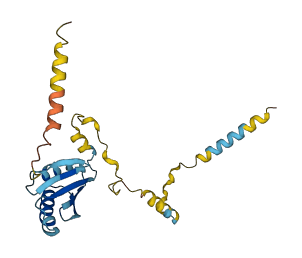
The autoinhibited protein was predicted that may have potential autoinhibitory elements via cis-regPred.
Autoinhibitory domains (AIDs)
Target domain |
|
Relief mechanism |
|
Assay |
cis-regPred |
Accessory elements
No accessory elements
Autoinhibited structure

Activated structure
1 structures for A1L243
| Entry ID | Method | Resolution | Chain | Position | Source |
|---|---|---|---|---|---|
| AF-A1L243-F1 | Predicted | AlphaFoldDB |
No variants for A1L243
| Variant ID(s) | Position | Change | Description | Diseaes Association | Provenance |
|---|---|---|---|---|---|
| No variants for A1L243 | |||||
No associated diseases with A1L243
No regional properties for A1L243
| Type | Name | Position | InterPro Accession |
|---|---|---|---|
| No domain, repeats, and functional sites for A1L243 | |||
1 GO annotations of cellular component
| Name | Definition |
|---|---|
| endoplasmic reticulum | The irregular network of unit membranes, visible only by electron microscopy, that occurs in the cytoplasm of many eukaryotic cells. The membranes form a complex meshwork of tubular channels, which are often expanded into slitlike cavities called cisternae. The ER takes two forms, rough (or granular), with ribosomes adhering to the outer surface, and smooth (with no ribosomes attached). |
No GO annotations of molecular function
| Name | Definition |
|---|---|
| No GO annotations for molecular function |
3 GO annotations of biological process
| Name | Definition |
|---|---|
| positive regulation of skeletal muscle acetylcholine-gated channel clustering | Any process that activates or increases the frequency, rate or extent of skeletal muscle acetylcholine-gated channel clustering. |
| protein folding | The process of assisting in the covalent and noncovalent assembly of single chain polypeptides or multisubunit complexes into the correct tertiary structure. |
| Wnt signaling pathway | The series of molecular signals initiated by binding of a Wnt protein to a frizzled family receptor on the surface of the target cell and ending with a change in cell state. |
4 homologous proteins in AiPD
| 10 | 20 | 30 | 40 | 50 | 60 |
| MASSVGCRTL | SVLFLLVLFI | TVHCTDTKPK | KKKDIRDYND | ADMARLLEEW | EKDDDIEEGD |
| 70 | 80 | 90 | 100 | 110 | 120 |
| LPEHKRSPPP | IDFSKIDASK | PEELLKMSKK | GKTLMVFASV | SGNPTEKETE | EITGLWQGSL |
| 130 | 140 | 150 | 160 | 170 | 180 |
| FNANYDVQRF | VVGSNRVIFM | LRDGSYAWEI | KDFLVSQDRC | EDVTVEGQVF | PGKNAKKDAK |
| 190 | 200 | ||||
| GKEQNETKKK | GDKKAANRAN | KGKQEL |