Q9ZQ19
Gene name |
RPA2A (ROR1, RPA32A, At2g24490, T28I24.22) |
Protein name |
Replication protein A 32 kDa subunit A |
Names |
AtRPA32A, RP-A p32 A, DNA replication protein A2 subunit A, Protein SUPPRESSOR OF ROS1, Replication factor A protein 2 A, AtRPA2 A, RF-A protein 2 A, Replicon protein A2 A |
Species |
Arabidopsis thaliana (Mouse-ear cress) |
KEGG Pathway |
ath:AT2G24490 |
EC number |
|
Protein Class |
|
Descriptions
The autoinhibited protein was predicted that may have potential autoinhibitory elements via cis-regPred.
Autoinhibitory domains (AIDs)
Target domain |
|
Relief mechanism |
|
Assay |
cis-regPred |
Accessory elements
No accessory elements
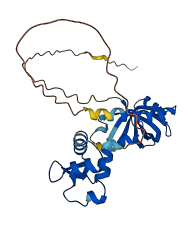
Autoinhibited structure

Activated structure
1 structures for Q9ZQ19
| Entry ID | Method | Resolution | Chain | Position | Source |
|---|---|---|---|---|---|
| AF-Q9ZQ19-F1 | Predicted | AlphaFoldDB |
26 variants for Q9ZQ19
| Variant ID(s) | Position | Change | Description | Diseaes Association | Provenance |
|---|---|---|---|---|---|
| ENSVATH13374312 | 13 | F>V | No | 1000Genomes | |
| ENSVATH14543954 | 17 | G>R | No | 1000Genomes | |
| ENSVATH05577752 | 32 | S>A | No | 1000Genomes | |
| ENSVATH01883763 | 33 | T>I | No | 1000Genomes | |
| ENSVATH14543952 | 47 | V>M | No | 1000Genomes | |
| ENSVATH01883761 | 51 | T>I | No | 1000Genomes | |
| ENSVATH00244911 | 55 | Q>H | No | 1000Genomes | |
| ENSVATH13374307 | 61 | S>A | No | 1000Genomes | |
| ENSVATH13374306 | 80 | C>R | No | 1000Genomes | |
| ENSVATH13374306 | 80 | C>S | No | 1000Genomes | |
| tmp_2_10399927_T_G | 84 | E>D | No | 1000Genomes | |
| tmp_2_10399564_A_G | 141 | L>P | No | 1000Genomes | |
| tmp_2_10399553_C_T | 145 | V>M | No | 1000Genomes | |
| tmp_2_10399415_T_C | 150 | D>G | No | 1000Genomes | |
| tmp_2_10399416_C_T | 150 | D>N | No | 1000Genomes | |
| ENSVATH05577729 | 168 | N>Y | No | 1000Genomes | |
| ENSVATH01883740 | 173 | R>G | No | 1000Genomes | |
| tmp_2_10399237_T_G | 180 | T>P | No | 1000Genomes | |
| ENSVATH05577722 | 197 | T>A | No | 1000Genomes | |
| ENSVATH05577721 | 198 | L>P | No | 1000Genomes | |
| tmp_2_10399045_T_C | 211 | N>S | No | 1000Genomes | |
| ENSVATH13374299 | 213 | R>S | No | 1000Genomes | |
| ENSVATH05577710 | 218 | D>E | No | 1000Genomes | |
| tmp_2_10398888_A_C | 237 | H>Q | No | 1000Genomes | |
| tmp_2_10398875_C_T | 242 | A>T | No | 1000Genomes | |
| ENSVATH14543949 | 255 | V>A | No | 1000Genomes |
No associated diseases with Q9ZQ19
4 GO annotations of cellular component
| Name | Definition |
|---|---|
| chromosome, telomeric region | The end of a linear chromosome, required for the integrity and maintenance of the end. A chromosome telomere usually includes a region of telomerase-encoded repeats the length of which rarely exceeds 20 bp each and that permits the formation of a telomeric loop (T-loop). The telomeric repeat region is usually preceded by a sub-telomeric region that is gene-poor but rich in repetitive elements. Some telomeres only consist of the latter part (for eg. D. melanogaster telomeres). |
| DNA replication factor A complex | A conserved heterotrimeric complex that binds nonspecifically to single-stranded DNA and is required for multiple processes in eukaryotic DNA metabolism, including DNA replication, DNA repair, and recombination. In all eukaryotic organisms examined the complex is composed of subunits of approximately 70, 30, and 14 kDa. |
| nucleus | A membrane-bounded organelle of eukaryotic cells in which chromosomes are housed and replicated. In most cells, the nucleus contains all of the cell's chromosomes except the organellar chromosomes, and is the site of RNA synthesis and processing. In some species, or in specialized cell types, RNA metabolism or DNA replication may be absent. |
| site of double-strand break | A region of a chromosome at which a DNA double-strand break has occurred. DNA damage signaling and repair proteins accumulate at the lesion to respond to the damage and repair the DNA to form a continuous DNA helix. |
1 GO annotations of molecular function
| Name | Definition |
|---|---|
| single-stranded DNA binding | Binding to single-stranded DNA. |
4 GO annotations of biological process
| Name | Definition |
|---|---|
| DNA repair | The process of restoring DNA after damage. Genomes are subject to damage by chemical and physical agents in the environment (e.g. UV and ionizing radiations, chemical mutagens, fungal and bacterial toxins, etc.) and by free radicals or alkylating agents endogenously generated in metabolism. DNA is also damaged because of errors during its replication. A variety of different DNA repair pathways have been reported that include direct reversal, base excision repair, nucleotide excision repair, photoreactivation, bypass, double-strand break repair pathway, and mismatch repair pathway. |
| DNA replication | The cellular metabolic process in which a cell duplicates one or more molecules of DNA. DNA replication begins when specific sequences, known as origins of replication, are recognized and bound by initiation proteins, and ends when the original DNA molecule has been completely duplicated and the copies topologically separated. The unit of replication usually corresponds to the genome of the cell, an organelle, or a virus. The template for replication can either be an existing DNA molecule or RNA. |
| double-strand break repair via homologous recombination | The error-free repair of a double-strand break in DNA in which the broken DNA molecule is repaired using homologous sequences. A strand in the broken DNA searches for a homologous region in an intact chromosome to serve as the template for DNA synthesis. The restoration of two intact DNA molecules results in the exchange, reciprocal or nonreciprocal, of genetic material between the intact DNA molecule and the broken DNA molecule. |
| nucleotide-excision repair | A DNA repair process in which a small region of the strand surrounding the damage is removed from the DNA helix as an oligonucleotide. The small gap left in the DNA helix is filled in by the sequential action of DNA polymerase and DNA ligase. Nucleotide excision repair recognizes a wide range of substrates, including damage caused by UV irradiation (pyrimidine dimers and 6-4 photoproducts) and chemicals (intrastrand cross-links and bulky adducts). |
3 homologous proteins in AiPD
| UniProt AC | Gene Name | Protein Name | Species | Evidence Code |
|---|---|---|---|---|
| Q13156 | RPA4 | Replication protein A 30 kDa subunit | Homo sapiens (Human) | PR |
| P15927 | RPA2 | Replication protein A 32 kDa subunit | Homo sapiens (Human) | PR |
| Q6DJ48 | stn1 | CST complex subunit STN1 | Xenopus tropicalis (Western clawed frog) (Silurana tropicalis) | PR |
| 10 | 20 | 30 | 40 | 50 | 60 |
| MFSSSQFEPN | SGFSGGGFMS | SQPSQAYESS | SSTAKNRDFQ | GLVPVTVKQI | TECFQSSGEK |
| 70 | 80 | 90 | 100 | 110 | 120 |
| SGLVINGISL | TNVSLVGLVC | DKDESKVTEV | RFTLDDGTGR | IDCKRWVSET | FDAREMESVR |
| 130 | 140 | 150 | 160 | 170 | 180 |
| DGTYVRLSGH | LKTFQGKTQL | LVFSVRPIMD | FNEVTFHYIE | CIHFYSQNSE | SQRQQVGDVT |
| 190 | 200 | 210 | 220 | 230 | 240 |
| QSVNTTFQGG | SNTNQATLLN | PVVSSQNNDG | NGRKNLDDMI | LDYLKQPACT | ARQQGIHIDE |
| 250 | 260 | 270 | |||
| IAQQLKIPKN | KLEGVVQSLE | GDGLIYSTID | EYHFKHVEL |