Q9Z2D1
Gene name |
Mtmr2 |
Protein name |
Myotubularin-related protein 2 |
Names |
Phosphatidylinositol-3,5-bisphosphate 3-phosphatase, Phosphatidylinositol-3-phosphate phosphatase |
Species |
Mus musculus (Mouse) |
KEGG Pathway |
mmu:77116 |
EC number |
3.1.3.64: Phosphoric monoester hydrolases |
Protein Class |
|
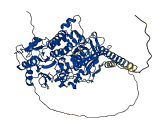
Descriptions
The autoinhibited protein was predicted that may have potential autoinhibitory elements via cis-regPred.
Autoinhibitory domains (AIDs)
Target domain |
|
Relief mechanism |
|
Assay |
cis-regPred |
Accessory elements
No accessory elements
Autoinhibited structure

Activated structure
1 structures for Q9Z2D1
| Entry ID | Method | Resolution | Chain | Position | Source |
|---|---|---|---|---|---|
| AF-Q9Z2D1-F1 | Predicted | AlphaFoldDB |
20 variants for Q9Z2D1
| Variant ID(s) | Position | Change | Description | Diseaes Association | Provenance |
|---|---|---|---|---|---|
| rs3389011349 | 32 | H>Y | No | EVA | |
| rs3389029875 | 51 | S>* | No | EVA | |
| rs3389022446 | 60 | D>N | No | EVA | |
| rs3388973058 | 65 | R>W | No | EVA | |
| rs3389004055 | 73 | M>L | No | EVA | |
| rs3389030726 | 87 | M>L | No | EVA | |
| rs238761321 | 109 | S>N | No | EVA | |
| rs3389024611 | 135 | V>I | No | EVA | |
| rs3399840689 | 281 | V>A | No | EVA | |
| rs3399911662 | 285 | S>N | No | EVA | |
| rs3399840676 | 289 | V>A | No | EVA | |
| rs3389019785 | 324 | S>N | No | EVA | |
| rs3389004131 | 332 | A>T | No | EVA | |
| rs3399945499 | 349 | V>L | No | EVA | |
| rs3389004078 | 364 | R>L | No | EVA | |
| rs3389027200 | 374 | I>F | No | EVA | |
| rs3389030719 | 474 | A>V | No | EVA | |
| rs3389024588 | 477 | S>P | No | EVA | |
| rs3389027173 | 505 | L>H | No | EVA | |
| rs3389027267 | 562 | H>D | No | EVA |
No associated diseases with Q9Z2D1
5 regional properties for Q9Z2D1
| Type | Name | Position | InterPro Accession |
|---|---|---|---|
| domain | Tyrosine-specific protein phosphatases domain | 386 - 433 | IPR000387 |
| domain | Protein-tyrosine phosphatase, catalytic | 365 - 513 | IPR003595 |
| domain | GRAM domain | 65 - 185 | IPR004182 |
| domain | Myotubularin-like, phosphatase domain | 192 - 580 | IPR010569 |
| active_site | Protein-tyrosine phosphatase, active site | 415 - 425 | IPR016130 |
Functions
| Description | ||
|---|---|---|
| EC Number | 3.1.3.64 | Phosphoric monoester hydrolases |
| Subcellular Localization |
|
|
| PANTHER Family | ||
| PANTHER Subfamily | ||
| PANTHER Protein Class | ||
| PANTHER Pathway Category | No pathway information available | |
13 GO annotations of cellular component
| Name | Definition |
|---|---|
| axon | The long process of a neuron that conducts nerve impulses, usually away from the cell body to the terminals and varicosities, which are sites of storage and release of neurotransmitter. |
| cytoplasm | The contents of a cell excluding the plasma membrane and nucleus, but including other subcellular structures. |
| cytosol | The part of the cytoplasm that does not contain organelles but which does contain other particulate matter, such as protein complexes. |
| dendrite | A neuron projection that has a short, tapering, morphology. Dendrites receive and integrate signals from other neurons or from sensory stimuli, and conduct nerve impulses towards the axon or the cell body. In most neurons, the impulse is conveyed from dendrites to axon via the cell body, but in some types of unipolar neuron, the impulse does not travel via the cell body. |
| dendritic spine | A small, membranous protrusion from a dendrite that forms a postsynaptic compartment, typically receiving input from a single presynapse. They function as partially isolated biochemical and an electrical compartments. Spine morphology is variable:they can be thin, stubby, mushroom, or branched, with a continuum of intermediate morphologies. They typically terminate in a bulb shape, linked to the dendritic shaft by a restriction. Spine remodeling is though to be involved in synaptic plasticity. |
| early endosome membrane | The lipid bilayer surrounding an early endosome. |
| intracellular membrane-bounded organelle | Organized structure of distinctive morphology and function, bounded by a single or double lipid bilayer membrane and occurring within the cell. Includes the nucleus, mitochondria, plastids, vacuoles, and vesicles. Excludes the plasma membrane. |
| nucleus | A membrane-bounded organelle of eukaryotic cells in which chromosomes are housed and replicated. In most cells, the nucleus contains all of the cell's chromosomes except the organellar chromosomes, and is the site of RNA synthesis and processing. In some species, or in specialized cell types, RNA metabolism or DNA replication may be absent. |
| perinuclear region of cytoplasm | Cytoplasm situated near, or occurring around, the nucleus. |
| postsynaptic density | An electron dense network of proteins within and adjacent to the postsynaptic membrane of an asymmetric, neuron-neuron synapse. Its major components include neurotransmitter receptors and the proteins that spatially and functionally organize them such as anchoring and scaffolding molecules, signaling enzymes and cytoskeletal components. |
| synaptic membrane | A specialized area of membrane on either the presynaptic or the postsynaptic side of a synapse, the junction between a nerve fiber of one neuron and another neuron or muscle fiber or glial cell. |
| synaptic vesicle | A secretory organelle, typically 50 nm in diameter, of presynaptic nerve terminals; accumulates in high concentrations of neurotransmitters and secretes these into the synaptic cleft by fusion with the 'active zone' of the presynaptic plasma membrane. |
| vacuolar membrane | The lipid bilayer surrounding the vacuole and separating its contents from the cytoplasm of the cell. |
4 GO annotations of molecular function
| Name | Definition |
|---|---|
| identical protein binding | Binding to an identical protein or proteins. |
| phosphatidylinositol phosphate phosphatase activity | Catalysis of the reaction: phosphatidylinositol phosphate(n) + H2O = phosphatidylinositol phosphate(n-1) + phosphate. This reaction is the removal of a phosphate group from a phosphatidylinositol phosphate. |
| phosphatidylinositol-3,5-bisphosphate 3-phosphatase activity | Catalysis of the reaction: 1-phosphatidyl-1D-myo-inositol 3,5-bisphosphate + H2O = a 1-phosphatidyl-1D-myo-inositol 5-phosphate + phosphate + 2 H+. |
| phosphatidylinositol-3-phosphatase activity | Catalysis of the reaction: 1-phosphatidyl-1D-myo-inositol 3-phosphate + H2O = 1-phosphatidyl-1D-myo-inositol + phosphate. |
15 GO annotations of biological process
| Name | Definition |
|---|---|
| dendritic spine maintenance | The organization process that preserves a dendritic spine in a stable functional or structural state. A dendritic spine is a specialized protrusion from a neuronal dendrite and is involved in synaptic transmission. |
| dephosphorylation | The process of removing one or more phosphoric (ester or anhydride) residues from a molecule. |
| inositol phosphate dephosphorylation | The process of removing a phosphate group from any mono- or polyphosphorylated inositol. |
| myelin assembly | The process in which the wraps of cell membrane that constitute myelin are laid down around an axon in the central or peripheral nervous system. |
| myelination | The process in which myelin sheaths are formed and maintained around neurons. Oligodendrocytes in the brain and spinal cord and Schwann cells in the peripheral nervous system wrap axons with compact layers of their plasma membrane. Adjacent myelin segments are separated by a non-myelinated stretch of axon called a node of Ranvier. |
| negative regulation of endocytosis | Any process that stops, prevents, or reduces the frequency, rate or extent of endocytosis. |
| negative regulation of excitatory postsynaptic potential | Any process that prevents the establishment or decreases the extent of the excitatory postsynaptic potential (EPSP) which is a temporary increase in postsynaptic potential due to the flow of positively charged ions into the postsynaptic cell. The flow of ions that causes an EPSP is an excitatory postsynaptic current (EPSC) and makes it easier for the neuron to fire an action potential. |
| negative regulation of myelination | Any process that stops, prevents, or reduces the frequency, rate or extent of the formation of a myelin sheath around nerve axons. |
| negative regulation of receptor catabolic process | Any process that stops, prevents or reduces the frequency, rate or extent of receptor catabolic process. |
| negative regulation of receptor internalization | Any process that stops, prevents, or reduces the frequency, rate or extent of receptor internalization. |
| neuron development | The process whose specific outcome is the progression of a neuron over time, from initial commitment of the cell to a specific fate, to the fully functional differentiated cell. |
| phosphatidylinositol dephosphorylation | The process of removing one or more phosphate groups from a phosphatidylinositol. |
| phosphatidylinositol metabolic process | The chemical reactions and pathways involving phosphatidylinositol, any glycophospholipid in which a sn-glycerol 3-phosphate residue is esterified to the 1-hydroxyl group of 1D-myo-inositol. |
| positive regulation of early endosome to late endosome transport | Any process that activates or increases the frequency, rate or extent of early endosome to late endosome transport. |
| regulation of phosphatidylinositol dephosphorylation | Any process that modulates the frequency, rate or extent of the chemical reaction involving the removal of one or more phosphate groups from a phosphatidylinositol. |
4 homologous proteins in AiPD
| UniProt AC | Gene Name | Protein Name | Species | Evidence Code |
|---|---|---|---|---|
| Q13614 | MTMR2 | Myotubularin-related protein 2 | Homo sapiens (Human) | PR |
| Q9Z2C4 | Mtmr1 | Myotubularin-related protein 1 | Mus musculus (Mouse) | PR |
| Q9Z2C5 | Mtm1 | Myotubularin | Mus musculus (Mouse) | PR |
| Q9Z2C9 | Mtmr7 | Myotubularin-related protein 7 | Mus musculus (Mouse) | PR |
| 10 | 20 | 30 | 40 | 50 | 60 |
| MEKSSSCESL | GAQLPAARLP | SEDSLSSAST | SHSENSVHTK | SASAISSDSI | STSADNFSPD |
| 70 | 80 | 90 | 100 | 110 | 120 |
| LRVLREANKL | AEMEEPALLP | GENIKDMAKD | VTYICPFTGA | VRGTLTVTSY | RLYFKSMERD |
| 130 | 140 | 150 | 160 | 170 | 180 |
| PPFVLDASLG | VISRVEKIGG | ASSRGENSYG | LETVCKDIRN | LRFAHKPEGR | TRRSIFENLM |
| 190 | 200 | 210 | 220 | 230 | 240 |
| KYAFPVSNGL | PLFAFEYKEV | FPENGWKLYD | PLLEYRRQGI | PNESWRITKI | NERYELCDTY |
| 250 | 260 | 270 | 280 | 290 | 300 |
| PALLVVPANI | PDEELKRVAS | FRSRGRIPVL | SWIHPESQAT | VTRCSQPMVG | VSGKRSKEDE |
| 310 | 320 | 330 | 340 | 350 | 360 |
| KYLQAIMDSN | AQSHKIFIFD | ARPSVNAVAN | KAKGGGYESE | DAYQNAELVF | LDIHNIHVMR |
| 370 | 380 | 390 | 400 | 410 | 420 |
| ESLRKLKEIV | YPTIEETHWL | SNLESTHWLE | HIKLILAGAL | RIADKVESGK | TSVVVHCSDG |
| 430 | 440 | 450 | 460 | 470 | 480 |
| WDRTAQLTSL | AMLMLDGYYR | TIRGFEVLVE | KEWLSFGHRF | QLRVGHGDKN | HADADRSPVF |
| 490 | 500 | 510 | 520 | 530 | 540 |
| LQFIDCVWQM | TRQFPTAFEF | NEYFLITILD | HLYSCLFGTF | LCNSEQQRGK | ENLPKKTVSL |
| 550 | 560 | 570 | 580 | 590 | 600 |
| WSYINSQLED | FTNPLYGSYS | NHVLYPVASM | RHLELWVGYY | IRWNPRMKPQ | EPIHSRYKEL |
| 610 | 620 | 630 | 640 | ||
| LAKRAELQRK | VEELQREISN | RSTSSSERAS | SPAQCVTPVQ | TVV |