Q9XSJ0
Gene name |
UCHL5 (UCH37) |
Protein name |
Ubiquitin carboxyl-terminal hydrolase isozyme L5 |
Names |
UCH-L5, Ubiquitin C-terminal hydrolase UCH37, Ubiquitin thioesterase L5 |
Species |
Bos taurus (Bovine) |
KEGG Pathway |
bta:282110 |
EC number |
3.4.19.12: Omega peptidases |
Protein Class |
|
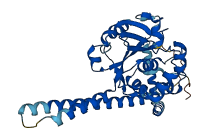
Descriptions
The autoinhibited protein was predicted that may have potential autoinhibitory elements via cis-regPred.
Autoinhibitory domains (AIDs)
Target domain |
|
Relief mechanism |
|
Assay |
cis-regPred |
Accessory elements
No accessory elements
Autoinhibited structure

Activated structure
1 structures for Q9XSJ0
| Entry ID | Method | Resolution | Chain | Position | Source |
|---|---|---|---|---|---|
| AF-Q9XSJ0-F1 | Predicted | AlphaFoldDB |
23 variants for Q9XSJ0
| Variant ID(s) | Position | Change | Description | Diseaes Association | Provenance |
|---|---|---|---|---|---|
| rs471528486 | 7 | E>Q | No | EVA | |
| rs452337545 | 36 | W>S | No | EVA | |
| rs464394710 | 46 | L>* | No | EVA | |
| rs434480177 | 47 | K>T | No | EVA | |
| rs436429094 | 83 | V>E | No | EVA | |
| rs447592299 | 85 | N>S | No | EVA | |
| rs437164060 | 91 | Q>H | No | EVA | |
| rs469999076 | 91 | Q>K | No | EVA | |
| rs456391709 | 98 | L>M | No | EVA | |
| rs471690938 | 102 | H>D | No | EVA | |
| rs432293615 | 103 | Q>E | No | EVA | |
| rs453821388 | 120 | S>G | No | EVA | |
| rs472434138 | 121 | F>S | No | EVA | |
| rs442535521 | 122 | D>V | No | EVA | |
| rs461054691 | 123 | A>P | No | EVA | |
| rs448450010 | 139 | V>G | No | EVA | |
| rs478331699 | 155 | T>I | No | EVA | |
| rs439648084 | 191 | C>R | No | EVA | |
| rs458248863 | 196 | W>S | No | EVA | |
| rs479834531 | 206 | K>E | No | EVA | |
| rs471723562 | 231 | Y>C | No | EVA | |
| rs444806192 | 312 | V>L | No | EVA | |
| rs459249710 | 315 | A>T | No | EVA |
No associated diseases with Q9XSJ0
Functions
| Description | ||
|---|---|---|
| EC Number | 3.4.19.12 | Omega peptidases |
| Subcellular Localization |
|
|
| PANTHER Family | ||
| PANTHER Subfamily | ||
| PANTHER Protein Class | ||
| PANTHER Pathway Category | No pathway information available | |
7 GO annotations of cellular component
| Name | Definition |
|---|---|
| cytoplasm | The contents of a cell excluding the plasma membrane and nucleus, but including other subcellular structures. |
| cytosol | The part of the cytoplasm that does not contain organelles but which does contain other particulate matter, such as protein complexes. |
| Ino80 complex | A multisubunit protein complex that contains the Ino80p ATPase; exhibits chromatin remodeling activity. |
| nucleolus | A small, dense body one or more of which are present in the nucleus of eukaryotic cells. It is rich in RNA and protein, is not bounded by a limiting membrane, and is not seen during mitosis. Its prime function is the transcription of the nucleolar DNA into 45S ribosomal-precursor RNA, the processing of this RNA into 5.8S, 18S, and 28S components of ribosomal RNA, and the association of these components with 5S RNA and proteins synthesized outside the nucleolus. This association results in the formation of ribonucleoprotein precursors; these pass into the cytoplasm and mature into the 40S and 60S subunits of the ribosome. |
| nucleoplasm | That part of the nuclear content other than the chromosomes or the nucleolus. |
| nucleus | A membrane-bounded organelle of eukaryotic cells in which chromosomes are housed and replicated. In most cells, the nucleus contains all of the cell's chromosomes except the organellar chromosomes, and is the site of RNA synthesis and processing. In some species, or in specialized cell types, RNA metabolism or DNA replication may be absent. |
| proteasome complex | A large multisubunit complex which catalyzes protein degradation, found in eukaryotes, archaea and some bacteria. In eukaryotes, this complex consists of the barrel shaped proteasome core complex and one or two associated proteins or complexes that act in regulating entry into or exit from the core. |
3 GO annotations of molecular function
| Name | Definition |
|---|---|
| cysteine-type deubiquitinase activity | An thiol-dependent isopeptidase activity that cleaves ubiquitin from a target protein to which it is conjugated. |
| endopeptidase inhibitor activity | Binds to and stops, prevents or reduces the activity of an endopeptidase, any enzyme that hydrolyzes nonterminal peptide bonds in polypeptides. |
| proteasome binding | Binding to a proteasome, a large multisubunit protein complex that catalyzes protein degradation. |
18 GO annotations of biological process
| Name | Definition |
|---|---|
| chromatin remodeling | A dynamic process of chromatin reorganization resulting in changes to chromatin structure. These changes allow DNA metabolic processes such as transcriptional regulation, DNA recombination, DNA repair, and DNA replication. |
| DNA recombination | Any process in which a new genotype is formed by reassortment of genes resulting in gene combinations different from those that were present in the parents. In eukaryotes genetic recombination can occur by chromosome assortment, intrachromosomal recombination, or nonreciprocal interchromosomal recombination. Interchromosomal recombination occurs by crossing over. In bacteria it may occur by genetic transformation, conjugation, transduction, or F-duction. |
| DNA repair | The process of restoring DNA after damage. Genomes are subject to damage by chemical and physical agents in the environment (e.g. UV and ionizing radiations, chemical mutagens, fungal and bacterial toxins, etc.) and by free radicals or alkylating agents endogenously generated in metabolism. DNA is also damaged because of errors during its replication. A variety of different DNA repair pathways have been reported that include direct reversal, base excision repair, nucleotide excision repair, photoreactivation, bypass, double-strand break repair pathway, and mismatch repair pathway. |
| forebrain morphogenesis | The process in which the anatomical structures of the forebrain are generated and organized. The forebrain is the anterior of the three primary divisions of the developing chordate brain or the corresponding part of the adult brain (in vertebrates, includes especially the cerebral hemispheres, the thalamus, and the hypothalamus and especially in higher vertebrates is the main control center for sensory and associative information processing, visceral functions, and voluntary motor functions). |
| lateral ventricle development | The process whose specific outcome is the progression of the lateral ventricles over time, from the formation to the mature structure. The two lateral ventricles are a cavity in each of the cerebral hemispheres derived from the cavity of the embryonic neural tube. They are separated from each other by the septum pellucidum, and each communicates with the third ventricle by the foramen of Monro, through which also the choroid plexuses of the lateral ventricles become continuous with that of the third ventricle. |
| midbrain development | The process whose specific outcome is the progression of the midbrain over time, from its formation to the mature structure. The midbrain is the middle division of the three primary divisions of the developing chordate brain or the corresponding part of the adult brain (in vertebrates, includes a ventral part containing the cerebral peduncles and a dorsal tectum containing the corpora quadrigemina and that surrounds the aqueduct of Sylvius connecting the third and fourth ventricles). |
| negative regulation of proteasomal ubiquitin-dependent protein catabolic process | Any process that stops, prevents, or reduces the frequency, rate or extent of the breakdown of a protein or peptide by hydrolysis of its peptide bonds, initiated by the covalent attachment of ubiquitin, and mediated by the proteasome. |
| positive regulation of DNA repair | Any process that activates or increases the frequency, rate or extent of DNA repair. |
| positive regulation of DNA-templated transcription | Any process that activates or increases the frequency, rate or extent of cellular DNA-templated transcription. |
| positive regulation of smoothened signaling pathway | Any process that activates or increases the frequency, rate or extent of smoothened signaling. |
| positive regulation of telomere maintenance in response to DNA damage | Any process that activates or increases the frequency, rate or extent of telomere maintenance in response to DNA damage. |
| protein deubiquitination | The removal of one or more ubiquitin groups from a protein. |
| regulation of cell cycle | Any process that modulates the rate or extent of progression through the cell cycle. |
| regulation of DNA replication | Any process that modulates the frequency, rate or extent of DNA replication. |
| regulation of DNA strand elongation | Any process that modulates the rate, frequency or extent of DNA strand elongation. DNA strand elongation is the DNA metabolic process in which an existing DNA strand is extended by activities including the addition of nucleotides to the 3' end of the strand. |
| regulation of embryonic development | Any process that modulates the frequency, rate or extent of embryonic development. |
| telomere maintenance | Any process that contributes to the maintenance of proper telomeric length and structure by affecting and monitoring the activity of telomeric proteins, the length of telomeric DNA and the replication and repair of the DNA. These processes includes those that shorten, lengthen, replicate and repair the telomeric DNA sequences. |
| ubiquitin-dependent protein catabolic process | The chemical reactions and pathways resulting in the breakdown of a protein or peptide by hydrolysis of its peptide bonds, initiated by the covalent attachment of a ubiquitin group, or multiple ubiquitin groups, to the protein. |
4 homologous proteins in AiPD
| UniProt AC | Gene Name | Protein Name | Species | Evidence Code |
|---|---|---|---|---|
| Q7K5N4 | calypso | Ubiquitin carboxyl-terminal hydrolase calypso | Drosophila melanogaster (Fruit fly) | PR |
| Q9Y5K5 | UCHL5 | Ubiquitin carboxyl-terminal hydrolase isozyme L5 | Homo sapiens (Human) | PR |
| Q9WUP7 | Uchl5 | Ubiquitin carboxyl-terminal hydrolase isozyme L5 | Mus musculus (Mouse) | PR |
| Q06AT3 | UCHL5 | Ubiquitin carboxyl-terminal hydrolase isozyme L5 | Sus scrofa (Pig) | PR |
| 10 | 20 | 30 | 40 | 50 | 60 |
| MTGNAGEWCL | MESDPGVFTE | LIKGFGCRGA | QVEEIWSLEP | ENFEKLKPVH | GLIFLFKWQP |
| 70 | 80 | 90 | 100 | 110 | 120 |
| GEEPAGSVVQ | DSRLDTIFFA | KQVINNACAT | QAIVSVLLNC | THQDVHLGET | LSEFKEFSQS |
| 130 | 140 | 150 | 160 | 170 | 180 |
| FDAAMKGLAL | SNSDVIRQVH | NSFARQQMFE | FDAKTAAKEE | DAFHFVSYVP | VNGRLYELDG |
| 190 | 200 | 210 | 220 | 230 | 240 |
| LREGPIDLGA | CNQDDWISAV | RPVIEKRIQK | YSEGEIRFNL | MAIVSDRKMI | YEQKIAELQR |
| 250 | 260 | 270 | 280 | 290 | 300 |
| QLAEEPMDTD | QGSNMLSAIQ | SEVAKNQMLI | EEEVQKLKRY | KIENIRRKHN | YLPFIMELLK |
| 310 | 320 | ||||
| TLAEHQQLIP | LVEKAKEKQN | AKKAQETK |