Q06AT3
Gene name |
UCHL5 |
Protein name |
Ubiquitin carboxyl-terminal hydrolase isozyme L5 |
Names |
UCH-L5, Ubiquitin thioesterase L5 |
Species |
Sus scrofa (Pig) |
KEGG Pathway |
ssc:100144472 |
EC number |
3.4.19.12: Omega peptidases |
Protein Class |
|
Descriptions
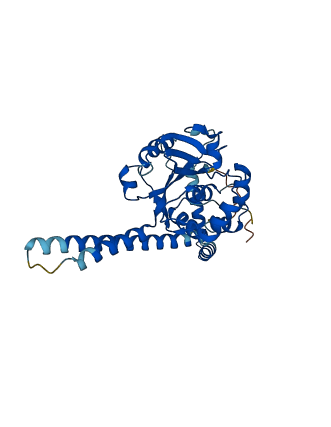
The autoinhibited protein was predicted that may have potential autoinhibitory elements via cis-regPred.
Autoinhibitory domains (AIDs)
Target domain |
|
Relief mechanism |
|
Assay |
cis-regPred |
Accessory elements
No accessory elements
Autoinhibited structure

Activated structure
1 structures for Q06AT3
| Entry ID | Method | Resolution | Chain | Position | Source |
|---|---|---|---|---|---|
| AF-Q06AT3-F1 | Predicted | AlphaFoldDB |
No variants for Q06AT3
| Variant ID(s) | Position | Change | Description | Diseaes Association | Provenance |
|---|---|---|---|---|---|
| No variants for Q06AT3 | |||||
No associated diseases with Q06AT3
Functions
| Description | ||
|---|---|---|
| EC Number | 3.4.19.12 | Omega peptidases |
| Subcellular Localization |
|
|
| PANTHER Family | ||
| PANTHER Subfamily | ||
| PANTHER Protein Class | ||
| PANTHER Pathway Category | No pathway information available | |
5 GO annotations of cellular component
| Name | Definition |
|---|---|
| cytoplasm | The contents of a cell excluding the plasma membrane and nucleus, but including other subcellular structures. |
| cytosol | The part of the cytoplasm that does not contain organelles but which does contain other particulate matter, such as protein complexes. |
| Ino80 complex | A multisubunit protein complex that contains the Ino80p ATPase; exhibits chromatin remodeling activity. |
| nucleus | A membrane-bounded organelle of eukaryotic cells in which chromosomes are housed and replicated. In most cells, the nucleus contains all of the cell's chromosomes except the organellar chromosomes, and is the site of RNA synthesis and processing. In some species, or in specialized cell types, RNA metabolism or DNA replication may be absent. |
| proteasome complex | A large multisubunit complex which catalyzes protein degradation, found in eukaryotes, archaea and some bacteria. In eukaryotes, this complex consists of the barrel shaped proteasome core complex and one or two associated proteins or complexes that act in regulating entry into or exit from the core. |
2 GO annotations of molecular function
| Name | Definition |
|---|---|
| cysteine-type deubiquitinase activity | An thiol-dependent isopeptidase activity that cleaves ubiquitin from a target protein to which it is conjugated. |
| proteasome binding | Binding to a proteasome, a large multisubunit protein complex that catalyzes protein degradation. |
4 GO annotations of biological process
| Name | Definition |
|---|---|
| DNA recombination | Any process in which a new genotype is formed by reassortment of genes resulting in gene combinations different from those that were present in the parents. In eukaryotes genetic recombination can occur by chromosome assortment, intrachromosomal recombination, or nonreciprocal interchromosomal recombination. Interchromosomal recombination occurs by crossing over. In bacteria it may occur by genetic transformation, conjugation, transduction, or F-duction. |
| DNA repair | The process of restoring DNA after damage. Genomes are subject to damage by chemical and physical agents in the environment (e.g. UV and ionizing radiations, chemical mutagens, fungal and bacterial toxins, etc.) and by free radicals or alkylating agents endogenously generated in metabolism. DNA is also damaged because of errors during its replication. A variety of different DNA repair pathways have been reported that include direct reversal, base excision repair, nucleotide excision repair, photoreactivation, bypass, double-strand break repair pathway, and mismatch repair pathway. |
| protein deubiquitination | The removal of one or more ubiquitin groups from a protein. |
| ubiquitin-dependent protein catabolic process | The chemical reactions and pathways resulting in the breakdown of a protein or peptide by hydrolysis of its peptide bonds, initiated by the covalent attachment of a ubiquitin group, or multiple ubiquitin groups, to the protein. |
4 homologous proteins in AiPD
| UniProt AC | Gene Name | Protein Name | Species | Evidence Code |
|---|---|---|---|---|
| Q9XSJ0 | UCHL5 | Ubiquitin carboxyl-terminal hydrolase isozyme L5 | Bos taurus (Bovine) | PR |
| Q7K5N4 | calypso | Ubiquitin carboxyl-terminal hydrolase calypso | Drosophila melanogaster (Fruit fly) | PR |
| Q9Y5K5 | UCHL5 | Ubiquitin carboxyl-terminal hydrolase isozyme L5 | Homo sapiens (Human) | PR |
| Q9WUP7 | Uchl5 | Ubiquitin carboxyl-terminal hydrolase isozyme L5 | Mus musculus (Mouse) | PR |
| 10 | 20 | 30 | 40 | 50 | 60 |
| MTGNAGEWCL | MESDPGVFTE | LIKGFGCRGA | QVEEIWSLEP | ENFEKLKPVH | GLIFLFKWQP |
| 70 | 80 | 90 | 100 | 110 | 120 |
| GEEPAGSVVQ | DSRLDTIFFA | KQVINNACAT | QAIVSVLLNC | THQDVHLGET | LSEFKEFSQS |
| 130 | 140 | 150 | 160 | 170 | 180 |
| FDAAMKGLAL | SNSDVIRQVH | NSFARQQMFE | FDAKTSAKEE | DAFHFVSYVP | VNGRLYELDG |
| 190 | 200 | 210 | 220 | 230 | 240 |
| LREGPIDLGA | CNQDDWISAV | RPVIEKRIQK | YSEGEIRFNL | MAIVSDRKMI | YEQKIAELQR |
| 250 | 260 | 270 | 280 | 290 | 300 |
| QLAEEEPMDT | DQGSNMLSAI | QSEVAKNQML | IEEEVQKLKR | YKIENIRRKH | NYLPFIMELL |
| 310 | 320 | ||||
| KTLAEHQQLI | PLVEKAKEKQ | NAKKAQETK |