Q9WV41
Gene name |
Insl6 |
Protein name |
Insulin-like peptide INSL6 |
Names |
Insulin-like peptide 6 |
Species |
Rattus norvegicus (Rat) |
KEGG Pathway |
rno:50546 |
EC number |
|
Protein Class |
|
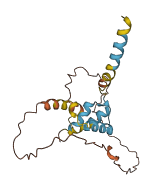
Descriptions
The autoinhibited protein was predicted that may have potential autoinhibitory elements via cis-regPred.
Autoinhibitory domains (AIDs)
Target domain |
|
Relief mechanism |
|
Assay |
cis-regPred |
Accessory elements
No accessory elements
Autoinhibited structure

Activated structure
1 structures for Q9WV41
| Entry ID | Method | Resolution | Chain | Position | Source |
|---|---|---|---|---|---|
| AF-Q9WV41-F1 | Predicted | AlphaFoldDB |
No variants for Q9WV41
| Variant ID(s) | Position | Change | Description | Diseaes Association | Provenance |
|---|---|---|---|---|---|
| No variants for Q9WV41 | |||||
No associated diseases with Q9WV41
1 GO annotations of cellular component
| Name | Definition |
|---|---|
| extracellular region | The space external to the outermost structure of a cell. For cells without external protective or external encapsulating structures this refers to space outside of the plasma membrane. This term covers the host cell environment outside an intracellular parasite. |
1 GO annotations of molecular function
| Name | Definition |
|---|---|
| hormone activity | The action characteristic of a hormone, any substance formed in very small amounts in one specialized organ or group of cells and carried (sometimes in the bloodstream) to another organ or group of cells in the same organism, upon which it has a specific regulatory action. The term was originally applied to agents with a stimulatory physiological action in vertebrate animals (as opposed to a chalone, which has a depressant action). Usage is now extended to regulatory compounds in lower animals and plants, and to synthetic substances having comparable effects; all bind receptors and trigger some biological process. |
10 GO annotations of biological process
| Name | Definition |
|---|---|
| apoptotic process | A programmed cell death process which begins when a cell receives an internal (e.g. DNA damage) or external signal (e.g. an extracellular death ligand), and proceeds through a series of biochemical events (signaling pathway phase) which trigger an execution phase. The execution phase is the last step of an apoptotic process, and is typically characterized by rounding-up of the cell, retraction of pseudopodes, reduction of cellular volume (pyknosis), chromatin condensation, nuclear fragmentation (karyorrhexis), plasma membrane blebbing and fragmentation of the cell into apoptotic bodies. When the execution phase is completed, the cell has died. |
| ectopic germ cell programmed cell death | Programmed cell death of an errant germ line cell that is outside the normal migratory path or ectopic to the gonad. This is an important mechanism of regulating germ cell survival within the embryo. |
| fertilization | The union of gametes of opposite sexes during the process of sexual reproduction to form a zygote. It involves the fusion of the gametic nuclei (karyogamy) and cytoplasm (plasmogamy). |
| flagellated sperm motility | The directed, self-propelled movement of a cilium (aka flagellum) that contributes to the movement of a flagellated sperm. |
| male gonad development | The process whose specific outcome is the progression of the male gonad over time, from its formation to the mature structure. |
| negative regulation of apoptotic process | Any process that stops, prevents, or reduces the frequency, rate or extent of cell death by apoptotic process. |
| negative regulation of developmental process | Any process that stops, prevents or reduces the rate or extent of development, the biological process whose specific outcome is the progression of an organism over time from an initial condition (e.g. a zygote, or a young adult) to a later condition (e.g. a multicellular animal or an aged adult). |
| negative regulation of reproductive process | Any process that stops, prevents, or reduces the frequency, rate or extent of reproductive process. |
| spermatid development | The process whose specific outcome is the progression of a spermatid over time, from its formation to the mature structure. |
| spermatogenesis | The developmental process by which male germ line stem cells self renew or give rise to successive cell types resulting in the development of a spermatozoa. |
| 10 | 20 | 30 | 40 | 50 | 60 |
| MKQLCCSCLL | WLGLLLAPFS | QEQEEVTSPT | KLCGRDLLVE | VIKLCGQNDW | SRFSMEEQSP |
| 70 | 80 | 90 | 100 | 110 | 120 |
| MTELVPQYTR | KVKTFNPHRS | SSSWGRFTNP | GVSQKKATHT | WESQSLPNYQ | LKKEELLPKT |
| 130 | 140 | 150 | 160 | 170 | 180 |
| GVHSYHGGKP | YVKSVKFQKK | NTDKMSTFSG | LFWGNHPQRK | RRGFADKCCA | IGCSKEELAV |
| ACLPFVDF |