P01347
Gene name |
Rln1 (Rln) |
Protein name |
Prorelaxin 1 |
Names |
|
Species |
Rattus norvegicus (Rat) |
KEGG Pathway |
rno:25616 |
EC number |
|
Protein Class |
|
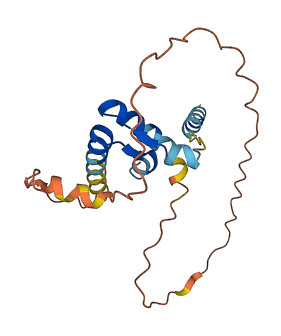
Descriptions
The autoinhibited protein was predicted that may have potential autoinhibitory elements via cis-regPred.
Autoinhibitory domains (AIDs)
Target domain |
|
Relief mechanism |
|
Assay |
cis-regPred |
Accessory elements
No accessory elements
Autoinhibited structure

Activated structure
1 structures for P01347
| Entry ID | Method | Resolution | Chain | Position | Source |
|---|---|---|---|---|---|
| AF-P01347-F1 | Predicted | AlphaFoldDB |
No variants for P01347
| Variant ID(s) | Position | Change | Description | Diseaes Association | Provenance |
|---|---|---|---|---|---|
| No variants for P01347 | |||||
No associated diseases with P01347
1 GO annotations of cellular component
| Name | Definition |
|---|---|
| extracellular region | The space external to the outermost structure of a cell. For cells without external protective or external encapsulating structures this refers to space outside of the plasma membrane. This term covers the host cell environment outside an intracellular parasite. |
2 GO annotations of molecular function
| Name | Definition |
|---|---|
| hormone activity | The action characteristic of a hormone, any substance formed in very small amounts in one specialized organ or group of cells and carried (sometimes in the bloodstream) to another organ or group of cells in the same organism, upon which it has a specific regulatory action. The term was originally applied to agents with a stimulatory physiological action in vertebrate animals (as opposed to a chalone, which has a depressant action). Usage is now extended to regulatory compounds in lower animals and plants, and to synthetic substances having comparable effects; all bind receptors and trigger some biological process. |
| signaling receptor binding | Binding to one or more specific sites on a receptor molecule, a macromolecule that undergoes combination with a hormone, neurotransmitter, drug or intracellular messenger to initiate a change in cell function. |
11 GO annotations of biological process
| Name | Definition |
|---|---|
| adenylate cyclase-modulating G protein-coupled receptor signaling pathway | A G protein-coupled receptor signaling pathway in which the signal is transmitted via the activation or inhibition of adenylyl cyclase activity and a subsequent change in the intracellular concentration of cyclic AMP (cAMP). |
| developmental growth | The increase in size or mass of an entire organism, a part of an organism or a cell, where the increase in size or mass has the specific outcome of the progression of the organism over time from one condition to another. |
| mammary gland morphogenesis | The process in which anatomical structures of the mammary gland are generated and organized. Morphogenesis refers to the creation of shape. The mammary gland is a large compound sebaceous gland that in female mammals is modified to secrete milk. |
| negative regulation of apoptotic process | Any process that stops, prevents, or reduces the frequency, rate or extent of cell death by apoptotic process. |
| nipple development | The progression of the nipple over time, from its formation to the mature structure. The nipple is a part of the mammary gland that protrudes from the surface ectoderm. |
| prostate gland growth | The increase in size or mass of the prostate gland where the increase in size or mass has the specific outcome of the progression of the gland, from its formation to its mature state. |
| regulation of apoptotic process | Any process that modulates the occurrence or rate of cell death by apoptotic process. |
| regulation of body fluid levels | Any process that modulates the levels of body fluids. |
| regulation of cell population proliferation | Any process that modulates the frequency, rate or extent of cell proliferation. |
| regulation of nitric oxide mediated signal transduction | Any process that modulates the rate, frequency or extent of nitric oxide mediated signal transduction. Nitric oxide mediated signal transduction is The series of molecular signals mediated by the detection of nitric oxide (NO). |
| spermatogenesis | The developmental process by which male germ line stem cells self renew or give rise to successive cell types resulting in the development of a spermatozoa. |
| 10 | 20 | 30 | 40 | 50 | 60 |
| MSSRLLLQLL | GFWLFLSQPC | RARVSEEWMD | QVIQVCGRGY | ARAWIEVCGA | SVGRLALSQE |
| 70 | 80 | 90 | 100 | 110 | 120 |
| EPAPLARQAT | AEVVPSFINK | DAEPFDMTLK | CLPNLSEERK | AALSEGRAPF | PELQQHAPAL |
| 130 | 140 | 150 | 160 | 170 | 180 |
| SDSVVSLEGF | KKTFHNQLGE | AEDGGPPELK | YLGSDAQSRK | KRQSGALLSE | QCCHIGCTRR |
| SIAKLC |