Q9V7D2
Gene name |
Vha36-1 (Vha36, CG8186) |
Protein name |
V-type proton ATPase subunit D 1 |
Names |
V-ATPase subunit D 1, Vacuolar H+ ATPase subunit 36-1, Vacuolar proton pump subunit D 1, dV-ATPase D |
Species |
Drosophila melanogaster (Fruit fly) |
KEGG Pathway |
dme:Dmel_CG8186 |
EC number |
|
Protein Class |
|
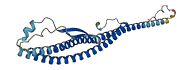
Descriptions
The autoinhibited protein was predicted that may have potential autoinhibitory elements via cis-regPred.
Autoinhibitory domains (AIDs)
Target domain |
|
Relief mechanism |
|
Assay |
cis-regPred |
Accessory elements
No accessory elements
Autoinhibited structure

Activated structure
1 structures for Q9V7D2
| Entry ID | Method | Resolution | Chain | Position | Source |
|---|---|---|---|---|---|
| AF-Q9V7D2-F1 | Predicted | AlphaFoldDB |
No variants for Q9V7D2
| Variant ID(s) | Position | Change | Description | Diseaes Association | Provenance |
|---|---|---|---|---|---|
| No variants for Q9V7D2 | |||||
No associated diseases with Q9V7D2
2 regional properties for Q9V7D2
| Type | Name | Position | InterPro Accession |
|---|---|---|---|
| domain | Adenylyl cyclase class-3/4/guanylyl cyclase | 7 - 214 | IPR001054-1 |
| domain | Adenylyl cyclase class-3/4/guanylyl cyclase | 290 - 461 | IPR001054-2 |
3 GO annotations of cellular component
| Name | Definition |
|---|---|
| plasma membrane proton-transporting V-type ATPase complex | A proton-transporting two-sector ATPase complex found in the plasma membrane. |
| proton-transporting V-type ATPase complex | A proton-transporting two-sector ATPase complex that couples ATP hydrolysis to the transport of protons across a concentration gradient. The resulting transmembrane electrochemical potential of H+ is used to drive a variety of (i) secondary active transport systems via H+-dependent symporters and antiporters and (ii) channel-mediated transport systems. The complex comprises a membrane sector (V0) that carries out proton transport and a cytoplasmic compartment sector (V1) that catalyzes ATP hydrolysis. V-type ATPases are found in the membranes of organelles such as vacuoles, endosomes, and lysosomes, and in the plasma membrane. |
| vacuolar proton-transporting V-type ATPase, V1 domain | The V1 domain of a proton-transporting V-type ATPase found in the vacuolar membrane. |
1 GO annotations of molecular function
| Name | Definition |
|---|---|
| proton-transporting ATPase activity, rotational mechanism | Enables the transfer of protons from one side of a membrane to the other according to the reaction: ATP + H2O + H+(in) = ADP + phosphate + H+(out), by a rotational mechanism. |
1 GO annotations of biological process
| Name | Definition |
|---|---|
| proton transmembrane transport | The directed movement of a proton across a membrane. |
4 homologous proteins in AiPD
| UniProt AC | Gene Name | Protein Name | Species | Evidence Code |
|---|---|---|---|---|
| P32610 | VMA8 | V-type proton ATPase subunit D | Saccharomyces cerevisiae (strain ATCC 204508 / S288c) (Baker's yeast) | PR |
| P39942 | ATP6V1D | V-type proton ATPase subunit D | Bos taurus (Bovine) | PR |
| Q9Y5K8 | ATP6V1D | V-type proton ATPase subunit D | Homo sapiens (Human) | PR |
| P57746 | Atp6v1d | V-type proton ATPase subunit D | Mus musculus (Mouse) | PR |
| 10 | 20 | 30 | 40 | 50 | 60 |
| MSGKDRLPIF | PSRGAQMLMK | ARLAGAQKGH | GLLKKKADAL | QMRFRLILGK | IIETKTLMGD |
| 70 | 80 | 90 | 100 | 110 | 120 |
| VMKEAAFSLA | EAKFTSGDIN | QVVLQNVTKA | QIKIRTKKDN | VAGVTLPVFE | SYQDGSDTYE |
| 130 | 140 | 150 | 160 | 170 | 180 |
| LAGLARGGQQ | LAKLKKNYQS | AVKLLVELAS | LQTSFVTLDE | VIKITNRRVN | AIEHVIIPRI |
| 190 | 200 | 210 | 220 | 230 | 240 |
| DRTLAYIISE | LDELEREEFY | RLKKIQDKKR | EARIKADAKK | AELLQQGIDV | RQQANILDEG |
| DDDVLF |