Q9R049
Gene name |
Amfr |
Protein name |
E3 ubiquitin-protein ligase AMFR |
Names |
Autocrine motility factor receptor, AMF receptor, RING-type E3 ubiquitin transferase AMFR |
Species |
Mus musculus (Mouse) |
KEGG Pathway |
mmu:23802 |
EC number |
2.3.2.36: Aminoacyltransferases |
Protein Class |
|
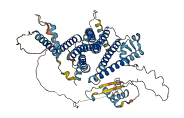
Descriptions
The autoinhibited protein was predicted that may have potential autoinhibitory elements via cis-regPred.
Autoinhibitory domains (AIDs)
Target domain |
|
Relief mechanism |
|
Assay |
cis-regPred |
Accessory elements
No accessory elements
Autoinhibited structure

Activated structure
1 structures for Q9R049
| Entry ID | Method | Resolution | Chain | Position | Source |
|---|---|---|---|---|---|
| AF-Q9R049-F1 | Predicted | AlphaFoldDB |
No variants for Q9R049
| Variant ID(s) | Position | Change | Description | Diseaes Association | Provenance |
|---|---|---|---|---|---|
| No variants for Q9R049 | |||||
No associated diseases with Q9R049
Functions
| Description | ||
|---|---|---|
| EC Number | 2.3.2.36 | Aminoacyltransferases |
| Subcellular Localization |
|
|
| PANTHER Family | ||
| PANTHER Subfamily | ||
| PANTHER Protein Class | ||
| PANTHER Pathway Category | No pathway information available | |
15 GO annotations of cellular component
| Name | Definition |
|---|---|
| cytoplasm | The contents of a cell excluding the plasma membrane and nucleus, but including other subcellular structures. |
| cytosol | The part of the cytoplasm that does not contain organelles but which does contain other particulate matter, such as protein complexes. |
| dendrite | A neuron projection that has a short, tapering, morphology. Dendrites receive and integrate signals from other neurons or from sensory stimuli, and conduct nerve impulses towards the axon or the cell body. In most neurons, the impulse is conveyed from dendrites to axon via the cell body, but in some types of unipolar neuron, the impulse does not travel via the cell body. |
| Derlin-1 retrotranslocation complex | A protein complex that functions in the retrotranslocation step of ERAD (ER-associated protein degradation), and includes at its core Derlin-1 oligomers forming a retrotranslocation channel. |
| endoplasmic reticulum | The irregular network of unit membranes, visible only by electron microscopy, that occurs in the cytoplasm of many eukaryotic cells. The membranes form a complex meshwork of tubular channels, which are often expanded into slitlike cavities called cisternae. The ER takes two forms, rough (or granular), with ribosomes adhering to the outer surface, and smooth (with no ribosomes attached). |
| endoplasmic reticulum membrane | The lipid bilayer surrounding the endoplasmic reticulum. |
| Golgi apparatus | A membrane-bound cytoplasmic organelle of the endomembrane system that further processes the core oligosaccharides (e.g. N-glycans) added to proteins in the endoplasmic reticulum and packages them into membrane-bound vesicles. The Golgi apparatus operates at the intersection of the secretory, lysosomal, and endocytic pathways. |
| growth cone | The migrating motile tip of a growing neuron projection, where actin accumulates, and the actin cytoskeleton is the most dynamic. |
| integral component of endoplasmic reticulum membrane | The component of the endoplasmic reticulum membrane consisting of the gene products and protein complexes having at least some part of their peptide sequence embedded in the hydrophobic region of the membrane. |
| integral component of plasma membrane | The component of the plasma membrane consisting of the gene products and protein complexes having at least some part of their peptide sequence embedded in the hydrophobic region of the membrane. |
| neuronal cell body | The portion of a neuron that includes the nucleus, but excludes cell projections such as axons and dendrites. |
| nucleus | A membrane-bounded organelle of eukaryotic cells in which chromosomes are housed and replicated. In most cells, the nucleus contains all of the cell's chromosomes except the organellar chromosomes, and is the site of RNA synthesis and processing. In some species, or in specialized cell types, RNA metabolism or DNA replication may be absent. |
| perinuclear region of cytoplasm | Cytoplasm situated near, or occurring around, the nucleus. |
| protein-containing complex | A stable assembly of two or more macromolecules, i.e. proteins, nucleic acids, carbohydrates or lipids, in which at least one component is a protein and the constituent parts function together. |
| ubiquitin ligase complex | A protein complex that includes a ubiquitin-protein ligase and enables ubiquitin protein ligase activity. The complex also contains other proteins that may confer substrate specificity on the complex. |
12 GO annotations of molecular function
| Name | Definition |
|---|---|
| BAT3 complex binding | Binding to a BAT3 complex. |
| chaperone binding | Binding to a chaperone protein, a class of proteins that bind to nascent or unfolded polypeptides and ensure correct folding or transport. |
| identical protein binding | Binding to an identical protein or proteins. |
| metal ion binding | Binding to a metal ion. |
| nucleotide binding | Binding to a nucleotide, any compound consisting of a nucleoside that is esterified with (ortho)phosphate or an oligophosphate at any hydroxyl group on the ribose or deoxyribose. |
| protein-macromolecule adaptor activity | The binding activity of a protein that brings together two or more macromolecules in contact, permitting those molecules to function in a coordinated way. The adaptor can bring together two proteins, or a protein and another macromolecule such as a lipid or a nucleic acid. |
| signaling receptor activity | Receiving a signal and transmitting it in the cell to initiate a change in cell activity. A signal is a physical entity or change in state that is used to transfer information in order to trigger a response. |
| ubiquitin binding | Binding to ubiquitin, a protein that when covalently bound to other cellular proteins marks them for proteolytic degradation. |
| ubiquitin protein ligase activity | Catalysis of the transfer of ubiquitin to a substrate protein via the reaction X-ubiquitin + S -> X + S-ubiquitin, where X is either an E2 or E3 enzyme, the X-ubiquitin linkage is a thioester bond, and the S-ubiquitin linkage is an amide bond: an isopeptide bond between the C-terminal glycine of ubiquitin and the epsilon-amino group of lysine residues in the substrate or, in the linear extension of ubiquitin chains, a peptide bond the between the C-terminal glycine and N-terminal methionine of ubiquitin residues. |
| ubiquitin-protein transferase activity | Catalysis of the transfer of ubiquitin from one protein to another via the reaction X-Ub + Y --> Y-Ub + X, where both X-Ub and Y-Ub are covalent linkages. |
| ubiquitin-specific protease binding | Binding to a ubiquitin-specific protease. |
| ubiquitin-ubiquitin ligase activity | Isoenergetic transfer of ubiquitin from one protein to an existing ubiquitin chain via the reaction X-ubiquitin + Y-ubiquitin -> Y-ubiquitin-ubiquitin + X, where both the X-ubiquitin and Y-ubiquitin-ubiquitin linkages are thioester bonds between the C-terminal glycine of ubiquitin and a sulfhydryl side group of a cysteine residue. |
13 GO annotations of biological process
| Name | Definition |
|---|---|
| aging | A developmental process that is a deterioration and loss of function over time. Aging includes loss of functions such as resistance to disease, homeostasis, and fertility, as well as wear and tear. Aging includes cellular senescence, but is more inclusive. May precede death and may succeed developmental maturation (GO:0021700). |
| endoplasmic reticulum unfolded protein response | The series of molecular signals generated as a consequence of the presence of unfolded proteins in the endoplasmic reticulum (ER) or other ER-related stress; results in changes in the regulation of transcription and translation. |
| learning or memory | The acquisition and processing of information and/or the storage and retrieval of this information over time. |
| negative regulation of canonical Wnt signaling pathway | Any process that decreases the rate, frequency, or extent of the Wnt signaling pathway through beta-catenin, the series of molecular signals initiated by binding of a Wnt protein to a frizzled family receptor on the surface of the target cell, followed by propagation of the signal via beta-catenin, and ending with a change in transcription of target genes. |
| positive regulation of protein binding | Any process that activates or increases the frequency, rate or extent of protein binding. |
| protein autoubiquitination | The ubiquitination by a protein of one or more of its own amino acid residues, or residues on an identical protein. Ubiquitination occurs on the lysine residue by formation of an isopeptide crosslink. |
| protein K48-linked ubiquitination | A protein ubiquitination process in which a polymer of ubiquitin, formed by linkages between lysine residues at position 48 of the ubiquitin monomers, is added to a protein. K48-linked ubiquitination targets the substrate protein for degradation. |
| protein polyubiquitination | Addition of multiple ubiquitin groups to a protein, forming a ubiquitin chain. |
| protein ubiquitination | The process in which one or more ubiquitin groups are added to a protein. |
| regulation of SREBP signaling pathway | Any process that modulates the frequency, rate or extent of the SREBP signaling pathway. |
| ubiquitin-dependent ERAD pathway | The series of steps necessary to target endoplasmic reticulum (ER)-resident proteins for degradation by the cytoplasmic proteasome. Begins with recognition of the ER-resident protein, includes retrotranslocation (dislocation) of the protein from the ER to the cytosol, protein ubiquitination necessary for correct substrate transfer, transport of the protein to the proteasome, and ends with degradation of the protein by the cytoplasmic proteasome. |
| ubiquitin-dependent protein catabolic process | The chemical reactions and pathways resulting in the breakdown of a protein or peptide by hydrolysis of its peptide bonds, initiated by the covalent attachment of a ubiquitin group, or multiple ubiquitin groups, to the protein. |
| Wnt signaling pathway | The series of molecular signals initiated by binding of a Wnt protein to a frizzled family receptor on the surface of the target cell and ending with a change in cell state. |
8 homologous proteins in AiPD
| UniProt AC | Gene Name | Protein Name | Species | Evidence Code |
|---|---|---|---|---|
| Q8WU17 | RNF139 | E3 ubiquitin-protein ligase RNF139 | Homo sapiens (Human) | PR |
| Q5M7Z0 | RNFT1 | E3 ubiquitin-protein ligase RNFT1 | Homo sapiens (Human) | PR |
| Q9UKV5 | AMFR | E3 ubiquitin-protein ligase AMFR | Homo sapiens (Human) | PR |
| Q9DCN7 | Rnft1 | E3 ubiquitin-protein ligase RNFT1 | Mus musculus (Mouse) | PR |
| Q7TMV1 | Rnf139 | E3 ubiquitin-protein ligase RNF139 | Mus musculus (Mouse) | PR |
| P90859 | F26E4.3 | E3 ubiquitin-protein ligase hrd-like protein 1 | Caenorhabditis elegans | PR |
| Q7ZWF4 | rnf145 | RING finger protein 145 | Danio rerio (Zebrafish) (Brachydanio rerio) | PR |
| A5WW08 | chfr | E3 ubiquitin-protein ligase CHFR | Danio rerio (Zebrafish) (Brachydanio rerio) | PR |
| 10 | 20 | 30 | 40 | 50 | 60 |
| MPLLFLERFP | WPSLRTYTGL | SGLALLGTIV | SAYRALSQPE | DGSGEPEPLT | APLQPEALAP |
| 70 | 80 | 90 | 100 | 110 | 120 |
| ARLTAGGPRA | RDVAQYLLSD | SLFVWVLVNT | ACCVLMLVAK | LIQCIVFGPL | RVSERQHLKD |
| 130 | 140 | 150 | 160 | 170 | 180 |
| KFWNFIFYKF | IFIFGVLNVQ | TVEEVVMWCL | WFAGLVFLHL | MVQLCKDRFE | YLSFSPTTPM |
| 190 | 200 | 210 | 220 | 230 | 240 |
| SSHGRVLSLL | IAMLLSCCGL | AVVCCVTGYT | HGMHTLAFMA | AESLLVTVRT | AHVILRYVIH |
| 250 | 260 | 270 | 280 | 290 | 300 |
| LWDLNHEGTW | EGKGTYVYYT | DFVMELALLS | LDLMHHIHML | LFGNIWLSMA | SLVIFMQLRY |
| 310 | 320 | 330 | 340 | 350 | 360 |
| LFHEVQRRIR | RHKNYLRVVG | NMEARFAVAT | PEELAVNNDD | CAICWDSMQA | ARKLPCGHLF |
| 370 | 380 | 390 | 400 | 410 | 420 |
| HNSCLRSWLE | QDTSCPTCRM | SLNIADGSRA | REDHQGENLD | ENLVPVAAAE | GRPRLNQHNH |
| 430 | 440 | 450 | 460 | 470 | 480 |
| FFHFDGSRIA | SWLPSFSVEV | MHTTNILGIT | QASNSQLNAM | AHQIQEMFPQ | VPYHLVLQDL |
| 490 | 500 | 510 | 520 | 530 | 540 |
| QMTRSVEITT | DNILEGRIQV | PFPTQRSDSL | RPALNSPVER | PSPDLEEGEA | SVQTERVPLD |
| 550 | 560 | 570 | 580 | 590 | 600 |
| LSPRLEETLD | FSEVELEPIE | VEDFEARGSR | FSKSADERQR | MLVQRKDDLL | QQARKRFLNK |
| 610 | 620 | 630 | 640 | ||
| SSEDDGASER | LLPSEGTSSD | PVTLRRRMLA | AAAERRLQRQ | RTT |