Q9QYM9
Gene name |
Tmeff2 (MNCb-1026) |
Protein name |
Tomoregulin-2 |
Names |
TR-2, Transmembrane protein with EGF-like and two follistatin-like domains |
Species |
Mus musculus (Mouse) |
KEGG Pathway |
mmu:56363 |
EC number |
|
Protein Class |
|
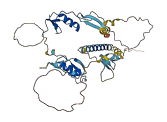
Descriptions
The autoinhibited protein was predicted that may have potential autoinhibitory elements via cis-regPred.
Autoinhibitory domains (AIDs)
Target domain |
|
Relief mechanism |
|
Assay |
cis-regPred |
Accessory elements
No accessory elements
Autoinhibited structure

Activated structure
1 structures for Q9QYM9
| Entry ID | Method | Resolution | Chain | Position | Source |
|---|---|---|---|---|---|
| AF-Q9QYM9-F1 | Predicted | AlphaFoldDB |
5 variants for Q9QYM9
| Variant ID(s) | Position | Change | Description | Diseaes Association | Provenance |
|---|---|---|---|---|---|
| rs3389910913 | 140 | G>R | No | EVA | |
| rs3388468476 | 254 | L>I | No | EVA | |
| rs3388468186 | 271 | G>D | No | EVA | |
| rs33782966 | 296 | T>A | No | EVA | |
| rs216299428 | 299 | H>R | No | EVA |
No associated diseases with Q9QYM9
3 regional properties for Q9QYM9
| Type | Name | Position | InterPro Accession |
|---|---|---|---|
| domain | EGF-like domain | 261 - 301 | IPR000742 |
| domain | Kazal domain | 90 - 137 | IPR002350-1 |
| domain | Kazal domain | 181 - 229 | IPR002350-2 |
3 GO annotations of cellular component
| Name | Definition |
|---|---|
| basement membrane | A collagen-containing extracellular matrix consisting of a thin layer of dense material found in various animal tissues interposed between the cells and the adjacent connective tissue. It consists of the basal lamina plus an associated layer of reticulin fibers. |
| integral component of membrane | The component of a membrane consisting of the gene products and protein complexes having at least some part of their peptide sequence embedded in the hydrophobic region of the membrane. |
| plasma membrane | The membrane surrounding a cell that separates the cell from its external environment. It consists of a phospholipid bilayer and associated proteins. |
No GO annotations of molecular function
| Name | Definition |
|---|---|
| No GO annotations for molecular function |
8 GO annotations of biological process
| Name | Definition |
|---|---|
| animal organ morphogenesis | Morphogenesis of an animal organ. An organ is defined as a tissue or set of tissues that work together to perform a specific function or functions. Morphogenesis is the process in which anatomical structures are generated and organized. Organs are commonly observed as visibly distinct structures, but may also exist as loosely associated clusters of cells that work together to perform a specific function or functions. |
| cell migration | The controlled self-propelled movement of a cell from one site to a destination guided by molecular cues. Cell migration is a central process in the development and maintenance of multicellular organisms. |
| negative regulation of cell migration | Any process that stops, prevents, or reduces the frequency, rate or extent of cell migration. |
| negative regulation of integrin biosynthetic process | Any process that stops, prevents, or reduces the frequency, rate or extent of the chemical reactions and pathways resulting in the formation of integrins. |
| negative regulation of stress fiber assembly | Any process that stops, prevents, or reduces the frequency, rate or extent of the assembly a stress fiber, a bundle of microfilaments and other proteins found in fibroblasts. |
| substrate adhesion-dependent cell spreading | The morphogenetic process that results in flattening of a cell as a consequence of its adhesion to a substrate. |
| tissue development | The process whose specific outcome is the progression of a tissue over time, from its formation to the mature structure. |
| wound healing, spreading of cells | The migration of a cell along or through a wound gap that contributes to the reestablishment of a continuous surface. |
| 10 | 20 | 30 | 40 | 50 | 60 |
| MVLWESPRQC | SSWTLCEGFC | WLLLLPVTLL | IIARPVKLAA | FPTSLSDCQT | PTGWNCSGYD |
| 70 | 80 | 90 | 100 | 110 | 120 |
| DRENDLFLCD | TNTCKFDGEC | LRIGDTVTCV | CQFKCNSDYV | PVCGSNGESY | QNECYLRQAA |
| 130 | 140 | 150 | 160 | 170 | 180 |
| CKQQSEILVV | SEGSCATDTG | SGSGDGVHEG | SGETSQKETS | TCDICQFGAE | CDEDAEDVWC |
| 190 | 200 | 210 | 220 | 230 | 240 |
| VCNIDCSQTN | FNPLCASDGK | SYDNACQIKE | ASCQKQEKIE | VMSLGRCQDN | TTTTTKSEDG |
| 250 | 260 | 270 | 280 | 290 | 300 |
| HYARTDYAEN | ANKLEESARE | HHIPCPEHYN | GFCMHGKCEH | SINMQEPSCR | CDAGYTGQHC |
| 310 | 320 | 330 | 340 | 350 | 360 |
| EKKDYSVLYV | VPGPVRFQYV | LIAAVIGTIQ | IAVICVVVLC | ITRKCPRSNR | IHRQKQNTGH |
| 370 | |||||
| YSSDNTTRAS | TRLI |