Q90844
Gene name |
FST |
Protein name |
Follistatin |
Names |
FS, Activin-binding protein |
Species |
Gallus gallus (Chicken) |
KEGG Pathway |
gga:396119 |
EC number |
|
Protein Class |
|
Descriptions
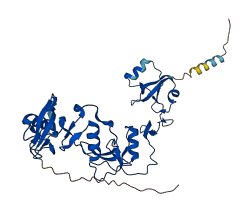
The autoinhibited protein was predicted that may have potential autoinhibitory elements via cis-regPred.
Autoinhibitory domains (AIDs)
Target domain |
|
Relief mechanism |
|
Assay |
cis-regPred |
Accessory elements
No accessory elements
Autoinhibited structure

Activated structure
1 structures for Q90844
| Entry ID | Method | Resolution | Chain | Position | Source |
|---|---|---|---|---|---|
| AF-Q90844-F1 | Predicted | AlphaFoldDB |
No variants for Q90844
| Variant ID(s) | Position | Change | Description | Diseaes Association | Provenance |
|---|---|---|---|---|---|
| No variants for Q90844 | |||||
No associated diseases with Q90844
8 regional properties for Q90844
| Type | Name | Position | InterPro Accession |
|---|---|---|---|
| domain | Kazal domain | 100 - 165 | IPR002350-1 |
| domain | Kazal domain | 189 - 240 | IPR002350-2 |
| domain | Kazal domain | 267 - 317 | IPR002350-3 |
| domain | Follistatin-like, N-terminal | 93 - 116 | IPR003645-1 |
| domain | Follistatin-like, N-terminal | 166 - 189 | IPR003645-2 |
| domain | Follistatin-like, N-terminal | 243 - 267 | IPR003645-3 |
| domain | Follistatin/Osteonectin EGF domain | 94 - 115 | IPR015369 |
| domain | TB domain | 29 - 90 | IPR017878 |
1 GO annotations of cellular component
| Name | Definition |
|---|---|
| extracellular space | That part of a multicellular organism outside the cells proper, usually taken to be outside the plasma membranes, and occupied by fluid. |
4 GO annotations of molecular function
| Name | Definition |
|---|---|
| activin binding | Binding to activin, a dimer of inhibin-beta subunits. |
| calcium ion binding | Binding to a calcium ion (Ca2+). |
| collagen binding | Binding to collagen, a group of fibrous proteins of very high tensile strength that form the main component of connective tissue in animals. Collagen is highly enriched in glycine (some regions are 33% glycine) and proline, occurring predominantly as 3-hydroxyproline (about 20%). |
| extracellular matrix binding | Binding to a component of the extracellular matrix. |
10 GO annotations of biological process
| Name | Definition |
|---|---|
| anatomical structure development | The biological process whose specific outcome is the progression of an anatomical structure from an initial condition to its mature state. This process begins with the formation of the structure and ends with the mature structure, whatever form that may be including its natural destruction. An anatomical structure is any biological entity that occupies space and is distinguished from its surroundings. Anatomical structures can be macroscopic such as a carpel, or microscopic such as an acrosome. |
| negative regulation of activin receptor signaling pathway | Any process that stops, prevents, or reduces the frequency, rate or extent of the activity of any activin receptor signaling pathway. |
| negative regulation of amacrine cell differentiation | Any process that stops, prevents or reduces the frequency, rate or extent of amacrine cell differentiation. |
| negative regulation of embryonic camera-type eye development | Any process that stops, prevents or reduces the frequency, rate or extent of embryonic camera-type eye development. |
| negative regulation of embryonic pattern specification | Any process that stops, prevents or reduces the frequency, rate or extent of embryonic pattern specification. |
| negative regulation of horizontal cell localization | Any process that stops, prevents or reduces the frequency, rate or extent of horizontal cell localization. |
| negative regulation of neuron projection development | Any process that decreases the rate, frequency or extent of neuron projection development. Neuron projection development is the process whose specific outcome is the progression of a neuron projection over time, from its formation to the mature structure. A neuron projection is any process extending from a neural cell, such as axons or dendrites (collectively called neurites). |
| negative regulation of retina development in camera-type eye | Any process that stops, prevents or reduces the frequency, rate or extent of retina development in camera-type eye. |
| positive regulation of retinal cell programmed cell death | Any process that activates or increases the frequency, rate or extent of programmed cell death that occurs in the retina. |
| positive regulation of transforming growth factor beta activation | Any process that activates or increases the frequency, rate or extent of transforming growth factor beta activation. |
| 10 | 20 | 30 | 40 | 50 | 60 |
| MLNQRIHPGM | LVLLMFLYHF | MEDHTAQAGN | CWLRQARNGR | CQVLYKTDLS | KEECCKSGRL |
| 70 | 80 | 90 | 100 | 110 | 120 |
| TTSWTEEDVN | DNTLFKWMIF | NGGAPNCIPC | KETCENVDCG | PGKKCKMNKK | NKPRCVCAPD |
| 130 | 140 | 150 | 160 | 170 | 180 |
| CSNITWKGPV | CGLDGKTYRN | ECALLKARCK | EQPELEVQYQ | GKCKKTCRDV | LCPGSSTCVV |
| 190 | 200 | 210 | 220 | 230 | 240 |
| DQTNNAYCVT | CNRICPEPTS | PEQYLCGNDG | ITYASACHLR | KATCLLGRSI | GLAYEGKCIK |
| 250 | 260 | 270 | 280 | 290 | 300 |
| AKSCEDIQCS | AGKKCLWDFK | VGRGRCALCD | ELCPESKSDE | AVCASDNTTY | PSECAMKEAA |
| 310 | 320 | 330 | 340 | ||
| CSMGVLLEVK | HSGSCNSINE | DPEEEEEDED | QDYSFPISSI | LEW |