Q9QWL7
Gene name |
Krt17 (Krt1-17) |
Protein name |
Keratin, type I cytoskeletal 17 |
Names |
Cytokeratin-17, CK-17, Keratin-17, K17 |
Species |
Mus musculus (Mouse) |
KEGG Pathway |
mmu:16667 |
EC number |
|
Protein Class |
|
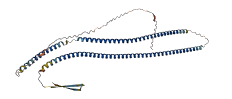
Descriptions
The autoinhibited protein was predicted that may have potential autoinhibitory elements via cis-regPred.
Autoinhibitory domains (AIDs)
Target domain |
|
Relief mechanism |
|
Assay |
cis-regPred |
Accessory elements
No accessory elements
Autoinhibited structure

Activated structure
1 structures for Q9QWL7
| Entry ID | Method | Resolution | Chain | Position | Source |
|---|---|---|---|---|---|
| AF-Q9QWL7-F1 | Predicted | AlphaFoldDB |
18 variants for Q9QWL7
| Variant ID(s) | Position | Change | Description | Diseaes Association | Provenance |
|---|---|---|---|---|---|
| rs3389201740 | 41 | R>M | No | EVA | |
| rs3389176425 | 67 | S>I | No | EVA | |
| rs3389212547 | 85 | K>N | No | EVA | |
| rs3389200742 | 100 | D>Y | No | EVA | |
| rs3389197930 | 107 | E>D | No | EVA | |
| rs3389201728 | 107 | E>G | No | EVA | |
| rs3389204296 | 125 | P>T | No | EVA | |
| rs3389200214 | 149 | T>I | No | EVA | |
| rs3389210512 | 170 | R>H | No | EVA | |
| rs3389163822 | 180 | R>L* | No | EVA | |
| rs3389210504 | 181 | M>L | No | EVA | |
| rs3389210517 | 182 | S>* | No | EVA | |
| rs3389212622 | 186 | D>A | No | EVA | |
| rs3389172358 | 193 | V>M | No | EVA | |
| rs3389205485 | 196 | E>G | No | EVA | |
| rs3389212597 | 350 | E>K | No | EVA | |
| rs3389215239 | 371 | L>M | No | EVA | |
| rs3389197932 | 429 | H>P | No | EVA |
No associated diseases with Q9QWL7
6 GO annotations of cellular component
| Name | Definition |
|---|---|
| cell periphery | The part of a cell encompassing the cell cortex, the plasma membrane, and any external encapsulating structures. |
| cornified envelope | A type of plasma membrane that has been modified through addition of distinct intracellular and extracellular components, including ceramide, found in cornifying epithelial cells (corneocytes). |
| cytoplasm | The contents of a cell excluding the plasma membrane and nucleus, but including other subcellular structures. |
| cytoskeleton | A cellular structure that forms the internal framework of eukaryotic and prokaryotic cells. The cytoskeleton includes intermediate filaments, microfilaments, microtubules, the microtrabecular lattice, and other structures characterized by a polymeric filamentous nature and long-range order within the cell. The various elements of the cytoskeleton not only serve in the maintenance of cellular shape but also have roles in other cellular functions, including cellular movement, cell division, endocytosis, and movement of organelles. |
| intermediate filament cytoskeleton | Cytoskeletal structure made from intermediate filaments, typically organized in the cytosol as an extended system that stretches from the nuclear envelope to the plasma membrane. Some intermediate filaments run parallel to the cell surface, while others traverse the cytosol; together they form an internal framework that helps support the shape and resilience of the cell. |
| keratin filament | A filament composed of acidic and basic keratins (types I and II), typically expressed in epithelial cells. The keratins are the most diverse classes of IF proteins, with a large number of keratin isoforms being expressed. Each type of epithelium always expresses a characteristic combination of type I and type II keratins. |
1 GO annotations of molecular function
| Name | Definition |
|---|---|
| structural molecule activity | The action of a molecule that contributes to the structural integrity of a complex or its assembly within or outside a cell. |
8 GO annotations of biological process
| Name | Definition |
|---|---|
| epithelial cell differentiation | The process in which a relatively unspecialized cell acquires specialized features of an epithelial cell, any of the cells making up an epithelium. |
| hair follicle morphogenesis | The process in which the anatomical structures of the hair follicle are generated and organized. |
| intermediate filament organization | Control of the spatial distribution of intermediate filaments; includes organizing filaments into meshworks, bundles, or other structures, as by cross-linking. |
| keratinization | The process in which the cytoplasm of the outermost cells of the vertebrate epidermis is replaced by keratin. Keratinization occurs in the stratum corneum, feathers, hair, claws, nails, hooves, and horns. |
| morphogenesis of an epithelium | The process in which the anatomical structures of epithelia are generated and organized. An epithelium consists of closely packed cells arranged in one or more layers, that covers the outer surfaces of the body or lines any internal cavity or tube. |
| positive regulation of cell growth | Any process that activates or increases the frequency, rate, extent or direction of cell growth. |
| positive regulation of hair follicle development | Any process that activates or increases the frequency, rate or extent of hair follicle development. |
| positive regulation of translation | Any process that activates or increases the frequency, rate or extent of the chemical reactions and pathways resulting in the formation of proteins by the translation of mRNA or circRNA. |
5 homologous proteins in AiPD
| UniProt AC | Gene Name | Protein Name | Species | Evidence Code |
|---|---|---|---|---|
| P19012 | KRT15 | Keratin, type I cytoskeletal 15 | Homo sapiens (Human) | PR |
| Q04695 | KRT17 | Keratin, type I cytoskeletal 17 | Homo sapiens (Human) | PR |
| Q61781 | Krt14 | Keratin, type I cytoskeletal 14 | Mus musculus (Mouse) | PR |
| P19001 | Krt19 | Keratin, type I cytoskeletal 19 | Mus musculus (Mouse) | PR |
| Q9D312 | Krt20 | Keratin, type I cytoskeletal 20 | Mus musculus (Mouse) | PR |
| 10 | 20 | 30 | 40 | 50 | 60 |
| MTTTIRQFTS | SSSIKGSSGL | GGGSSRTSCR | LSGSLGAGSC | RLGSASGLGS | ALGSNSYSSC |
| 70 | 80 | 90 | 100 | 110 | 120 |
| YSFGTGSGYG | GNFGGVDGLL | AGGEKATMQN | LNDRLASYLD | KVRALEEANT | ELEVKIRDWY |
| 130 | 140 | 150 | 160 | 170 | 180 |
| QKQAPGPARD | YSAYYHTIED | LKNKILVATV | DNASILLQID | NARLAADDFR | TKFETEQALR |
| 190 | 200 | 210 | 220 | 230 | 240 |
| MSVEADINGL | RRVLDELTLA | RADLEMQIEN | LKEELAYLKK | NHEEEMNALR | GQVGGEINVE |
| 250 | 260 | 270 | 280 | 290 | 300 |
| MDAAPGVDLS | RILSEMRDQY | EKMAEKNRKD | AEDWFFSKTE | ELNREVATNS | ELVQSGKSEI |
| 310 | 320 | 330 | 340 | 350 | 360 |
| SELRRTMQAL | EIELQSQLSM | KASLEGSLAE | TENRYCVQLS | QIQGLIGSVE | EQLAQLRCEM |
| 370 | 380 | 390 | 400 | 410 | 420 |
| EQQNQEYKIL | LDVKTRLEQE | IATYRRLLEG | EDAHLTQYKP | KEPVTTRQVR | TIVEEVQDGK |
| 430 | |||||
| VISSREQVHQ | TTR |