Q9D312
Gene name |
Krt20 |
Protein name |
Keratin, type I cytoskeletal 20 |
Names |
Cytokeratin-20, CK-20, Keratin-20, K20 |
Species |
Mus musculus (Mouse) |
KEGG Pathway |
mmu:66809 |
EC number |
|
Protein Class |
|
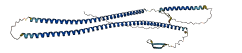
Descriptions
The autoinhibited protein was predicted that may have potential autoinhibitory elements via cis-regPred.
Autoinhibitory domains (AIDs)
Target domain |
|
Relief mechanism |
|
Assay |
cis-regPred |
Accessory elements
No accessory elements
Autoinhibited structure

Activated structure
1 structures for Q9D312
| Entry ID | Method | Resolution | Chain | Position | Source |
|---|---|---|---|---|---|
| AF-Q9D312-F1 | Predicted | AlphaFoldDB |
23 variants for Q9D312
| Variant ID(s) | Position | Change | Description | Diseaes Association | Provenance |
|---|---|---|---|---|---|
| rs3402291438 | 6 | Q>E | No | EVA | |
| rs3389197651 | 11 | S>N | No | EVA | |
| rs13481189 | 24 | S>N | No | EVA | |
| rs1135346617 | 28 | Y>C | No | EVA | |
| rs3389201812 | 31 | G>E | No | EVA | |
| rs3389136415 | 35 | R>E* | No | EVA | |
| rs3389201738 | 86 | D>Y | No | EVA | |
| rs226307514 | 121 | I>V | No | EVA | |
| rs3389201776 | 133 | E>G | No | EVA | |
| rs47126635 | 151 | R>Q | No | EVA | |
| rs250476481 | 160 | E>D | No | EVA | |
| rs29385411 | 173 | R>H | No | EVA | |
| rs3389199106 | 211 | L>V | No | EVA | |
| rs237792576 | 221 | V>A | No | EVA | |
| rs248977819 | 252 | R>K | No | EVA | |
| rs3389170200 | 259 | K>R | No | EVA | |
| rs3389188758 | 285 | E>K | No | EVA | |
| rs229895088 | 319 | R>H | No | EVA | |
| rs3389174959 | 329 | A>V | No | EVA | |
| rs3389174961 | 333 | A>T | No | EVA | |
| rs3389188755 | 385 | D>H | No | EVA | |
| rs1132884221 | 391 | Y>C | No | EVA | |
| rs3389211520 | 425 | K>* | No | EVA |
No associated diseases with Q9D312
4 GO annotations of cellular component
| Name | Definition |
|---|---|
| cytoplasm | The contents of a cell excluding the plasma membrane and nucleus, but including other subcellular structures. |
| cytoskeleton | A cellular structure that forms the internal framework of eukaryotic and prokaryotic cells. The cytoskeleton includes intermediate filaments, microfilaments, microtubules, the microtrabecular lattice, and other structures characterized by a polymeric filamentous nature and long-range order within the cell. The various elements of the cytoskeleton not only serve in the maintenance of cellular shape but also have roles in other cellular functions, including cellular movement, cell division, endocytosis, and movement of organelles. |
| cytosol | The part of the cytoplasm that does not contain organelles but which does contain other particulate matter, such as protein complexes. |
| intermediate filament | A cytoskeletal structure that forms a distinct elongated structure, characteristically 10 nm in diameter, that occurs in the cytoplasm of eukaryotic cells. Intermediate filaments form a fibrous system, composed of chemically heterogeneous subunits and involved in mechanically integrating the various components of the cytoplasmic space. Intermediate filaments may be divided into five chemically distinct classes: Type I, acidic keratins; Type II, basic keratins; Type III, including desmin, vimentin and others; Type IV, neurofilaments and related filaments; and Type V, lamins. |
1 GO annotations of molecular function
| Name | Definition |
|---|---|
| structural molecule activity | The action of a molecule that contributes to the structural integrity of a complex or its assembly within or outside a cell. |
5 GO annotations of biological process
| Name | Definition |
|---|---|
| apoptotic process | A programmed cell death process which begins when a cell receives an internal (e.g. DNA damage) or external signal (e.g. an extracellular death ligand), and proceeds through a series of biochemical events (signaling pathway phase) which trigger an execution phase. The execution phase is the last step of an apoptotic process, and is typically characterized by rounding-up of the cell, retraction of pseudopodes, reduction of cellular volume (pyknosis), chromatin condensation, nuclear fragmentation (karyorrhexis), plasma membrane blebbing and fragmentation of the cell into apoptotic bodies. When the execution phase is completed, the cell has died. |
| cellular response to starvation | Any process that results in a change in state or activity of a cell (in terms of movement, secretion, enzyme production, gene expression, etc.) as a result of deprivation of nourishment. |
| epithelial cell differentiation | The process in which a relatively unspecialized cell acquires specialized features of an epithelial cell, any of the cells making up an epithelium. |
| intermediate filament organization | Control of the spatial distribution of intermediate filaments; includes organizing filaments into meshworks, bundles, or other structures, as by cross-linking. |
| regulation of protein secretion | Any process that modulates the frequency, rate or extent of the controlled release of a protein from a cell. |
| 10 | 20 | 30 | 40 | 50 | 60 |
| MDFSRQSFHR | SLSSSSQGPA | LSMSGSLYRK | GTVQRLGAAP | SVYGGAGGHG | TRISVSKAVM |
| 70 | 80 | 90 | 100 | 110 | 120 |
| SYGGDLSNGS | DLFGGNGKLA | MQNLNDRLAN | YLEKVRSLEQ | SNSRLEAQIK | QWYETNAPST |
| 130 | 140 | 150 | 160 | 170 | 180 |
| IRDYSSYYAQ | IKELQNQVKD | AQVQNAQCVL | RIDNAKLAAE | DFRLKFETER | GMRIAVEADL |
| 190 | 200 | 210 | 220 | 230 | 240 |
| QGLSKVYDNL | TLQKTDLEIQ | IEELNKDLAL | LKKEHQEEVE | VLRRQLGNNV | NVEVDAAPGL |
| 250 | 260 | 270 | 280 | 290 | 300 |
| NLGEIMNEMR | QRYEVLAQKN | LQEAKEQFER | QSQTLQQQVT | VNTEELKGFE | VQVTELRRTY |
| 310 | 320 | 330 | 340 | 350 | 360 |
| QNLEIELQSH | LSMKESLERN | LEDVKARYAS | QLAAIQEMLS | SLEAQLMQIR | SDTERQNQEH |
| 370 | 380 | 390 | 400 | 410 | 420 |
| NILLDIKTRL | EQEIATYRRL | LEGEDIKTTE | YQLSTLEMKD | IKKTRKIKTV | VEEVVDGKVV |
| 430 | |||||
| SSEVKEIEES | V |