Q9M884
Gene name |
PMI1 (MEE31, At3g02570, F16B3.20) |
Protein name |
Mannose-6-phosphate isomerase 1 |
Names |
Phosphohexomutase 1, Phosphomannose isomerase 1, PMI1, Protein MATERNAL EFFECT EMBRYO ARREST 31 |
Species |
Arabidopsis thaliana (Mouse-ear cress) |
KEGG Pathway |
ath:AT3G02570 |
EC number |
5.3.1.8: Interconverting aldoses and ketoses |
Protein Class |
|
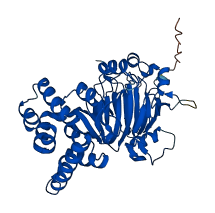
Descriptions
The autoinhibited protein was predicted that may have potential autoinhibitory elements via cis-regPred.
Autoinhibitory domains (AIDs)
Target domain |
|
Relief mechanism |
|
Assay |
cis-regPred |
Accessory elements
No accessory elements
Autoinhibited structure

Activated structure
1 structures for Q9M884
| Entry ID | Method | Resolution | Chain | Position | Source |
|---|---|---|---|---|---|
| AF-Q9M884-F1 | Predicted | AlphaFoldDB |
13 variants for Q9M884
| Variant ID(s) | Position | Change | Description | Diseaes Association | Provenance |
|---|---|---|---|---|---|
| tmp_3_544963_A_G | 131 | L>S | No | 1000Genomes | |
| ENSVATH02105606 | 134 | K>R | No | 1000Genomes | |
| ENSVATH05758361 | 172 | K>Q | No | 1000Genomes | |
| tmp_3_544404_G_A | 177 | A>V | No | 1000Genomes | |
| tmp_3_544370_T_G | 188 | E>D | No | 1000Genomes | |
| tmp_3_544363_T_C | 191 | N>D | No | 1000Genomes | |
| ENSVATH00302527 | 220 | A>P | No | 1000Genomes | |
| ENSVATH00302527 | 220 | A>T | No | 1000Genomes | |
| tmp_3_543994_C_T | 283 | G>D | No | 1000Genomes | |
| tmp_3_543668_G_A | 365 | S>L | No | 1000Genomes | |
| tmp_3_543545_T_A | 406 | D>V | No | 1000Genomes | |
| tmp_3_543471_G_A | 431 | P>S | No | 1000Genomes | |
| ENSVATH00302520 | 432 | L>Q | No | 1000Genomes |
No associated diseases with Q9M884
4 regional properties for Q9M884
| Type | Name | Position | InterPro Accession |
|---|---|---|---|
| conserved_site | Phosphomannose isomerase, type I, conserved site | 143 - 151 | IPR018050 |
| domain | Phosphomannose isomerase type I, C-terminal domain | 346 - 384 | IPR046456 |
| domain | Phosphomannose isomerase type I, catalytic domain | 21 - 167 | IPR046457 |
| domain | Phosphomannose isomerase type I, helical insertion domain | 197 - 268 | IPR046458 |
Functions
| Description | ||
|---|---|---|
| EC Number | 5.3.1.8 | Interconverting aldoses and ketoses |
| Subcellular Localization |
|
|
| PANTHER Family | ||
| PANTHER Subfamily | ||
| PANTHER Protein Class | ||
| PANTHER Pathway Category | No pathway information available | |
1 GO annotations of cellular component
| Name | Definition |
|---|---|
| cytosol | The part of the cytoplasm that does not contain organelles but which does contain other particulate matter, such as protein complexes. |
2 GO annotations of molecular function
| Name | Definition |
|---|---|
| mannose-6-phosphate isomerase activity | Catalysis of the reaction: D-mannose 6-phosphate = D-fructose 6-phosphate. |
| zinc ion binding | Binding to a zinc ion (Zn). |
8 GO annotations of biological process
| Name | Definition |
|---|---|
| carbohydrate metabolic process | The chemical reactions and pathways involving carbohydrates, any of a group of organic compounds based of the general formula Cx(H2O)y. |
| embryo development ending in seed dormancy | The process whose specific outcome is the progression of the embryo over time, from zygote formation to the end of seed dormancy. An example of this process is found in Arabidopsis thaliana. |
| GDP-mannose biosynthetic process | The chemical reactions and pathways resulting in the formation of GDP-mannose, a substance composed of mannose in glycosidic linkage with guanosine diphosphate. |
| response to cadmium ion | Any process that results in a change in state or activity of a cell or an organism (in terms of movement, secretion, enzyme production, gene expression, etc.) as a result of a cadmium (Cd) ion stimulus. |
| response to cobalt ion | Any process that results in a change in state or activity of a cell or an organism (in terms of movement, secretion, enzyme production, gene expression, etc.) as a result of a cobalt ion stimulus. |
| response to L-ascorbic acid | Any process that results in a change in state or activity of a cell or an organism (in terms of movement, secretion, enzyme production, gene expression, etc.) as a result of an L-ascorbic acid (vitamin C) stimulus. |
| response to light stimulus | Any process that results in a change in state or activity of a cell or an organism (in terms of movement, secretion, enzyme production, gene expression, etc.) as a result of a light stimulus, electromagnetic radiation of wavelengths classified as infrared, visible or ultraviolet light. |
| response to zinc ion | Any process that results in a change in state or activity of a cell or an organism (in terms of movement, secretion, enzyme production, gene expression, etc.) as a result of a zinc ion stimulus. |
4 homologous proteins in AiPD
| UniProt AC | Gene Name | Protein Name | Species | Evidence Code |
|---|---|---|---|---|
| P29952 | PMI40 | Mannose-6-phosphate isomerase | Saccharomyces cerevisiae (strain ATCC 204508 / S288c) (Baker's yeast) | PR |
| Q3SZI0 | MPI | Mannose-6-phosphate isomerase | Bos taurus (Bovine) | PR |
| A5A6K3 | MPI | Mannose-6-phosphate isomerase | Pan troglodytes (Chimpanzee) | PR |
| P34949 | MPI | Mannose-6-phosphate isomerase | Homo sapiens (Human) | PR |
| 10 | 20 | 30 | 40 | 50 | 60 |
| MEIATVVKAN | GGCEADRRRL | RRLRCSVKDY | DWGKIGSDSL | VYRVYAANSD | YEIDPTRPYA |
| 70 | 80 | 90 | 100 | 110 | 120 |
| ELWMGTHESG | PSYLEDADGS | NGVTLRSWIT | ENPKSLGNRV | LEKWGCDLPF | LFKVLSVARP |
| 130 | 140 | 150 | 160 | 170 | 180 |
| LSIQAHPDKK | LAKKMHKAHP | NLYKDDNHKP | EMALAYTQFE | ALCGFIPLQE | LKSVIRAIPE |
| 190 | 200 | 210 | 220 | 230 | 240 |
| IEELVGSEEA | NQVFCITEHD | EEKVKSVVRT | IFTLLMSADA | DTTKKIVSKL | KRRLHMESQE |
| 250 | 260 | 270 | 280 | 290 | 300 |
| RQLTDKERLV | LKLEKQYPND | IGVISAFFFN | YVKLNPGEAL | YLGANEPHAY | LFGECLEVMA |
| 310 | 320 | 330 | 340 | 350 | 360 |
| TSDNVVRAGL | TSKPLDIQTL | CSMLSYKLGY | PEILKGTRIR | PYITRYLPPF | EEFEVDLCDL |
| 370 | 380 | 390 | 400 | 410 | 420 |
| PSGASTVFPS | VPGPSLLLVL | QGEGRMSTEA | SADGISMGDV | LFVPADTEIH | LRSSSDLKLY |
| 430 | |||||
| RAGINSRFLF | PL |