Q9JHG2
Gene name |
Rcan2 (Dscr1l1, Zaki4) |
Protein name |
Calcipressin-2 |
Names |
Calcineurin inhibitory protein ZAKI-4, Down syndrome candidate region 1-like protein 1, Myocyte-enriched calcineurin-interacting protein 2, MCIP2, Regulator of calcineurin 2 |
Species |
Mus musculus (Mouse) |
KEGG Pathway |
mmu:53901 |
EC number |
|
Protein Class |
|
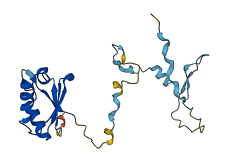
Descriptions
The autoinhibited protein was predicted that may have potential autoinhibitory elements via cis-regPred.
Autoinhibitory domains (AIDs)
Target domain |
|
Relief mechanism |
|
Assay |
cis-regPred |
Accessory elements
No accessory elements
Autoinhibited structure

Activated structure
1 structures for Q9JHG2
| Entry ID | Method | Resolution | Chain | Position | Source |
|---|---|---|---|---|---|
| AF-Q9JHG2-F1 | Predicted | AlphaFoldDB |
11 variants for Q9JHG2
| Variant ID(s) | Position | Change | Description | Diseaes Association | Provenance |
|---|---|---|---|---|---|
| rs46245276 | 12 | T>S | No | EVA | |
| rs3407716925 | 20 | V>L | No | EVA | |
| rs3389424304 | 24 | T>I | No | EVA | |
| rs3389464872 | 36 | F>S | No | EVA | |
| rs3389413188 | 92 | E>D | No | EVA | |
| rs3389468831 | 129 | P>L | No | EVA | |
| rs3389473165 | 133 | Y>H | No | EVA | |
| rs3389433888 | 134 | D>H | No | EVA | |
| rs1133972229 | 167 | S>N | No | EVA | |
| rs3389459874 | 167 | S>R | No | EVA | |
| rs3389473147 | 179 | P>Q | No | EVA |
No associated diseases with Q9JHG2
4 regional properties for Q9JHG2
| Type | Name | Position | InterPro Accession |
|---|---|---|---|
| domain | Signal transduction response regulator, receiver domain | 4 - 121 | IPR001789 |
| domain | RNA polymerase sigma factor 54 interaction domain | 143 - 369 | IPR002078 |
| domain | DNA binding HTH domain, Fis-type | 415 - 453 | IPR002197 |
| conserved_site | Sigma-54 interaction domain, conserved site | 353 - 362 | IPR025944 |
2 GO annotations of cellular component
| Name | Definition |
|---|---|
| cytoplasm | The contents of a cell excluding the plasma membrane and nucleus, but including other subcellular structures. |
| nucleus | A membrane-bounded organelle of eukaryotic cells in which chromosomes are housed and replicated. In most cells, the nucleus contains all of the cell's chromosomes except the organellar chromosomes, and is the site of RNA synthesis and processing. In some species, or in specialized cell types, RNA metabolism or DNA replication may be absent. |
2 GO annotations of molecular function
| Name | Definition |
|---|---|
| calcium-dependent protein serine/threonine phosphatase regulator activity | Binds to and modulates of the activity of the enzyme calcium-dependent protein serine/threonine phosphatase. |
| nucleic acid binding | Binding to a nucleic acid. |
6 GO annotations of biological process
| Name | Definition |
|---|---|
| calcineurin-NFAT signaling cascade | Any intracellular signal transduction in which the signal is passed on within the cell by activation of a member of the NFAT protein family as a consequence of NFAT dephosphorylation by Ca(2+)-activated calcineurin. The cascade begins with calcium-dependent activation of the phosphatase calcineurin. Calcineurin dephosphorylates multiple phosphoserine residues on NFAT, resulting in the translocation of NFAT to the nucleus. The cascade ends with regulation of transcription by NFAT. The calcineurin-NFAT cascade lies downstream of many cell surface receptors, including G protein-coupled receptors (GPCRs) and receptor tyrosine kinases (RTKs) that signal to mobilize calcium ions (Ca2+). |
| calcium-mediated signaling | Any intracellular signal transduction in which the signal is passed on within the cell via calcium ions. |
| locomotion involved in locomotory behavior | Self-propelled movement of a cell or organism from one location to another in a behavioral context; the aspect of locomotory behavior having to do with movement. |
| Notch signaling pathway | The series of molecular signals initiated by an extracellular ligand binding to the receptor Notch on the surface of a target cell, and ending with the regulation of a downstream cellular process, e.g. transcription. |
| response to oxidative stress | Any process that results in a change in state or activity of a cell or an organism (in terms of movement, secretion, enzyme production, gene expression, etc.) as a result of oxidative stress, a state often resulting from exposure to high levels of reactive oxygen species, e.g. superoxide anions, hydrogen peroxide (H2O2), and hydroxyl radicals. |
| short-term memory | The memory process that deals with the storage, retrieval and modification of information received a short time (up to about 30 minutes) ago. This type of memory is typically dependent on direct, transient effects of second messenger activation. |
9 homologous proteins in AiPD
| UniProt AC | Gene Name | Protein Name | Species | Evidence Code |
|---|---|---|---|---|
| P36054 | RCN1 | Calcipressin-like protein | Saccharomyces cerevisiae (strain ATCC 204508 / S288c) (Baker's yeast) | PR |
| Q2KIA1 | RCAN3 | Calcipressin-3 | Bos taurus (Bovine) | PR |
| Q3ZC15 | RCAN2 | Calcipressin-2 | Bos taurus (Bovine) | PR |
| Q5ZJV6 | RCAN3 | Calcipressin-3 | Gallus gallus (Chicken) | PR |
| A5A6I8 | RCAN2 | Calcipressin-2 | Pan troglodytes (Chimpanzee) | PR |
| Q9UKA8 | RCAN3 | Calcipressin-3 | Homo sapiens (Human) | PR |
| Q14206 | RCAN2 | Calcipressin-2 | Homo sapiens (Human) | PR |
| Q9JKK0 | Rcan3 | Calcipressin-3 | Mus musculus (Mouse) | PR |
| Q8CH27 | Rcan2 | Calcipressin-2 | Rattus norvegicus (Rat) | PR |
| 10 | 20 | 30 | 40 | 50 | 60 |
| MPAPSMDCDV | STLVACVVDV | EVFTNQEVKE | KFEGLFRTYD | ECVTFQLFKS | FRRVRINFSH |
| 70 | 80 | 90 | 100 | 110 | 120 |
| PKSAARARIE | LHETQFRGKK | LKLYFAQVQT | PETDGDKLHL | APPQPAKQFL | ISPPSSPPVG |
| 130 | 140 | 150 | 160 | 170 | 180 |
| WKPISDATPV | LNYDLLYAVA | KLGPGEKYEL | HAGTESTPSV | VVHVCDSDME | EEEDPKTSPK |
| 190 | |||||
| PKIIQTRRPG | LPPSVSN |