Q9IAK4
Gene name |
OLFM1 (NOEL, NOEL1) |
Protein name |
Noelin |
Names |
Neuronal olfactomedin-related ER localized protein, Olfactomedin-1, Pancortin |
Species |
Gallus gallus (Chicken) |
KEGG Pathway |
gga:395535 |
EC number |
|
Protein Class |
|
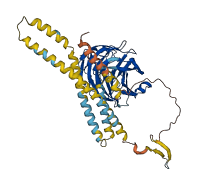
Descriptions
The autoinhibited protein was predicted that may have potential autoinhibitory elements via cis-regPred.
Autoinhibitory domains (AIDs)
Target domain |
|
Relief mechanism |
|
Assay |
cis-regPred |
Accessory elements
No accessory elements
Autoinhibited structure

Activated structure
1 structures for Q9IAK4
| Entry ID | Method | Resolution | Chain | Position | Source |
|---|---|---|---|---|---|
| AF-Q9IAK4-F1 | Predicted | AlphaFoldDB |
15 variants for Q9IAK4
| Variant ID(s) | Position | Change | Description | Diseaes Association | Provenance |
|---|---|---|---|---|---|
| rs736303757 | 121 | Y>D | No | Ensembl | |
| rs736995751 | 122 | V>G | No | Ensembl | |
| rs733525184 | 123 | E>G | No | Ensembl | |
| rs735547753 | 129 | M>R | No | Ensembl | |
| rs732624103 | 237 | I>L | No | Ensembl | |
| rs733951366 | 250 | M>R | No | Ensembl | |
| rs741436087 | 251 | T>A | No | Ensembl | |
| rs738749539 | 316 | Q>K | No | Ensembl | |
| rs735291072 | 355 | I>T | No | Ensembl | |
| rs732507167 | 387 | L>P | No | Ensembl | |
| rs735883709 | 395 | T>P | No | Ensembl | |
| rs736547556 | 399 | K>T | No | Ensembl | |
| rs733082652 | 408 | I>T | No | Ensembl | |
| rs733722138 | 422 | T>P | No | Ensembl | |
| rs741201762 | 426 | Y>S | No | Ensembl |
No associated diseases with Q9IAK4
No regional properties for Q9IAK4
| Type | Name | Position | InterPro Accession |
|---|---|---|---|
| No domain, repeats, and functional sites for Q9IAK4 | |||
8 GO annotations of cellular component
| Name | Definition |
|---|---|
| anchoring junction | A cell junction that mechanically attaches a cell (and its cytoskeleton) to neighboring cells or to the extracellular matrix. |
| axon | The long process of a neuron that conducts nerve impulses, usually away from the cell body to the terminals and varicosities, which are sites of storage and release of neurotransmitter. |
| axonal growth cone | The migrating motile tip of a growing nerve cell axon. |
| endoplasmic reticulum | The irregular network of unit membranes, visible only by electron microscopy, that occurs in the cytoplasm of many eukaryotic cells. The membranes form a complex meshwork of tubular channels, which are often expanded into slitlike cavities called cisternae. The ER takes two forms, rough (or granular), with ribosomes adhering to the outer surface, and smooth (with no ribosomes attached). |
| extracellular space | That part of a multicellular organism outside the cells proper, usually taken to be outside the plasma membranes, and occupied by fluid. |
| neuronal cell body | The portion of a neuron that includes the nucleus, but excludes cell projections such as axons and dendrites. |
| perikaryon | The portion of the cell soma (neuronal cell body) that excludes the nucleus. |
| synapse | The junction between an axon of one neuron and a dendrite of another neuron, a muscle fiber or a glial cell. As the axon approaches the synapse it enlarges into a specialized structure, the presynaptic terminal bouton, which contains mitochondria and synaptic vesicles. At the tip of the terminal bouton is the presynaptic membrane; facing it, and separated from it by a minute cleft (the synaptic cleft) is a specialized area of membrane on the receiving cell, known as the postsynaptic membrane. In response to the arrival of nerve impulses, the presynaptic terminal bouton secretes molecules of neurotransmitters into the synaptic cleft. These diffuse across the cleft and transmit the signal to the postsynaptic membrane. |
No GO annotations of molecular function
| Name | Definition |
|---|---|
| No GO annotations for molecular function |
10 GO annotations of biological process
| Name | Definition |
|---|---|
| atrioventricular valve formation | The developmental process pertaining to the initial formation of the atrioventricular valve from unspecified parts. This process begins with the specific processes that contribute to the appearance of the discrete structure and ends when the structural rudiment is recognizable. |
| cardiac epithelial to mesenchymal transition | A transition where a cardiac epithelial cell loses apical/basolateral polarity, severs intercellular adhesive junctions, degrades basement membrane components and becomes a migratory mesenchymal cell. |
| negative regulation of gene expression | Any process that decreases the frequency, rate or extent of gene expression. Gene expression is the process in which a gene's coding sequence is converted into a mature gene product (protein or RNA). |
| nervous system development | The process whose specific outcome is the progression of nervous tissue over time, from its formation to its mature state. |
| neuronal signal transduction | The process in which an activated neuronal cell receptor conveys information down a signaling pathway, resulting in a change in the function or state of a cell. This process may be intracellular or intercellular. |
| positive regulation of apoptotic process | Any process that activates or increases the frequency, rate or extent of cell death by apoptotic process. |
| positive regulation of epithelial to mesenchymal transition | Any process that increases the rate, frequency, or extent of epithelial to mesenchymal transition. Epithelial to mesenchymal transition is where an epithelial cell loses apical/basolateral polarity, severs intercellular adhesive junctions, degrades basement membrane components and becomes a migratory mesenchymal cell. |
| positive regulation of gene expression | Any process that increases the frequency, rate or extent of gene expression. Gene expression is the process in which a gene's coding sequence is converted into a mature gene product (protein or RNA). |
| regulation of axon extension | Any process that modulates the rate, direction or extent of axon extension. |
| signal transduction | The cellular process in which a signal is conveyed to trigger a change in the activity or state of a cell. Signal transduction begins with reception of a signal (e.g. a ligand binding to a receptor or receptor activation by a stimulus such as light), or for signal transduction in the absence of ligand, signal-withdrawal or the activity of a constitutively active receptor. Signal transduction ends with regulation of a downstream cellular process, e.g. regulation of transcription or regulation of a metabolic process. Signal transduction covers signaling from receptors located on the surface of the cell and signaling via molecules located within the cell. For signaling between cells, signal transduction is restricted to events at and within the receiving cell. |
8 homologous proteins in AiPD
| UniProt AC | Gene Name | Protein Name | Species | Evidence Code |
|---|---|---|---|---|
| Q594P2 | MYOC | Myocilin | Felis catus (Cat) (Felis silvestris catus) | PR |
| Q25C36 | OLFML3 | Olfactomedin-like protein 3 | Gallus gallus (Chicken) | PR |
| Q99972 | MYOC | Myocilin | Homo sapiens (Human) | PR |
| Q99784 | OLFM1 | Noelin | Homo sapiens (Human) | PR |
| Q80TR1 | Adgrl1 | Adhesion G protein-coupled receptor L1 | Mus musculus (Mouse) | PR |
| O88998 | Olfm1 | Noelin | Mus musculus (Mouse) | PR |
| Q62609 | Olfm1 | Noelin | Rattus norvegicus (Rat) | PR |
| A4IIT5 | olfml2a | Olfactomedin-like protein 2A | Xenopus tropicalis (Western clawed frog) (Silurana tropicalis) | PR |
| 10 | 20 | 30 | 40 | 50 | 60 |
| MSVPLLKIGV | VLSTMAMITN | WMSQTLPSLV | GLNTTKLTAA | SGGTLDRSTG | VLPTNPEESW |
| 70 | 80 | 90 | 100 | 110 | 120 |
| QVYSSAQDSE | GRCICTVVAP | QQTMCSRDAR | TKQLRQLLEK | VQNMSQSIEV | LDRRTQRDLQ |
| 130 | 140 | 150 | 160 | 170 | 180 |
| YVEKMENQMR | GLESKFKQVE | ESHKQHLARQ | FKAIKAKMEE | LRPLIPVLEE | YKADAKLVLQ |
| 190 | 200 | 210 | 220 | 230 | 240 |
| FKEEVQNLTS | VLNELQEEIG | AYDYEELQNR | VSNLEERLRA | CMQKLACGKL | TGISDPITIK |
| 250 | 260 | 270 | 280 | 290 | 300 |
| TSGSRFGSWM | TDPLAPEGEN | KVWYMDSYHN | NRFVREYKSM | ADFMNTDNFT | SHRLPHPWSG |
| 310 | 320 | 330 | 340 | 350 | 360 |
| TGQVVYNGSI | YFNKYQSHII | IRFDLKTETI | LKTRSLDYAG | YNNMYHYAWG | GHSDIDLMVD |
| 370 | 380 | 390 | 400 | 410 | 420 |
| ENGLWAVYAT | NQNAGNIVIS | KLDPNTLQSL | QTWNTSYPKR | SAGEAFIICG | TLYVTNGYSG |
| 430 | 440 | 450 | 460 | 470 | 480 |
| GTKVHYAYQT | NASTYEYIDI | PFQNKYSHIS | MLDYNPKDRA | LYAWNNGHQI | LYNVTLFHVI |
| RSDEL |