Q9EQH4
Gene name |
Taf8 (Tbn) |
Protein name |
Transcription initiation factor TFIID subunit 8 |
Names |
Protein taube nuss, TBP-associated factor 8 |
Species |
Mus musculus (Mouse) |
KEGG Pathway |
mmu:63856 |
EC number |
|
Protein Class |
|
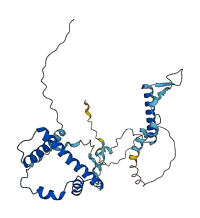
Descriptions
The autoinhibited protein was predicted that may have potential autoinhibitory elements via cis-regPred.
Autoinhibitory domains (AIDs)
Target domain |
|
Relief mechanism |
|
Assay |
cis-regPred |
Accessory elements
No accessory elements
Autoinhibited structure

Activated structure
1 structures for Q9EQH4
| Entry ID | Method | Resolution | Chain | Position | Source |
|---|---|---|---|---|---|
| AF-Q9EQH4-F1 | Predicted | AlphaFoldDB |
10 variants for Q9EQH4
| Variant ID(s) | Position | Change | Description | Diseaes Association | Provenance |
|---|---|---|---|---|---|
| rs3389437262 | 21 | T>I | No | EVA | |
| rs3389476461 | 24 | A>V | No | EVA | |
| rs3389427104 | 36 | Q>H | No | EVA | |
| rs3389381519 | 66 | Y>H | No | EVA | |
| rs3389427096 | 106 | P>A | No | EVA | |
| rs3389470123 | 130 | K>M | No | EVA | |
| rs3407119387 | 161 | P>KLTGVLM* | No | EVA | |
| rs33817005 | 267 | S>N | No | EVA | |
| rs212855655 | 274 | S>N | No | EVA | |
| rs3389460585 | 294 | R>Q | No | EVA |
1 associated diseases with Q9EQH4
[MIM: 618254]: Ciliary dyskinesia, primary, 39 (CILD39)
A form of primary ciliary dyskinesia, a disorder characterized by abnormalities of motile cilia. Respiratory infections leading to chronic inflammation and bronchiectasis are recurrent, due to defects in the respiratory cilia. Some patients exhibit randomization of left-right body asymmetry and situs inversus. Primary ciliary dyskinesia associated with situs inversus is referred to as Kartagener syndrome. CILD39 inheritance is autosomal recessive. {ECO:0000269|PubMed:30388400}. Note=The disease is caused by variants affecting the gene represented in this entry.
Without disease ID
- A form of primary ciliary dyskinesia, a disorder characterized by abnormalities of motile cilia. Respiratory infections leading to chronic inflammation and bronchiectasis are recurrent, due to defects in the respiratory cilia. Some patients exhibit randomization of left-right body asymmetry and situs inversus. Primary ciliary dyskinesia associated with situs inversus is referred to as Kartagener syndrome. CILD39 inheritance is autosomal recessive. {ECO:0000269|PubMed:30388400}. Note=The disease is caused by variants affecting the gene represented in this entry.
Functions
4 GO annotations of cellular component
| Name | Definition |
|---|---|
| nucleoplasm | That part of the nuclear content other than the chromosomes or the nucleolus. |
| nucleus | A membrane-bounded organelle of eukaryotic cells in which chromosomes are housed and replicated. In most cells, the nucleus contains all of the cell's chromosomes except the organellar chromosomes, and is the site of RNA synthesis and processing. In some species, or in specialized cell types, RNA metabolism or DNA replication may be absent. |
| perinuclear region of cytoplasm | Cytoplasm situated near, or occurring around, the nucleus. |
| transcription factor TFIID complex | A complex composed of TATA binding protein (TBP) and TBP associated factors (TAFs); the total mass is typically about 800 kDa. Most of the TAFs are conserved across species. In TATA-containing promoters for RNA polymerase II (Pol II), TFIID is believed to recognize at least two distinct elements, the TATA element and a downstream promoter element. TFIID is also involved in recognition of TATA-less Pol II promoters. Binding of TFIID to DNA is necessary but not sufficient for transcription initiation from most RNA polymerase II promoters. |
1 GO annotations of molecular function
| Name | Definition |
|---|---|
| protein heterodimerization activity | Binding to a nonidentical protein to form a heterodimer. |
10 GO annotations of biological process
| Name | Definition |
|---|---|
| cell differentiation | The process in which relatively unspecialized cells, e.g. embryonic or regenerative cells, acquire specialized structural and/or functional features that characterize the cells, tissues, or organs of the mature organism or some other relatively stable phase of the organism's life history. Differentiation includes the processes involved in commitment of a cell to a specific fate and its subsequent development to the mature state. |
| DNA-templated transcription open complex formation | Any process involved in the melting of the DNA hybrid of the core promoter region within the transcriptional closed complex of an RNA polymerase preinitiation complex (PIC) to produce an open complex where the DNA duplex around the transcription initiation site is unwound to form the transcription bubble. |
| inner cell mass cell proliferation | The proliferation of cells in the inner cell mass. |
| maintenance of protein location in nucleus | Any process in which a protein is maintained in the nucleus and prevented from moving elsewhere. These include sequestration within the nucleus, protein stabilization to prevent transport elsewhere and the active retrieval of proteins that escape the nucleus. |
| mRNA transcription by RNA polymerase II | The cellular synthesis of messenger RNA (mRNA) from a DNA template by RNA polymerase II, originating at an RNA polymerase II promoter. |
| positive regulation of transcription initiation by RNA polymerase II | Any process that increases the rate, frequency or extent of a process involved in starting transcription from an RNA polymerase II promoter. |
| protein phosphorylation | The process of introducing a phosphate group on to a protein. |
| regulation of fat cell differentiation | Any process that modulates the frequency, rate or extent of adipocyte differentiation. |
| RNA polymerase II preinitiation complex assembly | The aggregation, arrangement and bonding together of proteins on an RNA polymerase II promoter DNA to form the transcriptional preinitiation complex (PIC), the formation of which is a prerequisite for transcription by RNA polymerase. |
| transcription initiation at RNA polymerase II promoter | A transcription initiation process that takes place at a RNA polymerase II gene promoter. Messenger RNAs (mRNA) genes, as well as some non-coding RNAs, are transcribed by RNA polymerase II. |
5 homologous proteins in AiPD
| UniProt AC | Gene Name | Protein Name | Species | Evidence Code |
|---|---|---|---|---|
| A7MAZ4 | TAF8 | Transcription initiation factor TFIID subunit 8 | Bos taurus (Bovine) | PR |
| Q5ZMS1 | TAF8 | Transcription initiation factor TFIID subunit 8 | Gallus gallus (Chicken) | PR |
| Q7Z7C8 | TAF8 | Transcription initiation factor TFIID subunit 8 | Homo sapiens (Human) | PR |
| Q28J24 | taf8 | Transcription initiation factor TFIID subunit 8 | Xenopus tropicalis (Western clawed frog) (Silurana tropicalis) | PR |
| Q6P0T2 | taf8 | Transcription initiation factor TFIID subunit 8 | Danio rerio (Zebrafish) (Brachydanio rerio) | PR |
| 10 | 20 | 30 | 40 | 50 | 60 |
| MADTAAGPGG | SGTRPGSKQS | TNPADNYHLA | RRRTLQVVVS | SLLTEAGFES | AEKASVETLT |
| 70 | 80 | 90 | 100 | 110 | 120 |
| EMLQSYISEI | GRSAKSYCEH | TARTQPTLSD | IVVTLVEMGF | NVDTLPAYAK | RSQRMVITAP |
| 130 | 140 | 150 | 160 | 170 | 180 |
| PVTNQPVTPK | ALTAGQNRPH | PPHIPSHFPE | FPDPHTYIKT | PTYREPVSDY | QILREKAASQ |
| 190 | 200 | 210 | 220 | 230 | 240 |
| RRDVERALTR | FMAKTGETQS | LFKDDVSTFP | LIAARPFTIP | YLTALLPSEL | EIQQMEETDS |
| 250 | 260 | 270 | 280 | 290 | 300 |
| SEQEEQTDTE | NNALHISTDD | SGAEKESASV | LQQSSSLSGS | RNGEESVIDN | PYLRPVKKPK |
| IRRKKSLS |