Q9D6U8
Gene name |
Fam162a (E2ig5) |
Protein name |
Protein FAM162A |
Names |
E2-induced gene 5 protein homolog, Growth and transformation-dependent protein, HGTD-P |
Species |
Mus musculus (Mouse) |
KEGG Pathway |
mmu:70186 |
EC number |
|
Protein Class |
|
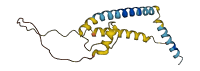
Descriptions
The autoinhibited protein was predicted that may have potential autoinhibitory elements via cis-regPred.
Autoinhibitory domains (AIDs)
Target domain |
|
Relief mechanism |
|
Assay |
cis-regPred |
Accessory elements
No accessory elements
Autoinhibited structure

Activated structure
1 structures for Q9D6U8
| Entry ID | Method | Resolution | Chain | Position | Source |
|---|---|---|---|---|---|
| AF-Q9D6U8-F1 | Predicted | AlphaFoldDB |
6 variants for Q9D6U8
| Variant ID(s) | Position | Change | Description | Diseaes Association | Provenance |
|---|---|---|---|---|---|
| rs3389432468 | 34 | L>M | No | EVA | |
| rs3389330423 | 49 | K>* | No | EVA | |
| rs3389330411 | 50 | T>S | No | EVA | |
| rs3412921034 | 61 | L>P | No | EVA | |
| rs3389430924 | 65 | T>R | No | EVA | |
| rs3389408908 | 154 | T>I | No | EVA |
No associated diseases with Q9D6U8
No regional properties for Q9D6U8
| Type | Name | Position | InterPro Accession |
|---|---|---|---|
| No domain, repeats, and functional sites for Q9D6U8 | |||
4 GO annotations of cellular component
| Name | Definition |
|---|---|
| cytosol | The part of the cytoplasm that does not contain organelles but which does contain other particulate matter, such as protein complexes. |
| integral component of membrane | The component of a membrane consisting of the gene products and protein complexes having at least some part of their peptide sequence embedded in the hydrophobic region of the membrane. |
| mitochondrial membrane | Either of the lipid bilayers that surround the mitochondrion and form the mitochondrial envelope. |
| mitochondrion | A semiautonomous, self replicating organelle that occurs in varying numbers, shapes, and sizes in the cytoplasm of virtually all eukaryotic cells. It is notably the site of tissue respiration. |
No GO annotations of molecular function
| Name | Definition |
|---|---|
| No GO annotations for molecular function |
5 GO annotations of biological process
| Name | Definition |
|---|---|
| activation of cysteine-type endopeptidase activity involved in apoptotic process | Any process that initiates the activity of the inactive enzyme cysteine-type endopeptidase in the context of an apoptotic process. |
| cellular response to hypoxia | Any process that results in a change in state or activity of a cell (in terms of movement, secretion, enzyme production, gene expression, etc.) as a result of a stimulus indicating lowered oxygen tension. Hypoxia, defined as a decline in O2 levels below normoxic levels of 20.8 - 20.95%, results in metabolic adaptation at both the cellular and organismal level. |
| neuron apoptotic process | Any apoptotic process in a neuron, the basic cellular unit of nervous tissue. Each neuron consists of a body, an axon, and dendrites. Their purpose is to receive, conduct, and transmit impulses in the nervous system. |
| positive regulation of apoptotic process | Any process that activates or increases the frequency, rate or extent of cell death by apoptotic process. |
| positive regulation of release of cytochrome c from mitochondria | Any process that increases the rate, frequency or extent of release of cytochrome c from mitochondria, the process in which cytochrome c is enabled to move from the mitochondrial intermembrane space into the cytosol, which is an early step in apoptosis and leads to caspase activation. |
5 homologous proteins in AiPD
| UniProt AC | Gene Name | Protein Name | Species | Evidence Code |
|---|---|---|---|---|
| A6QPI4 | FAM162B | Protein FAM162B | Bos taurus (Bovine) | PR |
| Q96A26 | FAM162A | Protein FAM162A | Homo sapiens (Human) | PR |
| Q5T6X4 | FAM162B | Protein FAM162B | Homo sapiens (Human) | PR |
| Q9CX19 | Fam162b | Protein FAM162B | Mus musculus (Mouse) | PR |
| Q4QQV3 | Fam162a | Protein FAM162A | Rattus norvegicus (Rat) | PR |
| 10 | 20 | 30 | 40 | 50 | 60 |
| MWSLGGLRLA | AGHCLRLYER | NASSSLRFTR | NTDLKRINGF | CTKPQESPKT | PTQSYRHGVP |
| 70 | 80 | 90 | 100 | 110 | 120 |
| LHKPTDFEKK | ILLWSGRFKK | EEEIPETISF | EMLDAAKNKL | RVKVSYLMIA | LTVAGCIYMV |
| 130 | 140 | 150 | |||
| IEGKKAAKRH | ESLTSLNLER | KARLREEAAM | KAKTD |