Q9CQS3
Gene name |
Fibin |
Protein name |
Fin bud initiation factor homolog |
Names |
|
Species |
Mus musculus (Mouse) |
KEGG Pathway |
mmu:67606 |
EC number |
|
Protein Class |
|
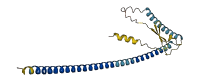
Descriptions
The autoinhibited protein was predicted that may have potential autoinhibitory elements via cis-regPred.
Autoinhibitory domains (AIDs)
Target domain |
|
Relief mechanism |
|
Assay |
cis-regPred |
Accessory elements
No accessory elements
Autoinhibited structure

Activated structure
1 structures for Q9CQS3
| Entry ID | Method | Resolution | Chain | Position | Source |
|---|---|---|---|---|---|
| AF-Q9CQS3-F1 | Predicted | AlphaFoldDB |
3 variants for Q9CQS3
| Variant ID(s) | Position | Change | Description | Diseaes Association | Provenance |
|---|---|---|---|---|---|
| rs248402247 | 70 | G>D | No | EVA | |
| rs3388573004 | 85 | T>R | No | EVA | |
| rs3388572066 | 102 | S>C | No | EVA |
No associated diseases with Q9CQS3
No regional properties for Q9CQS3
| Type | Name | Position | InterPro Accession |
|---|---|---|---|
| No domain, repeats, and functional sites for Q9CQS3 | |||
3 GO annotations of cellular component
| Name | Definition |
|---|---|
| endoplasmic reticulum | The irregular network of unit membranes, visible only by electron microscopy, that occurs in the cytoplasm of many eukaryotic cells. The membranes form a complex meshwork of tubular channels, which are often expanded into slitlike cavities called cisternae. The ER takes two forms, rough (or granular), with ribosomes adhering to the outer surface, and smooth (with no ribosomes attached). |
| extracellular region | The space external to the outermost structure of a cell. For cells without external protective or external encapsulating structures this refers to space outside of the plasma membrane. This term covers the host cell environment outside an intracellular parasite. |
| Golgi apparatus | A membrane-bound cytoplasmic organelle of the endomembrane system that further processes the core oligosaccharides (e.g. N-glycans) added to proteins in the endoplasmic reticulum and packages them into membrane-bound vesicles. The Golgi apparatus operates at the intersection of the secretory, lysosomal, and endocytic pathways. |
1 GO annotations of molecular function
| Name | Definition |
|---|---|
| protein homodimerization activity | Binding to an identical protein to form a homodimer. |
3 GO annotations of biological process
| Name | Definition |
|---|---|
| protein kinase C signaling | A series of reactions, mediated by the intracellular serine/threonine kinase protein kinase C, which occurs as a result of a single trigger reaction or compound. |
| response to dexamethasone | Any process that results in a change in state or activity of a cell or an organism (in terms of movement, secretion, enzyme production, gene expression, etc.) as a result of a dexamethasone stimulus. |
| response to manganese ion | Any process that results in a change in state or activity of a cell or an organism (in terms of movement, secretion, enzyme production, gene expression, etc.) as a result of a manganese ion stimulus. |
4 homologous proteins in AiPD
| UniProt AC | Gene Name | Protein Name | Species | Evidence Code |
|---|---|---|---|---|
| Q5E9H1 | FIBIN | Fin bud initiation factor homolog | Bos taurus (Bovine) | PR |
| A4UZ23 | FIBIN | Fin bud initiation factor homolog | Equus caballus (Horse) | PR |
| Q8TAL6 | FIBIN | Fin bud initiation factor homolog | Homo sapiens (Human) | PR |
| A1IGX5 | fibin | Fin bud initiation factor | Danio rerio (Zebrafish) (Brachydanio rerio) | PR |
| 10 | 20 | 30 | 40 | 50 | 60 |
| MVFPKLIWMG | FFCHLCRGYF | DGPLYPEMSN | GTLHHYFVPD | GDYEENDDPE | KCQLLFRVSD |
| 70 | 80 | 90 | 100 | 110 | 120 |
| RRRCSQGEGG | QASSLLSLTL | REEFTVLGRQ | VEDAGRVLEG | ISKSISYDLD | GEESYGKYLR |
| 130 | 140 | 150 | 160 | 170 | 180 |
| RESHQIGDAY | SNSDKSLTEL | ESKFKQGQEQ | DSRQESRLNE | DFLGMLVHTR | SLLKETLDIS |
| 190 | 200 | 210 | |||
| VGLRDKYELL | AHTIRSHGTR | LGRLKSDYLE | GGAQKTG |