Q99287
Gene name |
SEY1 |
Protein name |
Protein SEY1 |
Names |
Synthetic enhancer of YOP1 protein |
Species |
Saccharomyces cerevisiae (strain ATCC 204508 / S288c) (Baker's yeast) |
KEGG Pathway |
sce:YOR165W |
EC number |
|
Protein Class |
|
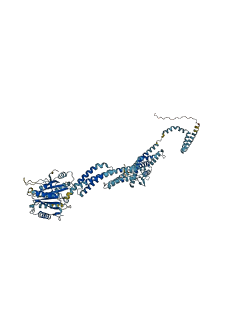
Descriptions
The autoinhibited protein was predicted that may have potential autoinhibitory elements via cis-regPred.
Autoinhibitory domains (AIDs)
Target domain |
|
Relief mechanism |
|
Assay |
cis-regPred |
Accessory elements
No accessory elements
Autoinhibited structure

Activated structure
1 structures for Q99287
| Entry ID | Method | Resolution | Chain | Position | Source |
|---|---|---|---|---|---|
| AF-Q99287-F1 | Predicted | AlphaFoldDB |
12 variants for Q99287
| Variant ID(s) | Position | Change | Description | Diseaes Association | Provenance |
|---|---|---|---|---|---|
| s15-644570 | 2 | A>T | No | SGRP | |
| s15-644579 | 5 | P>S | No | SGRP | |
| s15-645673 | 369 | K>N | No | SGRP | |
| s15-645872 | 436 | I>V | No | SGRP | |
| s15-645935 | 457 | R>C | No | SGRP | |
| s15-645972 | 469 | K>R | No | SGRP | |
| s15-646283 | 573 | E>K | No | SGRP | |
| s15-646328 | 588 | A>T | No | SGRP | |
| s15-646464 | 633 | R>Q | No | SGRP | |
| s15-646494 | 643 | R>L | No | SGRP | |
| s15-646599 | 678 | T>I | No | SGRP | |
| s15-646766 | 734 | V>I | No | SGRP |
No associated diseases with Q99287
Functions
7 GO annotations of cellular component
| Name | Definition |
|---|---|
| cell periphery | The part of a cell encompassing the cell cortex, the plasma membrane, and any external encapsulating structures. |
| cellular bud | A protuberance from a cell of an organism that reproduces by budding, which will grow larger and become a separate daughter cell after nuclear division, cytokinesis, and cell wall formation (when appropriate). The daughter cell may completely separate from the mother cell, or the mother and daughter cells may remain associated. |
| cortical endoplasmic reticulum | A cortical network of highly dynamic tubules that are juxtaposed to the plasma membrane and undergo ring closure and tubule-branching movements. |
| cytoplasm | The contents of a cell excluding the plasma membrane and nucleus, but including other subcellular structures. |
| endoplasmic reticulum | The irregular network of unit membranes, visible only by electron microscopy, that occurs in the cytoplasm of many eukaryotic cells. The membranes form a complex meshwork of tubular channels, which are often expanded into slitlike cavities called cisternae. The ER takes two forms, rough (or granular), with ribosomes adhering to the outer surface, and smooth (with no ribosomes attached). |
| endoplasmic reticulum membrane | The lipid bilayer surrounding the endoplasmic reticulum. |
| integral component of membrane | The component of a membrane consisting of the gene products and protein complexes having at least some part of their peptide sequence embedded in the hydrophobic region of the membrane. |
2 GO annotations of molecular function
| Name | Definition |
|---|---|
| GTP binding | Binding to GTP, guanosine triphosphate. |
| GTPase activity | Catalysis of the reaction: GTP + H2O = GDP + H+ + phosphate. |
4 GO annotations of biological process
| Name | Definition |
|---|---|
| endoplasmic reticulum inheritance | The partitioning of endoplasmic reticulum between daughter cells at cell division. |
| endoplasmic reticulum membrane fusion | The joining of 2 or more lipid bilayer membranes that surround the endoplasmic reticulum. |
| endoplasmic reticulum organization | A process that is carried out at the cellular level which results in the assembly, arrangement of constituent parts, or disassembly of the endoplasmic reticulum. |
| membrane organization | A process which results in the assembly, arrangement of constituent parts, or disassembly of a membrane. A membrane is a double layer of lipid molecules that encloses all cells, and, in eukaryotes, many organelles; may be a single or double lipid bilayer; also includes associated proteins. |
3 homologous proteins in AiPD
| UniProt AC | Gene Name | Protein Name | Species | Evidence Code |
|---|---|---|---|---|
| Q0JLS6 | RHD3 | Protein ROOT HAIR DEFECTIVE 3 | Oryza sativa subsp japonica (Rice) | PR |
| Q9SSN0 | At1g72960 | Protein ROOT HAIR DEFECTIVE 3 homolog 1 | Arabidopsis thaliana (Mouse-ear cress) | PR |
| P93042 | NAT4 | Protein ROOT HAIR DEFECTIVE 3 | Arabidopsis thaliana (Mouse-ear cress) | PR |
| 10 | 20 | 30 | 40 | 50 | 60 |
| MADRPAIQLI | DEEKEFHQSA | LQYFQQCIGN | RDVGLDYHVI | SVFGSQSSGK | STLLNVLFNT |
| 70 | 80 | 90 | 100 | 110 | 120 |
| NFDTMDAQVK | RQQTTKGIWL | AHTKQVNTTI | EIDNDRPDIF | VLDVEGSDGS | ERGEDQDFER |
| 130 | 140 | 150 | 160 | 170 | 180 |
| KAALFAIAVS | EVLIVNMWEQ | QIGLYQGNNM | ALLKTVFEVN | LSLFGKNDND | HKVLLLFVIR |
| 190 | 200 | 210 | 220 | 230 | 240 |
| DHVGVTPLSS | LSDSVTRELE | KIWTELSKPA | GCEGSSLYDY | FDLKFVGLAH | KLLQEDKFTQ |
| 250 | 260 | 270 | 280 | 290 | 300 |
| DVKKLGDSFV | MKGTENYYFK | PQYHHRLPLD | GWTMYAENCW | DQIERNKDLD | LPTQQILVAR |
| 310 | 320 | 330 | 340 | 350 | 360 |
| FKTEEISNEA | LEEFISKYDE | SIAPLKGNLG | SLTSQLVKLK | EECLTKYDEQ | ASRYARNVYM |
| 370 | 380 | 390 | 400 | 410 | 420 |
| EKREALNTKL | NSHISGTINE | FLESLMEKLW | DDLKLEVSSR | DKATTSFVES | VAAGKSKIEK |
| 430 | 440 | 450 | 460 | 470 | 480 |
| EFNESMETFK | KLGLLISNEE | ITCKFSDDIE | ERIKQLRDAE | LKAKIGRIKK | NLVPELKDHV |
| 490 | 500 | 510 | 520 | 530 | 540 |
| IHLLSHPSKK | VWDDIMNDFE | STIKDNISAY | QVEKDKYDFK | IGLSESENAK | IYKNIRILAW |
| 550 | 560 | 570 | 580 | 590 | 600 |
| RTLDTTVHDY | LKIDTIVSIL | RDRFEDVFRY | DAEGSPRLWK | TEEEIDGAFR | VAKEHALEVF |
| 610 | 620 | 630 | 640 | 650 | 660 |
| EVLSLAVTSD | NVEIIPDVPM | AEEESGEDNE | IYRDNEGVFH | SRRFAHILTE | LQKENVLDQF |
| 670 | 680 | 690 | 700 | 710 | 720 |
| RRQINITVLD | SKRSIITTRT | HIPPWIYVLL | AVLGWNEFVA | VIRNPLFVTL | TLILGATFFV |
| 730 | 740 | 750 | 760 | 770 | |
| IHKFGLWGPV | VNVVQSAVGE | TRTAIKDKLR | QFVVEDHEVK | ESFEMKDFSK | NEQKEK |