Q93561
Gene name |
cup-2 |
Protein name |
Derlin-1 |
Names |
Coelomocyte uptake defective protein 2, DER1-like protein 1, cDerlin-1 |
Species |
Caenorhabditis elegans |
KEGG Pathway |
cel:CELE_F25D7.1 |
EC number |
|
Protein Class |
|
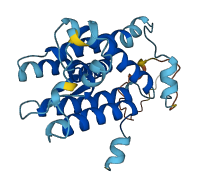
Descriptions
The autoinhibited protein was predicted that may have potential autoinhibitory elements via cis-regPred.
Autoinhibitory domains (AIDs)
Target domain |
|
Relief mechanism |
|
Assay |
cis-regPred |
Accessory elements
No accessory elements
Autoinhibited structure

Activated structure
1 structures for Q93561
| Entry ID | Method | Resolution | Chain | Position | Source |
|---|---|---|---|---|---|
| AF-Q93561-F1 | Predicted | AlphaFoldDB |
No variants for Q93561
| Variant ID(s) | Position | Change | Description | Diseaes Association | Provenance |
|---|---|---|---|---|---|
| No variants for Q93561 | |||||
No associated diseases with Q93561
6 regional properties for Q93561
| Type | Name | Position | InterPro Accession |
|---|---|---|---|
| domain | Coagulation factor 5/8 C-terminal domain | 272 - 422 | IPR000421-1 |
| domain | Coagulation factor 5/8 C-terminal domain | 428 - 581 | IPR000421-2 |
| domain | CUB domain | 25 - 139 | IPR000859-1 |
| domain | CUB domain | 145 - 263 | IPR000859-2 |
| domain | MAM domain | 639 - 811 | IPR000998 |
| domain | Neuropilin, C-terminal | 847 - 923 | IPR022579 |
7 GO annotations of cellular component
| Name | Definition |
|---|---|
| early endosome | A membrane-bounded organelle that receives incoming material from primary endocytic vesicles that have been generated by clathrin-dependent and clathrin-independent endocytosis; vesicles fuse with the early endosome to deliver cargo for sorting into recycling or degradation pathways. |
| endoplasmic reticulum | The irregular network of unit membranes, visible only by electron microscopy, that occurs in the cytoplasm of many eukaryotic cells. The membranes form a complex meshwork of tubular channels, which are often expanded into slitlike cavities called cisternae. The ER takes two forms, rough (or granular), with ribosomes adhering to the outer surface, and smooth (with no ribosomes attached). |
| endosome | A vacuole to which materials ingested by endocytosis are delivered. |
| Hrd1p ubiquitin ligase ERAD-L complex | A multiprotein complex that recognizes and ubiquitinates proteins with misfolded luminal domains during ER-associated protein degradation (ERAD). In S. cerevisiae, this complex contains the ubiquitin ligase Hrd1p. |
| integral component of endoplasmic reticulum membrane | The component of the endoplasmic reticulum membrane consisting of the gene products and protein complexes having at least some part of their peptide sequence embedded in the hydrophobic region of the membrane. |
| intracellular organelle | Organized structure of distinctive morphology and function, occurring within the cell. Includes the nucleus, mitochondria, plastids, vacuoles, vesicles, ribosomes and the cytoskeleton. Excludes the plasma membrane. |
| perinuclear endoplasmic reticulum | The portion of endoplasmic reticulum, the intracellular network of tubules and cisternae, that occurs near the nucleus. The lumen of the perinuclear endoplasmic reticulum is contiguous with the nuclear envelope lumen (also called perinuclear space), the region between the inner and outer nuclear membranes. |
2 GO annotations of molecular function
| Name | Definition |
|---|---|
| misfolded protein binding | Binding to a misfolded protein. |
| signal recognition particle binding | Binding to a signal recognition particle. |
5 GO annotations of biological process
| Name | Definition |
|---|---|
| endocytosis | A vesicle-mediated transport process in which cells take up external materials or membrane constituents by the invagination of a small region of the plasma membrane to form a new membrane-bounded vesicle. |
| endoplasmic reticulum unfolded protein response | The series of molecular signals generated as a consequence of the presence of unfolded proteins in the endoplasmic reticulum (ER) or other ER-related stress; results in changes in the regulation of transcription and translation. |
| protein transport | The directed movement of proteins into, out of or within a cell, or between cells, by means of some agent such as a transporter or pore. |
| response to misfolded protein | Any process that results in a change in state or activity of a cell or an organism (in terms of movement, secretion, enzyme production, gene expression, etc.) as a result of a misfolded protein stimulus. |
| ubiquitin-dependent ERAD pathway | The series of steps necessary to target endoplasmic reticulum (ER)-resident proteins for degradation by the cytoplasmic proteasome. Begins with recognition of the ER-resident protein, includes retrotranslocation (dislocation) of the protein from the ER to the cytosol, protein ubiquitination necessary for correct substrate transfer, transport of the protein to the proteasome, and ends with degradation of the protein by the cytoplasmic proteasome. |
| 10 | 20 | 30 | 40 | 50 | 60 |
| MDLENFLLGI | PIVTRYWFLA | STIIPLLGRF | GFINVQWMFL | QWDLVVNKFQ | FWRPLTALIY |
| 70 | 80 | 90 | 100 | 110 | 120 |
| YPVTPQTGFH | WLMMCYFLYN | YSKALESETY | RGRSADYLFM | LIFNWFFCSG | LCMALDIYFL |
| 130 | 140 | 150 | 160 | 170 | 180 |
| LEPMVISVLY | VWCQVNKDTI | VSFWFGMRFP | ARYLPWVLWG | FNAVLRGGGT | NELVGILVGH |
| 190 | 200 | 210 | 220 | 230 | 240 |
| AYFFVALKYP | DEYGVDLIST | PEFLHRLIPD | EDGGIHGQDG | NIRGARQQPR | GHQWPGGVGA |
| RLGGN |