Q8VHK9
Gene name |
Dhx36 |
Protein name |
ATP-dependent DNA/RNA helicase DHX36 |
Names |
DEAD/H box polypeptide 36, DEAH box protein 36, MLE-like protein 1, RNA helicase associated with AU-rich element ARE |
Species |
Mus musculus (Mouse) |
KEGG Pathway |
mmu:72162 |
EC number |
3.6.4.13: Acting on ATP; involved in cellular and subcellular movement |
Protein Class |
|
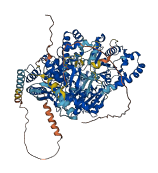
Descriptions
The autoinhibited protein was predicted that may have potential autoinhibitory elements via cis-regPred.
Autoinhibitory domains (AIDs)
Target domain |
|
Relief mechanism |
|
Assay |
cis-regPred |
Accessory elements
No accessory elements
Autoinhibited structure

Activated structure
4 structures for Q8VHK9
| Entry ID | Method | Resolution | Chain | Position | Source |
|---|---|---|---|---|---|
| 6UP2 | X-ray | 197 A | A | 153-982 | PDB |
| 6UP3 | X-ray | 269 A | A | 153-982 | PDB |
| 6UP4 | X-ray | 240 A | A | 153-982 | PDB |
| AF-Q8VHK9-F1 | Predicted | AlphaFoldDB |
27 variants for Q8VHK9
| Variant ID(s) | Position | Change | Description | Diseaes Association | Provenance |
|---|---|---|---|---|---|
| rs218967670 | 11 | R>C | No | EVA | |
| rs233234300 | 17 | G>A | No | EVA | |
| rs224043268 | 160 | S>T | No | EVA | |
| rs265181789 | 240 | N>D | No | EVA | |
| rs3388625108 | 299 | S>F | No | EVA | |
| rs3388613653 | 306 | G>R | No | EVA | |
| rs3388626815 | 315 | D>Y | No | EVA | |
| rs3388619775 | 418 | G>D | No | EVA | |
| rs3388627150 | 453 | D>Y | No | EVA | |
| rs3388628741 | 493 | N>K | No | EVA | |
| rs3388634717 | 502 | M>K | No | EVA | |
| rs3388625096 | 528 | Q>P | No | EVA | |
| rs47785188 | 543 | A>T | No | EVA | |
| rs3388634653 | 576 | I>N | No | EVA | |
| rs3388634016 | 576 | I>V | No | EVA | |
| rs3388626763 | 578 | T>I | No | EVA | |
| rs3388632757 | 624 | I>N | No | EVA | |
| rs213872523 | 656 | S>T | No | EVA | |
| rs3388630675 | 670 | L>* | No | EVA | |
| rs3388626811 | 673 | L>W | No | EVA | |
| rs3388630716 | 696 | G>R | No | EVA | |
| rs3388636507 | 731 | E>D | No | EVA | |
| rs3388630717 | 732 | K>R | No | EVA | |
| rs3388630671 | 735 | D>Y | No | EVA | |
| rs3388631356 | 758 | G>S | No | EVA | |
| rs3388634713 | 912 | I>L | No | EVA | |
| rs3388634643 | 988 | P>L | No | EVA |
No associated diseases with Q8VHK9
4 regional properties for Q8VHK9
| Type | Name | Position | InterPro Accession |
|---|---|---|---|
| repeat | Leucine-rich repeat | 66 - 87 | IPR001611-1 |
| repeat | Leucine-rich repeat | 88 - 109 | IPR001611-2 |
| repeat | Leucine-rich repeat | 110 - 131 | IPR001611-3 |
| repeat | Leucine-rich repeat | 132 - 153 | IPR001611-4 |
Functions
| Description | ||
|---|---|---|
| EC Number | 3.6.4.13 | Acting on ATP; involved in cellular and subcellular movement |
| Subcellular Localization |
|
|
| PANTHER Family | ||
| PANTHER Subfamily | ||
| PANTHER Protein Class | ||
| PANTHER Pathway Category | No pathway information available | |
11 GO annotations of cellular component
| Name | Definition |
|---|---|
| axon | The long process of a neuron that conducts nerve impulses, usually away from the cell body to the terminals and varicosities, which are sites of storage and release of neurotransmitter. |
| chromosome, telomeric region | The end of a linear chromosome, required for the integrity and maintenance of the end. A chromosome telomere usually includes a region of telomerase-encoded repeats the length of which rarely exceeds 20 bp each and that permits the formation of a telomeric loop (T-loop). The telomeric repeat region is usually preceded by a sub-telomeric region that is gene-poor but rich in repetitive elements. Some telomeres only consist of the latter part (for eg. D. melanogaster telomeres). |
| cytoplasm | The contents of a cell excluding the plasma membrane and nucleus, but including other subcellular structures. |
| cytoplasmic stress granule | A dense aggregation in the cytosol composed of proteins and RNAs that appear when the cell is under stress. |
| cytosol | The part of the cytoplasm that does not contain organelles but which does contain other particulate matter, such as protein complexes. |
| dendrite | A neuron projection that has a short, tapering, morphology. Dendrites receive and integrate signals from other neurons or from sensory stimuli, and conduct nerve impulses towards the axon or the cell body. In most neurons, the impulse is conveyed from dendrites to axon via the cell body, but in some types of unipolar neuron, the impulse does not travel via the cell body. |
| mitochondrion | A semiautonomous, self replicating organelle that occurs in varying numbers, shapes, and sizes in the cytoplasm of virtually all eukaryotic cells. It is notably the site of tissue respiration. |
| nuclear speck | A discrete extra-nucleolar subnuclear domain, 20-50 in number, in which splicing factors are seen to be localized by immunofluorescence microscopy. |
| nucleoplasm | That part of the nuclear content other than the chromosomes or the nucleolus. |
| nucleus | A membrane-bounded organelle of eukaryotic cells in which chromosomes are housed and replicated. In most cells, the nucleus contains all of the cell's chromosomes except the organellar chromosomes, and is the site of RNA synthesis and processing. In some species, or in specialized cell types, RNA metabolism or DNA replication may be absent. |
| perikaryon | The portion of the cell soma (neuronal cell body) that excludes the nucleus. |
19 GO annotations of molecular function
| Name | Definition |
|---|---|
| ATP binding | Binding to ATP, adenosine 5'-triphosphate, a universally important coenzyme and enzyme regulator. |
| ATP hydrolysis activity | Catalysis of the reaction: ATP + H2O = ADP + H+ phosphate. ATP hydrolysis is used in some reactions as an energy source, for example to catalyze a reaction or drive transport against a concentration gradient. |
| ATP-dependent activity, acting on DNA | Catalytic activity that acts to modify DNA, driven by ATP hydrolysis. |
| DNA helicase activity | Unwinding of a DNA helix, driven by ATP hydrolysis. |
| double-stranded RNA binding | Binding to double-stranded RNA. |
| G-quadruplex DNA binding | Binding to G-quadruplex DNA structures, in which groups of four guanines adopt a flat, cyclic Hoogsteen hydrogen-bonding arrangement known as a guanine tetrad. The stacking of guanine tetrads results in G-quadruplex DNA structures. G-quadruplex DNA can form under physiological conditions from some G-rich sequences, such as those found in telomeres, immunoglobulin switch regions, gene promoters, fragile X repeats, and the dimerization domain in the human immunodeficiency virus (HIV) genome. |
| G-quadruplex RNA binding | Binding to a G-quadruplex RNA structure, in which groups of four guanines adopt a flat, cyclic hydrogen-bonding arrangement known as a guanine tetrad. |
| histone deacetylase binding | Binding to histone deacetylase. |
| magnesium ion binding | Binding to a magnesium (Mg) ion. |
| mRNA 3'-UTR AU-rich region binding | Binding to a region containing frequent adenine and uridine bases within the 3' untranslated region of a mRNA molecule or in pre-mRNA intron. The ARE-binding element consensus is UUAUUUAUU. ARE-binding proteins control the stability and/or translation of mRNAs. |
| mRNA 3'-UTR binding | Binding to a 3' untranslated region of an mRNA molecule. |
| mRNA 5'-UTR binding | Binding to an mRNA molecule at its 5' untranslated region. |
| pre-miRNA binding | Binding to a precursor microRNA (pre-miRNA) transcript, a stem-loop-containing precursor of microRNA. |
| RNA binding | Binding to an RNA molecule or a portion thereof. |
| RNA helicase activity | Unwinding of an RNA helix, driven by ATP hydrolysis. |
| RNA polymerase II cis-regulatory region sequence-specific DNA binding | Binding to a specific upstream regulatory DNA sequence (transcription factor recognition sequence or binding site) located in cis relative to the transcription start site (i.e., on the same strand of DNA) of a gene transcribed by RNA polymerase II. |
| single-stranded DNA binding | Binding to single-stranded DNA. |
| telomerase RNA binding | Binding to the telomerase RNA template. |
| transcription cis-regulatory region binding | Binding to a specific sequence of DNA that is part of a regulatory region that controls transcription of that section of the DNA. The transcribed region might be described as a gene, cistron, or operon. |
33 GO annotations of biological process
| Name | Definition |
|---|---|
| 3'-UTR-mediated mRNA destabilization | An mRNA destabilization process in which one or more RNA-binding proteins associate with the 3'-untranslated region (UTR) of an mRNA. |
| cell differentiation | The process in which relatively unspecialized cells, e.g. embryonic or regenerative cells, acquire specialized structural and/or functional features that characterize the cells, tissues, or organs of the mature organism or some other relatively stable phase of the organism's life history. Differentiation includes the processes involved in commitment of a cell to a specific fate and its subsequent development to the mature state. |
| cellular response to arsenite ion | Any process that results in a change in state or activity of a cell (in terms of movement, secretion, enzyme production, gene expression, etc.) as a result of an arsenite ion stimulus. |
| cellular response to heat | Any process that results in a change in state or activity of a cell (in terms of movement, secretion, enzyme production, gene expression, etc.) as a result of a heat stimulus, a temperature stimulus above the optimal temperature for that organism. |
| cellular response to UV | Any process that results in a change in state or activity of a cell (in terms of movement, secretion, enzyme production, gene expression, etc.) as a result of an ultraviolet radiation (UV light) stimulus. Ultraviolet radiation is electromagnetic radiation with a wavelength in the range of 10 to 380 nanometers. |
| defense response to virus | Reactions triggered in response to the presence of a virus that act to protect the cell or organism. |
| G-quadruplex DNA unwinding | The process by which G-quadruplex (also known as G4) DNA, which is a four-stranded DNA structure held together by guanine base pairing, is unwound or 'melted'. |
| innate immune response | Innate immune responses are defense responses mediated by germline encoded components that directly recognize components of potential pathogens. |
| negative regulation of translation | Any process that stops, prevents, or reduces the frequency, rate or extent of the chemical reactions and pathways resulting in the formation of proteins by the translation of mRNA or circRNA. |
| ossification | The formation of bone or of a bony substance, or the conversion of fibrous tissue or of cartilage into bone or a bony substance. |
| positive regulation of cardioblast differentiation | Any process that activates or increases the frequency, rate or extent of cardioblast differentiation, the process in which a relatively unspecialized mesodermal cell acquires the specialized structural and/or functional features of a cardioblast. A cardioblast is a cardiac precursor cell. It is a cell that has been committed to a cardiac fate, but will undergo more cell division rather than terminally differentiating. |
| positive regulation of cytoplasmic translation | Any process that activates or increases the frequency, rate or extent of cytoplasmic translation. |
| positive regulation of dendritic spine morphogenesis | Any process that increases the rate, frequency, or extent of dendritic spine morphogenesis, the process in which the anatomical structures of a dendritic spine are generated and organized. A dendritic spine is a protrusion from a dendrite and a specialized subcellular compartment involved in synaptic transmission. |
| positive regulation of gene expression | Any process that increases the frequency, rate or extent of gene expression. Gene expression is the process in which a gene's coding sequence is converted into a mature gene product (protein or RNA). |
| positive regulation of hematopoietic progenitor cell differentiation | Any process that activates or increases the frequency, rate or extent of hematopoietic progenitor cell differentiation. |
| positive regulation of I-kappaB kinase/NF-kappaB signaling | Any process that activates or increases the frequency, rate or extent of I-kappaB kinase/NF-kappaB signaling. |
| positive regulation of interferon-alpha production | Any process that activates or increases the frequency, rate, or extent of interferon-alpha production. |
| positive regulation of intracellular mRNA localization | Any process that activates or increases the frequency, rate or extent of intracellular mRNA localization. |
| positive regulation of mRNA 3'-end processing | Any process that activates or increases the frequency, rate or extent of mRNA 3'-end processing. |
| positive regulation of myeloid dendritic cell cytokine production | Any process that activates or increases the frequency, rate, or extent of myeloid dendritic cell cytokine production. |
| positive regulation of nuclear-transcribed mRNA catabolic process, deadenylation-dependent decay | Any process that activates or increases the frequency, rate or extent of nuclear-transcribed mRNA catabolic process, deadenylation-dependent decay. |
| positive regulation of telomere maintenance | Any process that activates or increases the frequency, rate or extent of a process that affects and monitors the activity of telomeric proteins and the length of telomeric DNA. |
| positive regulation of telomere maintenance via telomere lengthening | Any process that activates or increases the frequency, rate or extent of telomere maintenance via telomere lengthening. |
| positive regulation of transcription by RNA polymerase II | Any process that activates or increases the frequency, rate or extent of transcription from an RNA polymerase II promoter. |
| positive regulation of transcription initiation by RNA polymerase II | Any process that increases the rate, frequency or extent of a process involved in starting transcription from an RNA polymerase II promoter. |
| regulation of embryonic development | Any process that modulates the frequency, rate or extent of embryonic development. |
| regulation of mRNA stability | Any process that modulates the propensity of mRNA molecules to degradation. Includes processes that both stabilize and destabilize mRNAs. |
| regulation of transcription by RNA polymerase III | Any process that modulates the frequency, rate or extent of transcription mediated by RNA ploymerase III. |
| response to exogenous dsRNA | Any process that results in a change in state or activity of a cell or an organism (in terms of movement, secretion, enzyme production, gene expression, etc.) as a result of an exogenous double-stranded RNA stimulus. |
| response to virus | Any process that results in a change in state or activity of a cell or an organism (in terms of movement, secretion, enzyme production, gene expression, etc.) as a result of a stimulus from a virus. |
| RNA secondary structure unwinding | The process in which a secondary structure of RNA are broken or 'melted'. |
| spermatogenesis | The developmental process by which male germ line stem cells self renew or give rise to successive cell types resulting in the development of a spermatozoa. |
| telomerase RNA stabilization | Prevention of degradation of telomerase RNA (TERC) molecules. |
4 homologous proteins in AiPD
| UniProt AC | Gene Name | Protein Name | Species | Evidence Code |
|---|---|---|---|---|
| P43329 | hrpA | ATP-dependent RNA helicase HrpA | Escherichia coli (strain K12) | PR |
| Q6P158 | DHX57 | Putative ATP-dependent RNA helicase DHX57 | Homo sapiens (Human) | PR |
| Q9H2U1 | DHX36 | ATP-dependent DNA/RNA helicase DHX36 | Homo sapiens (Human) | PR |
| Q14BI7 | Tdrd9 | ATP-dependent RNA helicase TDRD9 | Mus musculus (Mouse) | PR |
| 10 | 20 | 30 | 40 | 50 | 60 |
| MSYDYHQSWS | RDGGPRGSGQ | GSSGGGGGGS | RGSGGGGGGR | GGRGRHPAHL | KGREIGLWYA |
| 70 | 80 | 90 | 100 | 110 | 120 |
| KKQTQKNKEA | ERQERAVVHM | DERREEQIVQ | LLNSVQAKTD | KDSEAQISWF | APEDHGYGTE |
| 130 | 140 | 150 | 160 | 170 | 180 |
| VSSEKKINSE | KKLDNQEKKL | LNQEKKTFRI | TDKSYIDRDS | EYLLQENEPN | LSLDQHLLED |
| 190 | 200 | 210 | 220 | 230 | 240 |
| LQRKKTDPRY | IEMQRFRKKL | PSYGMQKELV | NLINNHQVTV | ISGETGCGKT | TQVTQFILDN |
| 250 | 260 | 270 | 280 | 290 | 300 |
| YIERGKGSAC | RIVCTQPRRI | SAISVAERVA | TERAESCGNG | NSTGYQIRLQ | SRLPRKQGSI |
| 310 | 320 | 330 | 340 | 350 | 360 |
| LYCTTGIILQ | WLQSDSRLSS | VSHIVLDEIH | ERNLQSDVLM | TVIKDLLHFR | SDLKVILMSA |
| 370 | 380 | 390 | 400 | 410 | 420 |
| TLNAEKFSEY | FGNCPMIHIP | GFTFPVVEYL | LEDIIEKIRY | VPDQKEHRSQ | FKRGFMQGHV |
| 430 | 440 | 450 | 460 | 470 | 480 |
| NRQEKEEKEA | IYKERWPAYI | KELRTRYSAS | TVDVLQMMDD | DKVDLNLIAA | LIRYIVLEEE |
| 490 | 500 | 510 | 520 | 530 | 540 |
| DGAILVFLPG | WDNISTLHDL | LMSQVMFKSD | KFLIIPLHSL | MPTVNQTQVF | KKTPPGVRKI |
| 550 | 560 | 570 | 580 | 590 | 600 |
| VIATNIAETS | ITIDDVVYVI | DGGKIKETHF | DTQNNISTMS | AEWVSKANAK | QRKGRAGRVQ |
| 610 | 620 | 630 | 640 | 650 | 660 |
| PGHCYHLYNG | LRASLLDDYQ | LPEILRTPLE | ELCLQIKILR | LGGIAYFLSR | LMDPPSNEAV |
| 670 | 680 | 690 | 700 | 710 | 720 |
| VLSIKHLMEL | SALDKQEELT | PLGVHLARLP | VEPHIGKMIL | FGALFCCLDP | VLTIAASLSF |
| 730 | 740 | 750 | 760 | 770 | 780 |
| KDPFVIPLGK | EKIADARRKE | LAKETRSDHL | TVVNAFEGWE | EAKRRGFRYE | KDYCWEYFLS |
| 790 | 800 | 810 | 820 | 830 | 840 |
| SNTLQMLHNM | KGQFAEHLLG | AGFVSSRSPK | DPKANINSDN | EKIIKAVICA | GLYPKVAKIR |
| 850 | 860 | 870 | 880 | 890 | 900 |
| LNLGKKRKMV | KVHTKSDGLV | SIHPKSVNVE | QTDFHYNWLI | YHLKMRTSSI | YLYDCTEVSP |
| 910 | 920 | 930 | 940 | 950 | 960 |
| YCLLFFGGDI | SIQKDKDQEI | IAVDEWIVFQ | SPERIAHLVK | GLRKELDSLL | QEKIESPHPV |
| 970 | 980 | 990 | 1000 | ||
| DWDDTKSRDC | AVLSAILDLI | KTQEKATPRN | LPPRSQDGYY | S |