Q8VHK7
Gene name |
Hdgf |
Protein name |
Hepatoma-derived growth factor |
Names |
IL-13 receptor subunit alpha-2, IL-13R subunit alpha-2, IL-13R-alpha-2, IL-13RA2, HDGF |
Species |
Rattus norvegicus (Rat) |
KEGG Pathway |
rno:114499 |
EC number |
|
Protein Class |
|
Descriptions
The autoinhibited protein was predicted that may have potential autoinhibitory elements via cis-regPred.
Autoinhibitory domains (AIDs)
Target domain |
|
Relief mechanism |
|
Assay |
cis-regPred |
Accessory elements
No accessory elements
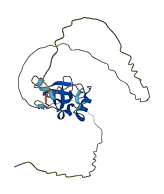
Autoinhibited structure

Activated structure
4 structures for Q8VHK7
| Entry ID | Method | Resolution | Chain | Position | Source |
|---|---|---|---|---|---|
| 2B8A | NMR | - | A | 1-110 | PDB |
| 5XSK | X-ray | 284 A | A/B | 1-100 | PDB |
| 5XSL | X-ray | 330 A | A | 1-100 | PDB |
| AF-Q8VHK7-F1 | Predicted | AlphaFoldDB |
1 variants for Q8VHK7
| Variant ID(s) | Position | Change | Description | Diseaes Association | Provenance |
|---|---|---|---|---|---|
| rs3319629663 | 220 | E>A | No | EVA |
No associated diseases with Q8VHK7
Functions
5 GO annotations of cellular component
| Name | Definition |
|---|---|
| cytoplasm | The contents of a cell excluding the plasma membrane and nucleus, but including other subcellular structures. |
| extracellular space | That part of a multicellular organism outside the cells proper, usually taken to be outside the plasma membranes, and occupied by fluid. |
| nucleoplasm | That part of the nuclear content other than the chromosomes or the nucleolus. |
| nucleus | A membrane-bounded organelle of eukaryotic cells in which chromosomes are housed and replicated. In most cells, the nucleus contains all of the cell's chromosomes except the organellar chromosomes, and is the site of RNA synthesis and processing. In some species, or in specialized cell types, RNA metabolism or DNA replication may be absent. |
| transcription repressor complex | A protein complex that possesses activity that prevents or downregulates transcription. |
10 GO annotations of molecular function
| Name | Definition |
|---|---|
| DNA-binding transcription repressor activity, RNA polymerase II-specific | A DNA-binding transcription factor activity that represses or decreases the transcription of specific gene sets transcribed by RNA polymerase II. |
| double-stranded DNA binding | Binding to double-stranded DNA. |
| growth factor activity | The function that stimulates a cell to grow or proliferate. Most growth factors have other actions besides the induction of cell growth or proliferation. |
| heparin binding | Binding to heparin, a member of a group of glycosaminoglycans found mainly as an intracellular component of mast cells and which consist predominantly of alternating alpha-(1->4)-linked D-galactose and N-acetyl-D-glucosamine-6-sulfate residues. |
| nucleotide binding | Binding to a nucleotide, any compound consisting of a nucleoside that is esterified with (ortho)phosphate or an oligophosphate at any hydroxyl group on the ribose or deoxyribose. |
| RNA polymerase II cis-regulatory region sequence-specific DNA binding | Binding to a specific upstream regulatory DNA sequence (transcription factor recognition sequence or binding site) located in cis relative to the transcription start site (i.e., on the same strand of DNA) of a gene transcribed by RNA polymerase II. |
| transcription coregulator activity | A transcription regulator activity that modulates the transcription of specific gene sets via binding to a DNA-bound DNA-binding transcription factor, either on its own or as part of a complex. Coregulators often act by altering chromatin structure and modifications. For example, one class of transcription coregulators modifies chromatin structure through covalent modification of histones. A second class remodels the conformation of chromatin in an ATP-dependent fashion. A third class modulates interactions of DNA-bound DNA-binding transcription factors with other transcription coregulators. |
| transcription corepressor activity | A transcription coregulator activity that represses or decreases the transcription of specific gene sets via binding to a DNA-bound DNA-binding transcription factor, either on its own or as part of a complex. Corepressors often act by altering chromatin structure and modifications. For example, one class of transcription corepressors modifies chromatin structure through covalent modification of histones. A second class remodels the conformation of chromatin in an ATP-dependent fashion. A third class modulates interactions of DNA-bound DNA-binding transcription factors with other transcription coregulators. |
| transcription corepressor binding | Binding to a transcription corepressor, a protein involved in negative regulation of transcription via protein-protein interactions with transcription factors and other proteins that negatively regulate transcription. Transcription corepressors do not bind DNA directly, but rather mediate protein-protein interactions between repressing transcription factors and the basal transcription machinery. |
| tubulin binding | Binding to monomeric or multimeric forms of tubulin, including microtubules. |
7 GO annotations of biological process
| Name | Definition |
|---|---|
| cellular response to interleukin-7 | Any process that results in a change in state or activity of a cell (in terms of movement, secretion, enzyme production, gene expression, etc.) as a result of an interleukin-7 stimulus. |
| negative regulation of neuron apoptotic process | Any process that stops, prevents, or reduces the frequency, rate or extent of cell death by apoptotic process in neurons. |
| negative regulation of transcription by RNA polymerase II | Any process that stops, prevents, or reduces the frequency, rate or extent of transcription mediated by RNA polymerase II. |
| positive regulation of cell division | Any process that activates or increases the frequency, rate or extent of cell division. |
| positive regulation of transcription by RNA polymerase II | Any process that activates or increases the frequency, rate or extent of transcription from an RNA polymerase II promoter. |
| protein localization to nucleus | A process in which a protein transports or maintains the localization of another protein to the nucleus. |
| regulation of transcription by RNA polymerase II | Any process that modulates the frequency, rate or extent of transcription mediated by RNA polymerase II. |
13 homologous proteins in AiPD
| UniProt AC | Gene Name | Protein Name | Species | Evidence Code |
|---|---|---|---|---|
| Q8MJG1 | PSIP1 | PC4 and SFRS1-interacting protein | Bos taurus (Bovine) | PR |
| Q9XSK7 | HDGF | Hepatoma-derived growth factor | Bos taurus (Bovine) | PR |
| Q66T72 | PSIP1 | PC4 and SFRS1-interacting protein | Felis catus (Cat) (Felis silvestris catus) | PR |
| Q5XXA9 | PSIP1 | Lens epithelium-derived growth factor | Gallus gallus (Chicken) | PR |
| Q9Y3E1 | HDGFL3 | Hepatoma-derived growth factor-related protein 3 | Homo sapiens (Human) | PR |
| O75475 | PSIP1 | PC4 and SFRS1-interacting protein | Homo sapiens (Human) | PR |
| Q7Z4V5 | HDGFL2 | Hepatoma-derived growth factor-related protein 2 | Homo sapiens (Human) | PR |
| P51858 | HDGF | Hepatoma-derived growth factor | Homo sapiens (Human) | PR |
| Q99JF8 | Psip1 | PC4 and SFRS1-interacting protein | Mus musculus (Mouse) | PR |
| Q9JMG7 | Hdgfl3 | Hepatoma-derived growth factor-related protein 3 | Mus musculus (Mouse) | PR |
| P51859 | Hdgf | Hepatoma-derived growth factor | Mus musculus (Mouse) | PR |
| Q812D1 | Psip1 | PC4 and SFRS1-interacting protein | Rattus norvegicus (Rat) | PR |
| Q923W4 | Hdgfl3 | Hepatoma-derived growth factor-related protein 3 | Rattus norvegicus (Rat) | PR |
| 10 | 20 | 30 | 40 | 50 | 60 |
| MSRSNRQKEY | KCGDLVFAKM | KGYPHWPARI | DEMPEAAVKS | TANKYQVFFF | GTHETAFLGP |
| 70 | 80 | 90 | 100 | 110 | 120 |
| KDLFPYEESK | EKFGKPNKRK | GFSEGLWEIE | NNPTVKASGY | QSSQKKSCAE | EPEVEPEAHE |
| 130 | 140 | 150 | 160 | 170 | 180 |
| GDGDKKGNAE | GSSDEEGKLV | IDEPAKEKNE | KGMLKRRAGD | MLEDSPKRPK | ESGDHEEEEK |
| 190 | 200 | 210 | 220 | 230 | |
| EIAALEGERP | LPVEMEKNST | PSEPDSGQGP | PPEEEEGEEE | AAKEEAEAQG | VRDHESL |