Q8BG40
Gene name |
Katnb1 |
Protein name |
Katanin p80 WD40 repeat-containing subunit B1 |
Names |
Katanin p80 subunit B1, p80 katanin |
Species |
Mus musculus (Mouse) |
KEGG Pathway |
mmu:74187 |
EC number |
|
Protein Class |
|
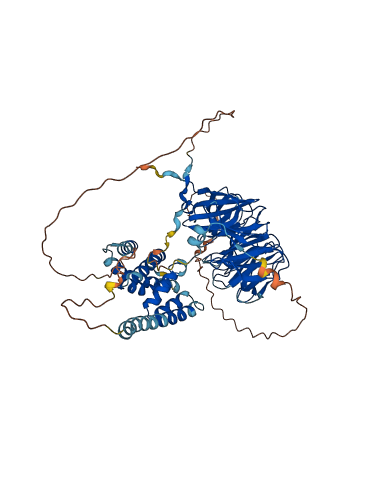
Descriptions
The autoinhibited protein was predicted that may have potential autoinhibitory elements via cis-regPred.
Autoinhibitory domains (AIDs)
Target domain |
|
Relief mechanism |
|
Assay |
cis-regPred |
Accessory elements
No accessory elements
Autoinhibited structure

Activated structure
5 structures for Q8BG40
| Entry ID | Method | Resolution | Chain | Position | Source |
|---|---|---|---|---|---|
| 5LB7 | X-ray | 150 A | PDB | ||
| 5NBT | X-ray | 240 A | A/C | 481-658 | PDB |
| 5OW5 | X-ray | 170 A | A/C | 481-658 | PDB |
| 6GZC | X-ray | 200 A | A/C | 481-658 | PDB |
| AF-Q8BG40-F1 | Predicted | AlphaFoldDB |
35 variants for Q8BG40
| Variant ID(s) | Position | Change | Description | Diseaes Association | Provenance |
|---|---|---|---|---|---|
| rs3389000953 | 23 | V>L | No | EVA | |
| rs3389007407 | 46 | N>S | No | EVA | |
| rs3389008951 | 48 | W>C | No | EVA | |
| rs3388977918 | 73 | T>I | No | EVA | |
| rs3388977924 | 76 | E>V | No | EVA | |
| rs3389003961 | 90 | W>R | No | EVA | |
| rs3388991096 | 105 | K>N | No | EVA | |
| rs3389002592 | 123 | G>S | No | EVA | |
| rs3389008880 | 148 | Q>L | No | EVA | |
| rs3388996394 | 149 | A>V | No | EVA | |
| rs3388971825 | 178 | A>D | No | EVA | |
| rs3389003995 | 195 | V>M | No | EVA | |
| rs3388952682 | 230 | E>K | No | EVA | |
| rs3389000841 | 246 | L>W | No | EVA | |
| rs3388996441 | 260 | E>A | No | EVA | |
| rs3388991077 | 308 | T>S | No | EVA | |
| rs232236791 | 319 | N>S | No | EVA | |
| rs3399557270 | 443 | S>* | No | EVA | |
| rs3399538877 | 445 | M>V | No | EVA | |
| rs232510615 | 456 | D>A | No | EVA | |
| rs3388979690 | 461 | T>S | No | EVA | |
| rs3388996411 | 509 | H>L | No | EVA | |
| rs3389004234 | 533 | A>T | No | EVA | |
| rs3388996425 | 535 | N>K | No | EVA | |
| rs3389003949 | 542 | D>G | No | EVA | |
| rs3388996450 | 548 | N>K | No | EVA | |
| rs3388999715 | 557 | D>N | No | EVA | |
| rs231820007 | 561 | T>I | No | EVA | |
| rs3399304127 | 588 | I>T | No | EVA | |
| rs3389002853 | 597 | T>P | No | EVA | |
| rs3389004270 | 598 | D>E | No | EVA | |
| rs3389004030 | 604 | P>S | No | EVA | |
| rs3399195906 | 611 | S>R | No | EVA | |
| rs3399195920 | 612 | R>L | No | EVA | |
| rs3388971785 | 639 | L>S | No | EVA |
No associated diseases with Q8BG40
8 regional properties for Q8BG40
| Type | Name | Position | InterPro Accession |
|---|---|---|---|
| repeat | WD40 repeat | 9 - 258 | IPR001680 |
| conserved_site | WD40 repeat, conserved site | 120 - 134 | IPR019775-1 |
| conserved_site | WD40 repeat, conserved site | 162 - 176 | IPR019775-2 |
| conserved_site | WD40 repeat, conserved site | 204 - 218 | IPR019775-3 |
| repeat | G-protein beta WD-40 repeat | 120 - 134 | IPR020472-1 |
| repeat | G-protein beta WD-40 repeat | 162 - 176 | IPR020472-2 |
| repeat | G-protein beta WD-40 repeat | 204 - 218 | IPR020472-3 |
| domain | Katanin p80 subunit, C-terminal | 496 - 654 | IPR028021 |
Functions
13 GO annotations of cellular component
| Name | Definition |
|---|---|
| axon | The long process of a neuron that conducts nerve impulses, usually away from the cell body to the terminals and varicosities, which are sites of storage and release of neurotransmitter. |
| centrosome | A structure comprised of a core structure (in most organisms, a pair of centrioles) and peripheral material from which a microtubule-based structure, such as a spindle apparatus, is organized. Centrosomes occur close to the nucleus during interphase in many eukaryotic cells, though in animal cells it changes continually during the cell-division cycle. |
| cytoplasm | The contents of a cell excluding the plasma membrane and nucleus, but including other subcellular structures. |
| cytosol | The part of the cytoplasm that does not contain organelles but which does contain other particulate matter, such as protein complexes. |
| growth cone | The migrating motile tip of a growing neuron projection, where actin accumulates, and the actin cytoskeleton is the most dynamic. |
| katanin complex | A complex possessing an activity that couples ATP hydrolysis to the severing of microtubules; usually a heterodimer comprising a catalytic subunit (often 60kDa) and a regulatory subunit (often 80 kDa). |
| microtubule | Any of the long, generally straight, hollow tubes of internal diameter 12-15 nm and external diameter 24 nm found in a wide variety of eukaryotic cells; each consists (usually) of 13 protofilaments of polymeric tubulin, staggered in such a manner that the tubulin monomers are arranged in a helical pattern on the microtubular surface, and with the alpha/beta axes of the tubulin subunits parallel to the long axis of the tubule; exist in equilibrium with pool of tubulin monomers and can be rapidly assembled or disassembled in response to physiological stimuli; concerned with force generation, e.g. in the spindle. |
| microtubule cytoskeleton | The part of the cytoskeleton (the internal framework of a cell) composed of microtubules and associated proteins. |
| midbody | A thin cytoplasmic bridge formed between daughter cells at the end of cytokinesis. The midbody forms where the contractile ring constricts, and may persist for some time before finally breaking to complete cytokinesis. |
| neuronal cell body | The portion of a neuron that includes the nucleus, but excludes cell projections such as axons and dendrites. |
| plasma membrane | The membrane surrounding a cell that separates the cell from its external environment. It consists of a phospholipid bilayer and associated proteins. |
| spindle | The array of microtubules and associated molecules that forms between opposite poles of a eukaryotic cell during mitosis or meiosis and serves to move the duplicated chromosomes apart. |
| spindle pole | Either of the ends of a spindle, where spindle microtubules are organized; usually contains a microtubule organizing center and accessory molecules, spindle microtubules and astral microtubules. |
4 GO annotations of molecular function
| Name | Definition |
|---|---|
| ATPase regulator activity | Binds to and modulates the activity of an ATP hydrolysis activity. |
| dynein complex binding | Binding to a dynein complex, a protein complex that contains two or three dynein heavy chains and several light chains, and has microtubule motor activity. |
| microtubule binding | Binding to a microtubule, a filament composed of tubulin monomers. |
| protein heterodimerization activity | Binding to a nonidentical protein to form a heterodimer. |
8 GO annotations of biological process
| Name | Definition |
|---|---|
| cell division | The process resulting in division and partitioning of components of a cell to form more cells; may or may not be accompanied by the physical separation of a cell into distinct, individually membrane-bounded daughter cells. |
| microtubule depolymerization | The removal of tubulin heterodimers from one or both ends of a microtubule. |
| microtubule severing | The process in which a microtubule is broken down into smaller segments. Severing enzymes remove dimers from the middle of the filament to create new ends, unlike depolymerizing kinesins that use ATP to uncap microtubules at their ends. |
| mitotic chromosome movement towards spindle pole | The cell cycle process in which the directed movement of chromosomes from the center of the spindle towards the spindle poles occurs. This mediates by the shortening of microtubules attached to the chromosomes, during mitosis. |
| negative regulation of microtubule depolymerization | Any process that stops, prevents, or reduces the frequency, rate or extent of microtubule depolymerization; prevention of depolymerization of a microtubule can result from binding by 'capping' at the plus end (e.g. by interaction with another cellular protein of structure) or by exposing microtubules to a stabilizing drug such as taxol. |
| positive regulation of cell death | Any process that increases the rate or frequency of cell death. Cell death is the specific activation or halting of processes within a cell so that its vital functions markedly cease, rather than simply deteriorating gradually over time, which culminates in cell death. |
| positive regulation of microtubule depolymerization | Any process that activates or increases the frequency, rate or extent of microtubule depolymerization. |
| positive regulation of neuron projection development | Any process that increases the rate, frequency or extent of neuron projection development. Neuron projection development is the process whose specific outcome is the progression of a neuron projection over time, from its formation to the mature structure. A neuron projection is any process extending from a neural cell, such as axons or dendrites (collectively called neurites). |
4 homologous proteins in AiPD
| UniProt AC | Gene Name | Protein Name | Species | Evidence Code |
|---|---|---|---|---|
| Q9BVA0 | KATNB1 | Katanin p80 WD40 repeat-containing subunit B1 | Homo sapiens (Human) | PR |
| Q8C7V3 | Utp15 | U3 small nucleolar RNA-associated protein 15 homolog | Mus musculus (Mouse) | PR |
| Q9CWJ3 | Katnbl1 | KATNB1-like protein 1 | Mus musculus (Mouse) | PR |
| A2RRU3 | Utp15 | U3 small nucleolar RNA-associated protein 15 homolog | Rattus norvegicus (Rat) | PR |
| 10 | 20 | 30 | 40 | 50 | 60 |
| MATPVVTKTA | WKLQEIVAHA | SNVSSLVLGK | ASGRLLATGG | DDCRVNLWSI | NKPNCIMSLT |
| 70 | 80 | 90 | 100 | 110 | 120 |
| GHTSPVESVR | LNTPEELIVA | GSQSGSIRVW | DLEAAKILRT | LMGHKANICS | LDFHPYGEFV |
| 130 | 140 | 150 | 160 | 170 | 180 |
| ASGSQDTNIK | LWDIRRKGCV | FRYRGHSQAV | RCLRFSPDGK | WLASAADDHT | VKLWDLTAGK |
| 190 | 200 | 210 | 220 | 230 | 240 |
| MMSEFPGHTG | PVNVVEFHPN | EYLLASGSSD | RTIRFWDLEK | FQVVSCIEGE | PGPVRSVLFN |
| 250 | 260 | 270 | 280 | 290 | 300 |
| PDGCCLYSGC | QDSLRVYGWE | PERCFDVVLV | NWGKVADLAI | CNDQLIGVAF | SQSNVSSYVV |
| 310 | 320 | 330 | 340 | 350 | 360 |
| DLTRVTRTGT | VTQDPVQANQ | PLTQQTPNPG | VSLRRIYERP | STTCSKPQRV | KHNSESERRS |
| 370 | 380 | 390 | 400 | 410 | 420 |
| PSSEDDRDER | ESRAEIQNAE | DYNEIFQPKN | SISRTPPRRS | EPFPAPPEDD | AATVKEVSKP |
| 430 | 440 | 450 | 460 | 470 | 480 |
| SPAMDVQLPQ | LPVPNLEVPA | RPSVMTSTPA | PKGEPDIIPA | TRNEPIGLKA | SDFLPAVKVP |
| 490 | 500 | 510 | 520 | 530 | 540 |
| QQAELVDEDA | MSQIRKGHDT | MFVVLTSRHK | NLDTVRAVWT | TGDIKTSVDS | AVAINDLSVV |
| 550 | 560 | 570 | 580 | 590 | 600 |
| VDLLNIVNQK | ASLWKLDLCT | TVLPQIEKLL | QSKYESYVQT | GCTSLKLILQ | RFLPLITDIL |
| 610 | 620 | 630 | 640 | 650 | |
| AAPPSVGVDI | SREERLHKCR | LCFKQLKSIS | GLVKSKSGLS | GRHGSAFREL | HLLMASLD |