Q8BFQ3
Gene name |
Gpr68 (Ogr1) |
Protein name |
Ovarian cancer G-protein coupled receptor 1 |
Names |
G-protein coupled receptor 68, Sphingosylphosphorylcholine receptor |
Species |
Mus musculus (Mouse) |
KEGG Pathway |
mmu:238377 |
EC number |
|
Protein Class |
|
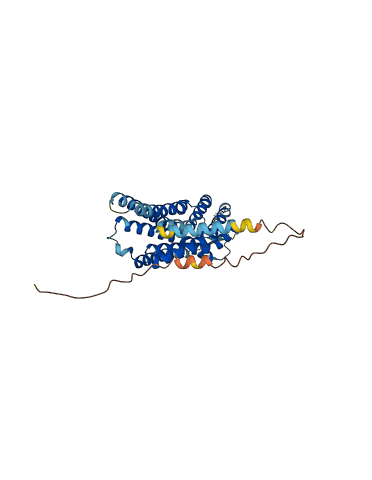
Descriptions
The autoinhibited protein was predicted that may have potential autoinhibitory elements via cis-regPred.
Autoinhibitory domains (AIDs)
Target domain |
|
Relief mechanism |
|
Assay |
cis-regPred |
Accessory elements
No accessory elements
Autoinhibited structure

Activated structure
1 structures for Q8BFQ3
| Entry ID | Method | Resolution | Chain | Position | Source |
|---|---|---|---|---|---|
| AF-Q8BFQ3-F1 | Predicted | AlphaFoldDB |
19 variants for Q8BFQ3
| Variant ID(s) | Position | Change | Description | Diseaes Association | Provenance |
|---|---|---|---|---|---|
| rs3389269396 | 63 | L>M | No | EVA | |
| rs3400429569 | 71 | I>V | No | EVA | |
| rs3389256639 | 100 | L>F | No | EVA | |
| rs3389213923 | 125 | H>N | No | EVA | |
| rs3389269449 | 137 | A>T | No | EVA | |
| rs3402976318 | 139 | V>M | No | EVA | |
| rs3403554189 | 140 | G>A | No | EVA | |
| rs3403706021 | 142 | S>R | No | EVA | |
| rs3389228501 | 163 | I>F | No | EVA | |
| rs3389255406 | 173 | F>V | No | EVA | |
| rs3389269404 | 223 | K>T | No | EVA | |
| rs232678129 | 227 | Q>H | No | EVA | |
| rs3389252785 | 290 | S>G | No | EVA | |
| rs3389258533 | 328 | S>Y | No | EVA | |
| rs3389222814 | 331 | S>E* | No | EVA | |
| rs3389251722 | 334 | Q>K | No | EVA | |
| rs214867950 | 335 | G>V | No | EVA | |
| rs3389228500 | 362 | V>E | No | EVA | |
| rs3389258491 | 366 | A>Y | No | EVA |
No associated diseases with Q8BFQ3
2 GO annotations of cellular component
| Name | Definition |
|---|---|
| integral component of membrane | The component of a membrane consisting of the gene products and protein complexes having at least some part of their peptide sequence embedded in the hydrophobic region of the membrane. |
| plasma membrane | The membrane surrounding a cell that separates the cell from its external environment. It consists of a phospholipid bilayer and associated proteins. |
1 GO annotations of molecular function
| Name | Definition |
|---|---|
| G protein-coupled receptor activity | Combining with an extracellular signal and transmitting the signal across the membrane by activating an associated G-protein; promotes the exchange of GDP for GTP on the alpha subunit of a heterotrimeric G-protein complex. |
8 GO annotations of biological process
| Name | Definition |
|---|---|
| cellular response to pH | Any process that results in a change in state or activity of a cell (in terms of movement, secretion, enzyme production, gene expression, etc.) as a result of a pH stimulus. pH is a measure of the acidity or basicity of an aqueous solution. |
| insulin secretion | The regulated release of proinsulin from secretory granules accompanied by cleavage of proinsulin to form mature insulin. In vertebrates, insulin is secreted from B granules in the B cells of the vertebrate pancreas and from insulin-producing cells in insects. |
| monocyte differentiation | The process in which a relatively unspecialized myeloid precursor cell acquires the specialized features of a monocyte. |
| negative regulation of monocyte differentiation | Any process that stops, prevents, or reduces the frequency, rate or extent of monocyte differentiation. |
| osteoclast development | The process whose specific outcome is the progression of a osteoclast from its formation to the mature structure. Cell development does not include the steps involved in committing a cell to a specific fate. An osteoclast is a specialized phagocytic cell associated with the absorption and removal of the mineralized matrix of bone tissue. |
| positive regulation of insulin secretion | Any process that activates or increases the frequency, rate or extent of the regulated release of insulin. |
| positive regulation of insulin secretion involved in cellular response to glucose stimulus | Any process that increases the frequency, rate or extent of the regulated release of insulin that contributes to the response of a cell to glucose. |
| positive regulation of osteoclast development | Any process that activates or increases the frequency, rate or extent of osteoclast development. |
5 homologous proteins in AiPD
| UniProt AC | Gene Name | Protein Name | Species | Evidence Code |
|---|---|---|---|---|
| O46685 | GPR68 | Ovarian cancer G-protein coupled receptor 1 | Bos taurus (Bovine) | PR |
| Q1JQB3 | GPR4 | G-protein coupled receptor 4 | Bos taurus (Bovine) | PR |
| P46093 | GPR4 | G-protein coupled receptor 4 | Homo sapiens (Human) | PR |
| Q8BUD0 | Gpr4 | G-protein coupled receptor 4 | Mus musculus (Mouse) | PR |
| Q4KLH9 | Gpr4 | G-protein coupled receptor 4 | Rattus norvegicus (Rat) | PR |
| 10 | 20 | 30 | 40 | 50 | 60 |
| MGNITTENSS | LSCPIDHTIH | QTLAPVVYVT | VLVVGFPANC | LSLYFGYLQI | KARNELGVYL |
| 70 | 80 | 90 | 100 | 110 | 120 |
| CNLTIADLFY | ICSLPFWLQY | VLQHDDWSHG | DLSCQVCGIL | LYENIYISVG | FLCCISIDRY |
| 130 | 140 | 150 | 160 | 170 | 180 |
| LAVAHPFRFH | QFRTLKAAVG | VSVLIWAKEL | LTSIYFLNHK | EVIEDEDQHR | VCFEHYPIQA |
| 190 | 200 | 210 | 220 | 230 | 240 |
| WQRSINYYRF | LVGFLFPICL | LLASYQGILR | AVRRSHGTQK | SRKDQIQRLV | LSTVVIFLAC |
| 250 | 260 | 270 | 280 | 290 | 300 |
| FLPYHVLLLV | RSLWERNCEF | AKSIFNVYHF | SLLLTSFNCV | ADPVLYCFVS | ETTHRDLARL |
| 310 | 320 | 330 | 340 | 350 | 360 |
| RGACLAVLTC | SRTSRAREAY | PLGAPEASGK | SGAQGEEPEL | LTKLHSAFQT | PSSLGVGGPS |
| TVGLA |