Q850M0
Gene name |
TPKA (KCO1) |
Protein name |
Two pore potassium channel a |
Names |
Two K(+) channel a, Calcium-activated outward-rectifying potassium channel 1, OsKCO1 |
Species |
Oryza sativa subsp japonica (Rice) |
KEGG Pathway |
osa:4334137 |
EC number |
|
Protein Class |
|
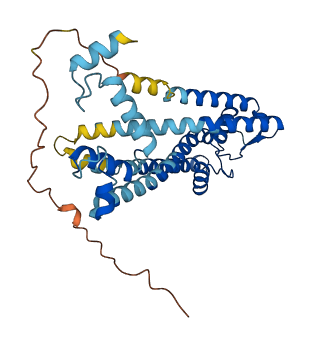
Descriptions
The autoinhibited protein was predicted that may have potential autoinhibitory elements via cis-regPred.
Autoinhibitory domains (AIDs)
Target domain |
|
Relief mechanism |
|
Assay |
cis-regPred |
Accessory elements
No accessory elements
Autoinhibited structure

Activated structure
1 structures for Q850M0
| Entry ID | Method | Resolution | Chain | Position | Source |
|---|---|---|---|---|---|
| AF-Q850M0-F1 | Predicted | AlphaFoldDB |
No variants for Q850M0
| Variant ID(s) | Position | Change | Description | Diseaes Association | Provenance |
|---|---|---|---|---|---|
| No variants for Q850M0 | |||||
No associated diseases with Q850M0
4 regional properties for Q850M0
| Type | Name | Position | InterPro Accession |
|---|---|---|---|
| domain | EF-hand domain | 315 - 347 | IPR002048 |
| domain | Potassium channel domain | 74 - 150 | IPR013099-1 |
| domain | Potassium channel domain | 191 - 263 | IPR013099-2 |
| binding_site | EF-Hand 1, calcium-binding site | 328 - 340 | IPR018247 |
3 GO annotations of cellular component
| Name | Definition |
|---|---|
| integral component of plasma membrane | The component of the plasma membrane consisting of the gene products and protein complexes having at least some part of their peptide sequence embedded in the hydrophobic region of the membrane. |
| plant-type vacuole membrane | The lipid bilayer surrounding a vacuole that retains the same shape regardless of cell cycle phase. The membrane separates its contents from the cytoplasm of the cell. An example of this component is found in Arabidopsis thaliana. |
| potassium ion-transporting ATPase complex | Protein complex that carries out the reaction: ATP + H2O + K+(out) = ADP + phosphate + K+(in). It is a high affinity potassium uptake system. The E. coli complex consists of 4 proteins: KdpA is the potassium ion translocase, KdpB is the ATPase, and KdpC and KdpF seem to be involved in assembly and stabilization of the complex. |
4 GO annotations of molecular function
| Name | Definition |
|---|---|
| calcium ion binding | Binding to a calcium ion (Ca2+). |
| inward rectifier potassium channel activity | Enables the transmembrane transfer of a potassium ion by an inwardly-rectifying voltage-gated channel. An inwardly rectifying current-voltage relation is one where at any given driving force the inward flow of K+ ions exceeds the outward flow for the opposite driving force. The inward-rectification is due to a voltage-dependent block of the channel pore by a specific ligand or ligands, and as a result the macroscopic conductance depends on the difference between membrane voltage and the K+ equilibrium potential rather than on membrane voltage itself. |
| outward rectifier potassium channel activity | Enables the transmembrane transfer of a potassium ion by an outwardly-rectifying voltage-gated channel. An outwardly rectifying current-voltage relation is one where at any given driving force the outward flow of K+ ions exceeds the inward flow for the opposite driving force. |
| potassium ion leak channel activity | Enables the transport of a potassium ion across a membrane via a narrow pore channel that is open even in an unstimulated or 'resting' state. |
3 GO annotations of biological process
| Name | Definition |
|---|---|
| cellular potassium ion homeostasis | Any process involved in the maintenance of an internal steady state of potassium ions at the level of a cell. |
| potassium ion transmembrane transport | A process in which a potassium ion is transported from one side of a membrane to the other. |
| stabilization of membrane potential | The accomplishment of a non-fluctuating membrane potential, the electric potential existing across any membrane arising from charges in the membrane itself and from the charges present in the media on either side of the membrane. |
5 homologous proteins in AiPD
| UniProt AC | Gene Name | Protein Name | Species | Evidence Code |
|---|---|---|---|---|
| Q7Z418 | KCNK18 | Potassium channel subfamily K member 18 | Homo sapiens (Human) | PR |
| Q96T55 | KCNK16 | Potassium channel subfamily K member 16 | Homo sapiens (Human) | PR |
| O08581 | Kcnk1 | Potassium channel subfamily K member 1 | Mus musculus (Mouse) | PR |
| Q6VV64 | Kcnk18 | Potassium channel subfamily K member 18 | Mus musculus (Mouse) | PR |
| Q22271 | unc-58 | Uncoordinated protein 58 | Caenorhabditis elegans | PR |
| 10 | 20 | 30 | 40 | 50 | 60 |
| MDDNSIQQSL | LADNPNVLQR | KPSEGVNRFR | RCRSTPSTDP | LQGPPEKGSS | VKAKELFKEM |
| 70 | 80 | 90 | 100 | 110 | 120 |
| RPSFRLVGLL | LFIYLLVGVL | AFYAVMDEIS | GKRTNRVLDA | LYFCVVTMTT | VGYGDLVPNN |
| 130 | 140 | 150 | 160 | 170 | 180 |
| DTTKLLACAF | VFMGMAVVAL | FVSKVADYLV | EKQEVLFFKA | LHTNLKGGET | KMLRAIETNR |
| 190 | 200 | 210 | 220 | 230 | 240 |
| IKYKFYTNAL | LLVLSIISGT | VFLWKVEKLS | LVDSFYCVCA | TITTLGYGDK | SFSSKLGRVF |
| 250 | 260 | 270 | 280 | 290 | 300 |
| AVFWIITSTI | IMAQFFMYLA | EIYTERRQKM | LANWVLTRKM | TKMDLEAADL | DDDRQVGAAE |
| 310 | 320 | 330 | 340 | ||
| FVVYKLKELG | KINQEEISSF | LEEFEKLDVD | HSGTLSPYDL | TLAQSAQ |