O08581
Gene name |
Kcnk1 |
Protein name |
Potassium channel subfamily K member 1 |
Names |
Inward rectifying potassium channel protein TWIK-1 |
Species |
Mus musculus (Mouse) |
KEGG Pathway |
mmu:16525 |
EC number |
|
Protein Class |
|
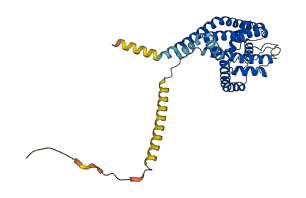
Descriptions
The autoinhibited protein was predicted that may have potential autoinhibitory elements via cis-regPred.
Autoinhibitory domains (AIDs)
Target domain |
|
Relief mechanism |
|
Assay |
cis-regPred |
Accessory elements
No accessory elements
Autoinhibited structure

Activated structure
1 structures for O08581
| Entry ID | Method | Resolution | Chain | Position | Source |
|---|---|---|---|---|---|
| AF-O08581-F1 | Predicted | AlphaFoldDB |
16 variants for O08581
| Variant ID(s) | Position | Change | Description | Diseaes Association | Provenance |
|---|---|---|---|---|---|
| rs3388989266 | 3 | Q>* | No | EVA | |
| rs3389027159 | 3 | Q>H | No | EVA | |
| rs3399777662 | 71 | S>T | No | EVA | |
| rs3399221370 | 88 | Y>* | No | EVA | |
| rs3399986979 | 88 | Y>H | No | EVA | |
| rs3389024354 | 106 | S>* | No | EVA | |
| rs3388971498 | 151 | A>S | No | EVA | |
| rs3389027166 | 163 | R>I | No | EVA | |
| rs3389020180 | 180 | A>G | No | EVA | |
| rs3389008322 | 183 | H>Q | No | EVA | |
| rs3389021467 | 209 | D>Y | No | EVA | |
| rs32063899 | 290 | L>Q | No | EVA | |
| rs32063902 | 297 | D>H | No | EVA | |
| rs3399848379 | 306 | E>* | No | EVA | |
| rs3388971577 | 323 | A>P | No | EVA | |
| rs234409038 | 334 | A>V | No | EVA |
No associated diseases with O08581
5 regional properties for O08581
| Type | Name | Position | InterPro Accession |
|---|---|---|---|
| conserved_site | TPP-binding enzyme, conserved site | 503 - 522 | IPR000399 |
| domain | Thiamine pyrophosphate enzyme, TPP-binding | 466 - 621 | IPR011766 |
| domain | Thiamine pyrophosphate enzyme, central domain | 273 - 402 | IPR012000 |
| domain | Thiamine pyrophosphate enzyme, N-terminal TPP-binding domain | 80 - 243 | IPR012001 |
| domain | Acetolactate synthase large subunit, TPP binding domain | 444 - 636 | IPR039368 |
Functions
14 GO annotations of cellular component
| Name | Definition |
|---|---|
| anchoring junction | A cell junction that mechanically attaches a cell (and its cytoskeleton) to neighboring cells or to the extracellular matrix. |
| apical plasma membrane | The region of the plasma membrane located at the apical end of the cell. |
| brush border membrane | The portion of the plasma membrane surrounding the brush border. |
| cytoplasm | The contents of a cell excluding the plasma membrane and nucleus, but including other subcellular structures. |
| dendrite | A neuron projection that has a short, tapering, morphology. Dendrites receive and integrate signals from other neurons or from sensory stimuli, and conduct nerve impulses towards the axon or the cell body. In most neurons, the impulse is conveyed from dendrites to axon via the cell body, but in some types of unipolar neuron, the impulse does not travel via the cell body. |
| endosome | A vacuole to which materials ingested by endocytosis are delivered. |
| integral component of membrane | The component of a membrane consisting of the gene products and protein complexes having at least some part of their peptide sequence embedded in the hydrophobic region of the membrane. |
| integral component of plasma membrane | The component of the plasma membrane consisting of the gene products and protein complexes having at least some part of their peptide sequence embedded in the hydrophobic region of the membrane. |
| intracellular membrane-bounded organelle | Organized structure of distinctive morphology and function, bounded by a single or double lipid bilayer membrane and occurring within the cell. Includes the nucleus, mitochondria, plastids, vacuoles, and vesicles. Excludes the plasma membrane. |
| inward rectifier potassium channel complex | A protein complex which is capable of inward rectifier potassium channel activity. |
| perikaryon | The portion of the cell soma (neuronal cell body) that excludes the nucleus. |
| potassium channel complex | An ion channel complex through which potassium ions pass. |
| recycling endosome | An organelle consisting of a network of tubules that functions in targeting molecules, such as receptors transporters and lipids, to the plasma membrane. |
| synaptic membrane | A specialized area of membrane on either the presynaptic or the postsynaptic side of a synapse, the junction between a nerve fiber of one neuron and another neuron or muscle fiber or glial cell. |
5 GO annotations of molecular function
| Name | Definition |
|---|---|
| identical protein binding | Binding to an identical protein or proteins. |
| inward rectifier potassium channel activity | Enables the transmembrane transfer of a potassium ion by an inwardly-rectifying voltage-gated channel. An inwardly rectifying current-voltage relation is one where at any given driving force the inward flow of K+ ions exceeds the outward flow for the opposite driving force. The inward-rectification is due to a voltage-dependent block of the channel pore by a specific ligand or ligands, and as a result the macroscopic conductance depends on the difference between membrane voltage and the K+ equilibrium potential rather than on membrane voltage itself. |
| potassium channel activity | Enables the facilitated diffusion of a potassium ion (by an energy-independent process) involving passage through a transmembrane aqueous pore or channel without evidence for a carrier-mediated mechanism. |
| potassium ion leak channel activity | Enables the transport of a potassium ion across a membrane via a narrow pore channel that is open even in an unstimulated or 'resting' state. |
| sodium channel activity | Enables the facilitated diffusion of a sodium ion (by an energy-independent process) involving passage through a transmembrane aqueous pore or channel without evidence for a carrier-mediated mechanism. |
6 GO annotations of biological process
| Name | Definition |
|---|---|
| potassium ion transmembrane transport | A process in which a potassium ion is transported from one side of a membrane to the other. |
| potassium ion transport | The directed movement of potassium ions (K+) into, out of or within a cell, or between cells, by means of some agent such as a transporter or pore. |
| regulation of resting membrane potential | Any process that modulates the establishment or extent of a resting potential, the electrical charge across the plasma membrane, with the interior of the cell negative with respect to the exterior. The resting potential is the membrane potential of a cell that is not stimulated to be depolarized or hyperpolarized. |
| response to nicotine | Any process that results in a change in state or activity of a cell or an organism (in terms of movement, secretion, enzyme production, gene expression, etc.) as a result of a nicotine stimulus. |
| sodium ion transmembrane transport | A process in which a sodium ion is transported from one side of a membrane to the other by means of some agent such as a transporter or pore. |
| stabilization of membrane potential | The accomplishment of a non-fluctuating membrane potential, the electric potential existing across any membrane arising from charges in the membrane itself and from the charges present in the media on either side of the membrane. |
5 homologous proteins in AiPD
| UniProt AC | Gene Name | Protein Name | Species | Evidence Code |
|---|---|---|---|---|
| Q7Z418 | KCNK18 | Potassium channel subfamily K member 18 | Homo sapiens (Human) | PR |
| Q96T55 | KCNK16 | Potassium channel subfamily K member 16 | Homo sapiens (Human) | PR |
| Q6VV64 | Kcnk18 | Potassium channel subfamily K member 18 | Mus musculus (Mouse) | PR |
| Q850M0 | TPKA | Two pore potassium channel a | Oryza sativa subsp japonica (Rice) | PR |
| Q22271 | unc-58 | Uncoordinated protein 58 | Caenorhabditis elegans | PR |
| 10 | 20 | 30 | 40 | 50 | 60 |
| MLQSLAGSSC | VRLVERHRSA | WCFGFLVLGY | LLYLVFGAVV | FSSVELPYED | LLRQELRKLK |
| 70 | 80 | 90 | 100 | 110 | 120 |
| RRFLEEHECL | SEPQLEQFLG | RVLEASNYGV | SVLSNASGNW | NWDFTSALFF | ASTVLSTTGY |
| 130 | 140 | 150 | 160 | 170 | 180 |
| GHTVPLSDGG | KAFCIIYSVI | GIPFTLLFLT | AVVQRVTVHV | TRRPVLYFHI | RWGFSKQVVA |
| 190 | 200 | 210 | 220 | 230 | 240 |
| IVHAVLLGFV | TVSCFFFIPA | AVFSVLEDDW | NFLESFYFCF | ISLSTIGLGD | YVPGEGYNQK |
| 250 | 260 | 270 | 280 | 290 | 300 |
| FRELYKIGIT | CYLLLGLIAM | LVVLETFCEL | HELKKFRKMF | YVKKDKDEDL | VHIMEHDQLS |
| 310 | 320 | 330 | |||
| FSSVTEQVAG | LKEEQKQSEP | FVASQSPPYE | DGSADH |