Q7F1M0
Gene name |
KU70 (Os07g0184900, LOC_Os07g08729, OJ1046_F10.128, OsJ_23357, OsJ_23359) |
Protein name |
ATP-dependent DNA helicase 2 subunit KU70 |
Names |
OsKU70, ATP-dependent DNA helicase 2 subunit 1, ATP-dependent DNA helicase II 70 kDa subunit |
Species |
Oryza sativa subsp japonica (Rice) |
KEGG Pathway |
osa:4342584 |
EC number |
3.6.4.12: Acting on ATP; involved in cellular and subcellular movement |
Protein Class |
|
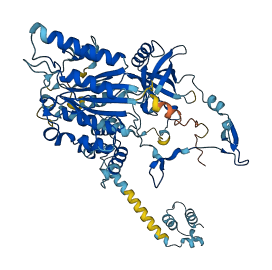
Descriptions
The autoinhibited protein was predicted that may have potential autoinhibitory elements via cis-regPred.
Autoinhibitory domains (AIDs)
Target domain |
|
Relief mechanism |
|
Assay |
cis-regPred |
Accessory elements
No accessory elements
Autoinhibited structure

Activated structure
1 structures for Q7F1M0
| Entry ID | Method | Resolution | Chain | Position | Source |
|---|---|---|---|---|---|
| AF-Q7F1M0-F1 | Predicted | AlphaFoldDB |
No variants for Q7F1M0
| Variant ID(s) | Position | Change | Description | Diseaes Association | Provenance |
|---|---|---|---|---|---|
| No variants for Q7F1M0 | |||||
No associated diseases with Q7F1M0
5 regional properties for Q7F1M0
Functions
| Description | ||
|---|---|---|
| EC Number | 3.6.4.12 | Acting on ATP; involved in cellular and subcellular movement |
| Subcellular Localization |
|
|
| PANTHER Family | ||
| PANTHER Subfamily | ||
| PANTHER Protein Class | ||
| PANTHER Pathway Category | No pathway information available | |
1 GO annotations of cellular component
| Name | Definition |
|---|---|
| Ku70:Ku80 complex | Heterodimeric protein complex composed of a 70 kDa and a 80 kDa subunit, binds DNA through a channel formed by the heterodimer. Functions in DNA double stranded break repair, chromosome maintenance, transcription regulation, V(D)J recombination, and activation of DNA-PK. |
6 GO annotations of molecular function
| Name | Definition |
|---|---|
| ATP binding | Binding to ATP, adenosine 5'-triphosphate, a universally important coenzyme and enzyme regulator. |
| ATP hydrolysis activity | Catalysis of the reaction: ATP + H2O = ADP + H+ phosphate. ATP hydrolysis is used in some reactions as an energy source, for example to catalyze a reaction or drive transport against a concentration gradient. |
| damaged DNA binding | Binding to damaged DNA. |
| DNA helicase activity | Unwinding of a DNA helix, driven by ATP hydrolysis. |
| double-stranded DNA binding | Binding to double-stranded DNA. |
| telomeric DNA binding | Binding to a telomere, a specific structure at the end of a linear chromosome required for the integrity and maintenance of the end. |
7 GO annotations of biological process
| Name | Definition |
|---|---|
| cellular response to gamma radiation | Any process that results in a change in state or activity of a cell (in terms of movement, secretion, enzyme production, gene expression, etc.) as a result of a gamma radiation stimulus. Gamma radiation is a form of electromagnetic radiation (EMR) or light emission of a specific frequency produced from sub-atomic particle interaction, such as electron-positron annihilation and radioactive decay. Gamma rays are generally characterized as EMR having the highest frequency and energy, and also the shortest wavelength, within the electromagnetic radiation spectrum. |
| cellular response to X-ray | Any process that results in a change in state or activity of a cell (in terms of movement, secretion, enzyme production, gene expression, etc.) as a result of X-ray radiation. An X-ray is a form of electromagnetic radiation with a wavelength in the range of 10 nanometers to 100 picometers (corresponding to frequencies in the range 30 PHz to 3 EHz). |
| DNA recombination | Any process in which a new genotype is formed by reassortment of genes resulting in gene combinations different from those that were present in the parents. In eukaryotes genetic recombination can occur by chromosome assortment, intrachromosomal recombination, or nonreciprocal interchromosomal recombination. Interchromosomal recombination occurs by crossing over. In bacteria it may occur by genetic transformation, conjugation, transduction, or F-duction. |
| DNA repair | The process of restoring DNA after damage. Genomes are subject to damage by chemical and physical agents in the environment (e.g. UV and ionizing radiations, chemical mutagens, fungal and bacterial toxins, etc.) and by free radicals or alkylating agents endogenously generated in metabolism. DNA is also damaged because of errors during its replication. A variety of different DNA repair pathways have been reported that include direct reversal, base excision repair, nucleotide excision repair, photoreactivation, bypass, double-strand break repair pathway, and mismatch repair pathway. |
| double-strand break repair via nonhomologous end joining | The repair of a double-strand break in DNA in which the two broken ends are rejoined with little or no sequence complementarity. Information at the DNA ends may be lost due to the modification of broken DNA ends. This term covers instances of separate pathways, called classical (or canonical) and alternative nonhomologous end joining (C-NHEJ and A-NHEJ). These in turn may further branch into sub-pathways, but evidence is still unclear. |
| response to heat | Any process that results in a change in state or activity of a cell or an organism (in terms of movement, secretion, enzyme production, gene expression, etc.) as a result of a heat stimulus, a temperature stimulus above the optimal temperature for that organism. |
| telomere maintenance | Any process that contributes to the maintenance of proper telomeric length and structure by affecting and monitoring the activity of telomeric proteins, the length of telomeric DNA and the replication and repair of the DNA. These processes includes those that shorten, lengthen, replicate and repair the telomeric DNA sequences. |
4 homologous proteins in AiPD
| UniProt AC | Gene Name | Protein Name | Species | Evidence Code |
|---|---|---|---|---|
| O93257 | XRCC6 | X-ray repair cross-complementing protein 5 | Gallus gallus (Chicken) | PR |
| P12956 | XRCC6 | X-ray repair cross-complementing protein 6 | Homo sapiens (Human) | PR |
| P23475 | Xrcc6 | X-ray repair cross-complementing protein 6 | Mus musculus (Mouse) | PR |
| Q9FQ08 | KU70 | ATP-dependent DNA helicase 2 subunit KU70 | Arabidopsis thaliana (Mouse-ear cress) | PR |
| 10 | 20 | 30 | 40 | 50 | 60 |
| MDLDPEGLFR | DDSDEDDDNV | QEREANKEMV | VYLIDASPKM | FTPATKADEK | EETHFHTIVN |
| 70 | 80 | 90 | 100 | 110 | 120 |
| CITHALKTQI | IGRSYDEVAI | CFFNTKEKKN | LQELAGVYVY | NVTEREPLDR | PDARLIKEFS |
| 130 | 140 | 150 | 160 | 170 | 180 |
| CIEDSFMSNI | GSRYGITSGS | RENTLYNALW | VAQALLRKGS | VKTVSKRIVI | FTNEDDPFGG |
| 190 | 200 | 210 | 220 | 230 | 240 |
| LTGAVKTDMI | RTTIQRARDA | QDLGLSIELL | PLSRPDEEFN | MSLFYADLIG | LEGDEIVDYL |
| 250 | 260 | 270 | 280 | 290 | 300 |
| PSSGEKLEDM | TNQLKKRMMK | KRKVKTLAFA | ITNDVCIEVN | TYALIRSTTP | GAITWLDSIS |
| 310 | 320 | 330 | 340 | 350 | 360 |
| NLPLKAERSF | ICNDTGALIQ | DPQKRFQVYN | DKIVKFSTRE | LSDVKRVSSH | HLRLLGFKPL |
| 370 | 380 | 390 | 400 | 410 | 420 |
| DYLKDYHNLR | PSTFIYPSDE | QIFGSTRVFV | ALHSSMRRLG | RFALAFYGNP | TRPQLVALIA |
| 430 | 440 | 450 | 460 | 470 | 480 |
| QEEVTSAGGQ | IEPPGIHMIY | LPYSDDVRYP | EEVHLTSDDA | PRATDEQIKK | ASNLLRRIDL |
| 490 | 500 | 510 | 520 | 530 | 540 |
| KNFSVCQFSN | PALQRHYGIL | EALALGEDEM | PDVKDETLPD | EEGLARPVVV | KAVEEFKASV |
| 550 | 560 | 570 | 580 | 590 | 600 |
| YGENYDQEEA | EAAAAKAGAS | KKRKALTDAA | AEKSAAHNWA | ELADTGKLKD | MTVVDLKSYL |
| 610 | 620 | ||||
| SAHGLPVSGK | KEALVSRILT | HLGK |