P23475
Gene name |
Xrcc6 (G22p1, Ku70) |
Protein name |
X-ray repair cross-complementing protein 6 |
Names |
5'-deoxyribose-5-phosphate lyase Ku70, 5'-dRP/AP lyase Ku70, ATP-dependent DNA helicase 2 subunit 1, ATP-dependent DNA helicase II 70 kDa subunit, CTC box-binding factor 75 kDa subunit, CTC75, CTCBF, DNA repair protein XRCC6, Ku autoantigen protein p70 homolog, Ku70 |
Species |
Mus musculus (Mouse) |
KEGG Pathway |
mmu:14375 |
EC number |
|
Protein Class |
|
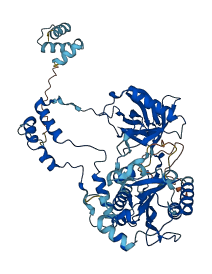
Descriptions
The autoinhibited protein was predicted that may have potential autoinhibitory elements via cis-regPred.
Autoinhibitory domains (AIDs)
Target domain |
|
Relief mechanism |
|
Assay |
cis-regPred |
Accessory elements
No accessory elements
Autoinhibited structure

Activated structure
1 structures for P23475
| Entry ID | Method | Resolution | Chain | Position | Source |
|---|---|---|---|---|---|
| AF-P23475-F1 | Predicted | AlphaFoldDB |
No variants for P23475
| Variant ID(s) | Position | Change | Description | Diseaes Association | Provenance |
|---|---|---|---|---|---|
| No variants for P23475 | |||||
No associated diseases with P23475
5 regional properties for P23475
11 GO annotations of cellular component
| Name | Definition |
|---|---|
| chromosome | A structure composed of a very long molecule of DNA and associated proteins (e.g. histones) that carries hereditary information. |
| cytoplasm | The contents of a cell excluding the plasma membrane and nucleus, but including other subcellular structures. |
| DNA-dependent protein kinase complex | A protein complex that is involved in the repair of DNA double-strand breaks and, in mammals, V(D)J recombination events. It consists of the DNA-dependent protein kinase catalytic subunit (DNA-PKcs) and the DNA end-binding heterodimer Ku. |
| Ku70:Ku80 complex | Heterodimeric protein complex composed of a 70 kDa and a 80 kDa subunit, binds DNA through a channel formed by the heterodimer. Functions in DNA double stranded break repair, chromosome maintenance, transcription regulation, V(D)J recombination, and activation of DNA-PK. |
| nonhomologous end joining complex | A protein complex that plays a role in DNA double-strand break repair via nonhomologous end joining. Such complexes typically contain a specialized DNA ligase (e.g. Lig4 in eukaryotes) and one or more proteins that bind to DNA ends. |
| nucleolus | A small, dense body one or more of which are present in the nucleus of eukaryotic cells. It is rich in RNA and protein, is not bounded by a limiting membrane, and is not seen during mitosis. Its prime function is the transcription of the nucleolar DNA into 45S ribosomal-precursor RNA, the processing of this RNA into 5.8S, 18S, and 28S components of ribosomal RNA, and the association of these components with 5S RNA and proteins synthesized outside the nucleolus. This association results in the formation of ribonucleoprotein precursors; these pass into the cytoplasm and mature into the 40S and 60S subunits of the ribosome. |
| nucleoplasm | That part of the nuclear content other than the chromosomes or the nucleolus. |
| nucleus | A membrane-bounded organelle of eukaryotic cells in which chromosomes are housed and replicated. In most cells, the nucleus contains all of the cell's chromosomes except the organellar chromosomes, and is the site of RNA synthesis and processing. In some species, or in specialized cell types, RNA metabolism or DNA replication may be absent. |
| protein-containing complex | A stable assembly of two or more macromolecules, i.e. proteins, nucleic acids, carbohydrates or lipids, in which at least one component is a protein and the constituent parts function together. |
| protein-DNA complex | A macromolecular complex containing both protein and DNA molecules. |
| transcription regulator complex | A protein complex that is capable of associating with DNA by direct binding, or via other DNA-binding proteins or complexes, and regulating transcription. |
15 GO annotations of molecular function
| Name | Definition |
|---|---|
| 5'-deoxyribose-5-phosphate lyase activity | Catalysis of the beta-elimination of the 5' deoxyribose-5-phosphate at an abasic site in DNA where a DNA-(apurinic or apyrimidinic site) lyase has already cleaved the C-O-P bond 3' to the apurinic or apyrimidinic site. |
| ATP binding | Binding to ATP, adenosine 5'-triphosphate, a universally important coenzyme and enzyme regulator. |
| ATP-dependent activity, acting on DNA | Catalytic activity that acts to modify DNA, driven by ATP hydrolysis. |
| cyclin binding | Binding to cyclins, proteins whose levels in a cell varies markedly during the cell cycle, rising steadily until mitosis, then falling abruptly to zero. As cyclins reach a threshold level, they are thought to drive cells into G2 phase and thus to mitosis. |
| damaged DNA binding | Binding to damaged DNA. |
| DNA end binding | Binding to DNA ends exposed by the creation of double-strand breaks (DSBs). |
| DNA helicase activity | Unwinding of a DNA helix, driven by ATP hydrolysis. |
| double-stranded DNA binding | Binding to double-stranded DNA. |
| double-stranded telomeric DNA binding | Binding to double-stranded telomere-associated DNA. |
| hydrolase activity | Catalysis of the hydrolysis of various bonds, e.g. C-O, C-N, C-C, phosphoric anhydride bonds, etc. |
| protein C-terminus binding | Binding to a protein C-terminus, the end of a peptide chain at which the 1-carboxyl function of a constituent amino acid is not attached in peptide linkage to another amino-acid residue. |
| protein-containing complex binding | Binding to a macromolecular complex. |
| scaffold protein binding | Binding to a scaffold protein. Scaffold proteins are crucial regulators of many key signaling pathways. Although not strictly defined in function, they are known to interact and/or bind with multiple members of a signaling pathway, tethering them into complexes. |
| telomeric DNA binding | Binding to a telomere, a specific structure at the end of a linear chromosome required for the integrity and maintenance of the end. |
| transcription cis-regulatory region binding | Binding to a specific sequence of DNA that is part of a regulatory region that controls transcription of that section of the DNA. The transcribed region might be described as a gene, cistron, or operon. |
21 GO annotations of biological process
| Name | Definition |
|---|---|
| activation of innate immune response | Any process that initiates an innate immune response. Innate immune responses are defense responses mediated by germline encoded components that directly recognize components of potential pathogens. Examples of this process include activation of the hypersensitive response of Arabidopsis thaliana and activation of any NOD or TLR signaling pathway in vertebrate species. |
| cellular hyperosmotic salinity response | Any process that results in a change in state or activity of a cell (in terms of movement, secretion, enzyme production, gene expression, etc.) as a result of detection of, or exposure to, an increase in the concentration of salt (particularly but not exclusively sodium and chloride ions) in the environment. |
| cellular response to DNA damage stimulus | Any process that results in a change in state or activity of a cell (in terms of movement, secretion, enzyme production, gene expression, etc.) as a result of a stimulus indicating damage to its DNA from environmental insults or errors during metabolism. |
| cellular response to gamma radiation | Any process that results in a change in state or activity of a cell (in terms of movement, secretion, enzyme production, gene expression, etc.) as a result of a gamma radiation stimulus. Gamma radiation is a form of electromagnetic radiation (EMR) or light emission of a specific frequency produced from sub-atomic particle interaction, such as electron-positron annihilation and radioactive decay. Gamma rays are generally characterized as EMR having the highest frequency and energy, and also the shortest wavelength, within the electromagnetic radiation spectrum. |
| cellular response to X-ray | Any process that results in a change in state or activity of a cell (in terms of movement, secretion, enzyme production, gene expression, etc.) as a result of X-ray radiation. An X-ray is a form of electromagnetic radiation with a wavelength in the range of 10 nanometers to 100 picometers (corresponding to frequencies in the range 30 PHz to 3 EHz). |
| double-strand break repair | The repair of double-strand breaks in DNA via homologous and nonhomologous mechanisms to reform a continuous DNA helix. |
| double-strand break repair via classical nonhomologous end joining | An instance of double-strand break repair via nonhomologous end joining that requires a number of factors important for V(D)J recombination, including the KU70/80 heterodimer (KU), XRCC4, ligase IV, and DNA-PKcs in mammals. It does not produce translocations (as opposed to the alternative nonhomologous end joining). |
| double-strand break repair via nonhomologous end joining | The repair of a double-strand break in DNA in which the two broken ends are rejoined with little or no sequence complementarity. Information at the DNA ends may be lost due to the modification of broken DNA ends. This term covers instances of separate pathways, called classical (or canonical) and alternative nonhomologous end joining (C-NHEJ and A-NHEJ). These in turn may further branch into sub-pathways, but evidence is still unclear. |
| innate immune response | Innate immune responses are defense responses mediated by germline encoded components that directly recognize components of potential pathogens. |
| negative regulation of DNA-templated transcription | Any process that stops, prevents, or reduces the frequency, rate or extent of cellular DNA-templated transcription. |
| neurogenesis | Generation of cells within the nervous system. |
| positive regulation of DNA-templated transcription | Any process that activates or increases the frequency, rate or extent of cellular DNA-templated transcription. |
| positive regulation of lymphocyte differentiation | Any process that activates or increases the frequency, rate or extent of lymphocyte differentiation. |
| positive regulation of neurogenesis | Any process that activates or increases the frequency, rate or extent of neurogenesis, the generation of cells within the nervous system. |
| positive regulation of protein kinase activity | Any process that activates or increases the frequency, rate or extent of protein kinase activity. |
| positive regulation of transcription by RNA polymerase II | Any process that activates or increases the frequency, rate or extent of transcription from an RNA polymerase II promoter. |
| recombinational repair | A DNA repair process that involves the exchange, reciprocal or nonreciprocal, of genetic material between the broken DNA molecule and a homologous DNA region. |
| regulation of smooth muscle cell proliferation | Any process that modulates the frequency, rate or extent of smooth muscle cell proliferation. |
| response to ionizing radiation | Any process that results in a change in state or activity of a cell or an organism (in terms of movement, secretion, enzyme production, gene expression, etc.) as a result of a ionizing radiation stimulus. Ionizing radiation is radiation with sufficient energy to remove electrons from atoms and may arise from spontaneous decay of unstable isotopes, resulting in alpha and beta particles and gamma rays. Ionizing radiation also includes X-rays. |
| telomere maintenance | Any process that contributes to the maintenance of proper telomeric length and structure by affecting and monitoring the activity of telomeric proteins, the length of telomeric DNA and the replication and repair of the DNA. These processes includes those that shorten, lengthen, replicate and repair the telomeric DNA sequences. |
| V(D)J recombination | The process in which immune receptor V, D, and J, or V and J gene segments, depending on the specific receptor, are recombined within a single locus utilizing the conserved heptamer and nonomer recombination signal sequences (RSS). |
4 homologous proteins in AiPD
| UniProt AC | Gene Name | Protein Name | Species | Evidence Code |
|---|---|---|---|---|
| O93257 | XRCC6 | X-ray repair cross-complementing protein 5 | Gallus gallus (Chicken) | PR |
| P12956 | XRCC6 | X-ray repair cross-complementing protein 6 | Homo sapiens (Human) | PR |
| Q7F1M0 | KU70 | ATP-dependent DNA helicase 2 subunit KU70 | Oryza sativa subsp japonica (Rice) | PR |
| Q9FQ08 | KU70 | ATP-dependent DNA helicase 2 subunit KU70 | Arabidopsis thaliana (Mouse-ear cress) | PR |
| 10 | 20 | 30 | 40 | 50 | 60 |
| MSEWESYYKT | EGEEEEEEEE | SPDTGGEYKY | SGRDSLIFLV | DASRAMFESQ | GEDELTPFDM |
| 70 | 80 | 90 | 100 | 110 | 120 |
| SIQCIQSVYT | SKIISSDRDL | LAVVFYGTEK | DKNSVNFKNI | YVLQDLDNPG | AKRVLELDQF |
| 130 | 140 | 150 | 160 | 170 | 180 |
| KGQQGKKHFR | DTVGHGSDYS | LSEVLWVCAN | LFSDVQLKMS | HKRIMLFTNE | DDPHGRDSAK |
| 190 | 200 | 210 | 220 | 230 | 240 |
| ASRARTKASD | LRDTGIFLDL | MHLKKPGGFD | VSVFYRDIIT | TAEDEDLGVH | FEESSKLEDL |
| 250 | 260 | 270 | 280 | 290 | 300 |
| LRKVRAKETK | KRVLSRLKFK | LGEDVVLMVG | IYNLVQKANK | PFPVRLYRET | NEPVKTKTRT |
| 310 | 320 | 330 | 340 | 350 | 360 |
| FNVNTGSLLL | PSDTKRSLTY | GTRQIVLEKE | ETEELKRFDE | PGLILMGFKP | TVMLKKQHYL |
| 370 | 380 | 390 | 400 | 410 | 420 |
| RPSLFVYPEE | SLVSGSSTLF | SALLTKCVEK | KVIAVCRYTP | RKNVSPYFVA | LVPQEEELDD |
| 430 | 440 | 450 | 460 | 470 | 480 |
| QNIQVTPGGF | QLVFLPYADD | KRKVPFTEKV | TANQEQIDKM | KAIVQKLRFT | YRSDSFENPV |
| 490 | 500 | 510 | 520 | 530 | 540 |
| LQQHFRNLEA | LALDMMESEQ | VVDLTLPKVE | AIKKRLGSLA | DEFKELVYPP | GYNPEGKVAK |
| 550 | 560 | 570 | 580 | 590 | 600 |
| RKQDDEGSTS | KKPKVELSEE | ELKAHFRKGT | LGKLTVPTLK | DICKAHGLKS | GPKKQELLDA |
| LIRHLEKN |