Q6WV16
Gene name |
Pgant6 |
Protein name |
N-acetylgalactosaminyltransferase 6 |
Names |
Protein-UDP acetylgalactosaminyltransferase 6, UDP-GalNAc:polypeptide N-acetylgalactosaminyltransferase 6, pp-GaNTase 6 |
Species |
Drosophila melanogaster (Fruit fly) |
KEGG Pathway |
dme:Dmel_CG2103 |
EC number |
2.4.1.41: Hexosyltransferases |
Protein Class |
|
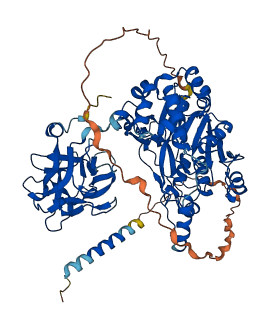
Descriptions
The autoinhibited protein was predicted that may have potential autoinhibitory elements via cis-regPred.
Autoinhibitory domains (AIDs)
Target domain |
|
Relief mechanism |
|
Assay |
cis-regPred |
Accessory elements
No accessory elements
Autoinhibited structure

Activated structure
1 structures for Q6WV16
| Entry ID | Method | Resolution | Chain | Position | Source |
|---|---|---|---|---|---|
| AF-Q6WV16-F1 | Predicted | AlphaFoldDB |
No variants for Q6WV16
| Variant ID(s) | Position | Change | Description | Diseaes Association | Provenance |
|---|---|---|---|---|---|
| No variants for Q6WV16 | |||||
No associated diseases with Q6WV16
Functions
| Description | ||
|---|---|---|
| EC Number | 2.4.1.41 | Hexosyltransferases |
| Subcellular Localization |
|
|
| PANTHER Family | ||
| PANTHER Subfamily | ||
| PANTHER Protein Class | ||
| PANTHER Pathway Category | No pathway information available | |
5 GO annotations of cellular component
| Name | Definition |
|---|---|
| endoplasmic reticulum | The irregular network of unit membranes, visible only by electron microscopy, that occurs in the cytoplasm of many eukaryotic cells. The membranes form a complex meshwork of tubular channels, which are often expanded into slitlike cavities called cisternae. The ER takes two forms, rough (or granular), with ribosomes adhering to the outer surface, and smooth (with no ribosomes attached). |
| Golgi apparatus | A membrane-bound cytoplasmic organelle of the endomembrane system that further processes the core oligosaccharides (e.g. N-glycans) added to proteins in the endoplasmic reticulum and packages them into membrane-bound vesicles. The Golgi apparatus operates at the intersection of the secretory, lysosomal, and endocytic pathways. |
| Golgi membrane | The lipid bilayer surrounding any of the compartments of the Golgi apparatus. |
| Golgi stack | The set of thin, flattened membrane-bounded compartments, called cisternae, that form the central portion of the Golgi complex. The stack usually comprises cis, medial, and trans cisternae; the cis- and trans-Golgi networks are not considered part of the stack. |
| integral component of membrane | The component of a membrane consisting of the gene products and protein complexes having at least some part of their peptide sequence embedded in the hydrophobic region of the membrane. |
3 GO annotations of molecular function
| Name | Definition |
|---|---|
| carbohydrate binding | Binding to a carbohydrate, which includes monosaccharides, oligosaccharides and polysaccharides as well as substances derived from monosaccharides by reduction of the carbonyl group (alditols), by oxidation of one or more hydroxy groups to afford the corresponding aldehydes, ketones, or carboxylic acids, or by replacement of one or more hydroxy group(s) by a hydrogen atom. Cyclitols are generally not regarded as carbohydrates. |
| metal ion binding | Binding to a metal ion. |
| polypeptide N-acetylgalactosaminyltransferase activity | Catalysis of the reaction: UDP-N-acetyl-D-galactosamine + polypeptide = UDP + N-acetyl-D-galactosaminyl-polypeptide. This reaction is the modification of serine or threonine residues in polypeptide chains by the transfer of a N-acetylgalactose from UDP-N-acetylgalactose to the hydroxyl group of the amino acid; it is the first step in O-glycan biosynthesis. |
2 GO annotations of biological process
| Name | Definition |
|---|---|
| oligosaccharide biosynthetic process | The chemical reactions and pathways resulting in the formation of oligosaccharides, molecules with between two and (about) 20 monosaccharide residues connected by glycosidic linkages. |
| protein O-linked glycosylation | A protein glycosylation process in which a carbohydrate or carbohydrate derivative unit is added to a protein via the hydroxyl group of peptidyl-serine, peptidyl-threonine, peptidyl-hydroxylysine, or peptidyl-hydroxyproline, or via the phenol group of peptidyl-tyrosine, forming an O-glycan. |
23 homologous proteins in AiPD
| UniProt AC | Gene Name | Protein Name | Species | Evidence Code |
|---|---|---|---|---|
| Q07537 | GALNT1 | Polypeptide N-acetylgalactosaminyltransferase 1 | Bos taurus (Bovine) | PR |
| Q9Y117 | Pgant3 | Polypeptide N-acetylgalactosaminyltransferase 3 | Drosophila melanogaster (Fruit fly) | PR |
| Q6WV17 | Pgant5 | Polypeptide N-acetylgalactosaminyltransferase 5 | Drosophila melanogaster (Fruit fly) | PR |
| Q9NY28 | GALNT8 | Probable polypeptide N-acetylgalactosaminyltransferase 8 | Homo sapiens (Human) | PR |
| Q7Z7M9 | GALNT5 | Polypeptide N-acetylgalactosaminyltransferase 5 | Homo sapiens (Human) | PR |
| Q10472 | GALNT1 | Polypeptide N-acetylgalactosaminyltransferase 1 | Homo sapiens (Human) | PR |
| Q8IXK2 | GALNT12 | Polypeptide N-acetylgalactosaminyltransferase 12 | Homo sapiens (Human) | PR |
| Q14435 | GALNT3 | Polypeptide N-acetylgalactosaminyltransferase 3 | Homo sapiens (Human) | PR |
| Q8IUC8 | GALNT13 | Polypeptide N-acetylgalactosaminyltransferase 13 | Homo sapiens (Human) | PR |
| Q86SR1 | GALNT10 | Polypeptide N-acetylgalactosaminyltransferase 10 | Homo sapiens (Human) | PR |
| Q49A17 | GALNTL6 | Polypeptide N-acetylgalactosaminyltransferase-like 6 | Homo sapiens (Human) | PR |
| O08912 | Galnt1 | Polypeptide N-acetylgalactosaminyltransferase 1 | Mus musculus (Mouse) | PR |
| P70419 | Galnt3 | Polypeptide N-acetylgalactosaminyltransferase 3 | Mus musculus (Mouse) | PR |
| Q921L8 | Galnt11 | Polypeptide N-acetylgalactosaminyltransferase 11 | Mus musculus (Mouse) | PR |
| Q8BGT9 | Galnt12 | Polypeptide N-acetylgalactosaminyltransferase 12 | Mus musculus (Mouse) | PR |
| Q8CF93 | Galnt13 | Polypeptide N-acetylgalactosaminyltransferase 13 | Mus musculus (Mouse) | PR |
| Q29121 | GALNT1 | Polypeptide N-acetylgalactosaminyltransferase 1 | Sus scrofa (Pig) | PR |
| O88422 | Galnt5 | Polypeptide N-acetylgalactosaminyltransferase 5 | Rattus norvegicus (Rat) | PR |
| Q10473 | Galnt1 | Polypeptide N-acetylgalactosaminyltransferase 1 | Rattus norvegicus (Rat) | PR |
| Q6UE39 | Galnt13 | Polypeptide N-acetylgalactosaminyltransferase 13 | Rattus norvegicus (Rat) | PR |
| Q925R7 | Galnt10 | Polypeptide N-acetylgalactosaminyltransferase 10 | Rattus norvegicus (Rat) | PR |
| Q7K755 | gly-11 | Putative polypeptide N-acetylgalactosaminyltransferase 11 | Caenorhabditis elegans | PR |
| P34678 | gly-3 | Polypeptide N-acetylgalactosaminyltransferase 3 | Caenorhabditis elegans | PR |
| 10 | 20 | 30 | 40 | 50 | 60 |
| MRRPNLKWIV | KASLLLLISL | TLFVLITSWI | SSTPYTNKPV | HHGVEPVPEK | AGLSGDVKVK |
| 70 | 80 | 90 | 100 | 110 | 120 |
| VPAIKQPEPQ | KPQEPDFEED | PELQKIDEPE | PVEEEVDNPH | PADDEPQQQP | QEELQMAAPA |
| 130 | 140 | 150 | 160 | 170 | 180 |
| DASVKKDWHD | YTFMEKDAKR | VGLGEGGKAS | TLDDESQRDL | EKRMSLENGF | NALLSDSISV |
| 190 | 200 | 210 | 220 | 230 | 240 |
| NRSVPDIRHP | LCRKKEYVAK | LPTVSVIIIF | YNEYLSVLMR | SVHSLINRSP | PELMKEIILV |
| 250 | 260 | 270 | 280 | 290 | 300 |
| DDHSDREYLG | KELETYIAEH | FKWVRVVRLP | RRTGLIGARA | AGARNATAEV | LIFLDSHVEA |
| 310 | 320 | 330 | 340 | 350 | 360 |
| NYNWLPPLLE | PIALNKRTAV | CPFIDVIDHT | NFHYRAQDEG | ARGAFDWEFF | YKRLPLLPED |
| 370 | 380 | 390 | 400 | 410 | 420 |
| LKHPADPFKS | PIMAGGLFAI | SREFFWELGG | YDEGLDIWGG | EQYELSFKIW | MCGGEMYDAP |
| 430 | 440 | 450 | 460 | 470 | 480 |
| CSRIGHIYRG | PRNHQPSPRK | GDYLHKNYKR | VAEVWMDEYK | NYLYSHGDGL | YESVDPGDLT |
| 490 | 500 | 510 | 520 | 530 | 540 |
| EQKAIRTKLN | CKSFKWFMEE | VAFDLMKTYP | PVDPPSYAMG | ALQNVGNQNL | CLDTLGRKKH |
| 550 | 560 | 570 | 580 | 590 | 600 |
| NKMGMYACAD | NIKTPQRTQF | WELSWKRDLR | LRRKKECLDV | QIWDANAPVW | LWDCHSQGGN |
| 610 | 620 | 630 | 640 | 650 | 660 |
| QYWYYDYRHK | QLKHGTEGRR | CLELLPFSQE | VVANKCDTDN | RFQQWNFGSF | NKTALDNYSQ |
| DLVLSL |