Q6IRE4
Gene name |
Tsg101 |
Protein name |
Tumor susceptibility gene 101 protein |
Names |
ESCRT-I complex subunit TSG101 |
Species |
Rattus norvegicus (Rat) |
KEGG Pathway |
rno:292925 |
EC number |
|
Protein Class |
|
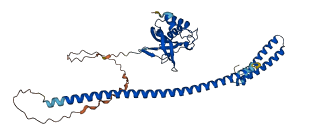
Descriptions
The autoinhibited protein was predicted that may have potential autoinhibitory elements via cis-regPred.
Autoinhibitory domains (AIDs)
Target domain |
|
Relief mechanism |
|
Assay |
cis-regPred |
Accessory elements
No accessory elements
Autoinhibited structure

Activated structure
1 structures for Q6IRE4
| Entry ID | Method | Resolution | Chain | Position | Source |
|---|---|---|---|---|---|
| AF-Q6IRE4-F1 | Predicted | AlphaFoldDB |
No variants for Q6IRE4
| Variant ID(s) | Position | Change | Description | Diseaes Association | Provenance |
|---|---|---|---|---|---|
| No variants for Q6IRE4 | |||||
No associated diseases with Q6IRE4
Functions
15 GO annotations of cellular component
| Name | Definition |
|---|---|
| cytoplasm | The contents of a cell excluding the plasma membrane and nucleus, but including other subcellular structures. |
| cytosol | The part of the cytoplasm that does not contain organelles but which does contain other particulate matter, such as protein complexes. |
| early endosome | A membrane-bounded organelle that receives incoming material from primary endocytic vesicles that have been generated by clathrin-dependent and clathrin-independent endocytosis; vesicles fuse with the early endosome to deliver cargo for sorting into recycling or degradation pathways. |
| early endosome membrane | The lipid bilayer surrounding an early endosome. |
| endosome | A vacuole to which materials ingested by endocytosis are delivered. |
| endosome membrane | The lipid bilayer surrounding an endosome. |
| ESCRT I complex | An endosomal sorting complex required for transport. It consists of the class E vacuolar protein sorting (Vps) proteins and interacts with ubiquitinated cargoes. |
| extracellular exosome | A vesicle that is released into the extracellular region by fusion of the limiting endosomal membrane of a multivesicular body with the plasma membrane. Extracellular exosomes, also simply called exosomes, have a diameter of about 40-100 nm. |
| Flemming body | A cell part that is the central region of the midbody characterized by a gap in alpha-tubulin staining. It is a dense structure of antiparallel microtubules from the central spindle in the middle of the intercellular bridge. |
| late endosome | A prelysosomal endocytic organelle differentiated from early endosomes by lower lumenal pH and different protein composition. Late endosomes are more spherical than early endosomes and are mostly juxtanuclear, being concentrated near the microtubule organizing center. |
| late endosome membrane | The lipid bilayer surrounding a late endosome. |
| microtubule organizing center | An intracellular structure that can catalyze gamma-tubulin-dependent microtubule nucleation and that can anchor microtubules by interacting with their minus ends, plus ends or sides. |
| nucleolus | A small, dense body one or more of which are present in the nucleus of eukaryotic cells. It is rich in RNA and protein, is not bounded by a limiting membrane, and is not seen during mitosis. Its prime function is the transcription of the nucleolar DNA into 45S ribosomal-precursor RNA, the processing of this RNA into 5.8S, 18S, and 28S components of ribosomal RNA, and the association of these components with 5S RNA and proteins synthesized outside the nucleolus. This association results in the formation of ribonucleoprotein precursors; these pass into the cytoplasm and mature into the 40S and 60S subunits of the ribosome. |
| nucleus | A membrane-bounded organelle of eukaryotic cells in which chromosomes are housed and replicated. In most cells, the nucleus contains all of the cell's chromosomes except the organellar chromosomes, and is the site of RNA synthesis and processing. In some species, or in specialized cell types, RNA metabolism or DNA replication may be absent. |
| plasma membrane | The membrane surrounding a cell that separates the cell from its external environment. It consists of a phospholipid bilayer and associated proteins. |
8 GO annotations of molecular function
| Name | Definition |
|---|---|
| calcium-dependent protein binding | Binding to a protein or protein complex in the presence of calcium. |
| nuclear receptor coactivator activity | A transcription coactivator activity that activates or increases the transcription of specific gene sets via binding to a DNA-bound nuclear receptor, either on its own or as part of a complex. Coactivators often act by altering chromatin structure and modifications. For example, one class of transcription coregulators modifies chromatin structure through covalent modification of histones. A second class remodels the conformation of chromatin in an ATP-dependent fashion. A third class modulates interactions of DNA-bound DNA-binding transcription factors with other transcription coregulators. A fourth class of coactivator activity is the bridging of a DNA-binding transcription factor to the general (basal) transcription machinery. The Mediator complex, which bridges sequence-specific DNA binding transcription factors and RNA polymerase, is also a transcription coactivator. |
| protein homodimerization activity | Binding to an identical protein to form a homodimer. |
| protein-containing complex binding | Binding to a macromolecular complex. |
| transcription corepressor activity | A transcription coregulator activity that represses or decreases the transcription of specific gene sets via binding to a DNA-bound DNA-binding transcription factor, either on its own or as part of a complex. Corepressors often act by altering chromatin structure and modifications. For example, one class of transcription corepressors modifies chromatin structure through covalent modification of histones. A second class remodels the conformation of chromatin in an ATP-dependent fashion. A third class modulates interactions of DNA-bound DNA-binding transcription factors with other transcription coregulators. |
| ubiquitin binding | Binding to ubiquitin, a protein that when covalently bound to other cellular proteins marks them for proteolytic degradation. |
| ubiquitin protein ligase binding | Binding to a ubiquitin protein ligase enzyme, any of the E3 proteins. |
| virion binding | Binding to a virion, either by binding to components of the capsid or the viral envelope. |
24 GO annotations of biological process
| Name | Definition |
|---|---|
| cell cycle | The progression of biochemical and morphological phases and events that occur in a cell during successive cell replication or nuclear replication events. Canonically, the cell cycle comprises the replication and segregation of genetic material followed by the division of the cell, but in endocycles or syncytial cells nuclear replication or nuclear division may not be followed by cell division. |
| cell differentiation | The process in which relatively unspecialized cells, e.g. embryonic or regenerative cells, acquire specialized structural and/or functional features that characterize the cells, tissues, or organs of the mature organism or some other relatively stable phase of the organism's life history. Differentiation includes the processes involved in commitment of a cell to a specific fate and its subsequent development to the mature state. |
| cell division | The process resulting in division and partitioning of components of a cell to form more cells; may or may not be accompanied by the physical separation of a cell into distinct, individually membrane-bounded daughter cells. |
| endosome to lysosome transport | The directed movement of substances from endosomes to lysosomes. |
| exosomal secretion | The process whereby a membrane-bounded vesicle is released into the extracellular region by fusion of the limiting endosomal membrane of a multivesicular body with the plasma membrane. |
| extracellular transport | The transport of substances that occurs outside cells. |
| keratinocyte differentiation | The process in which a relatively unspecialized cell acquires specialized features of a keratinocyte. |
| negative regulation of cell population proliferation | Any process that stops, prevents or reduces the rate or extent of cell proliferation. |
| negative regulation of DNA-templated transcription | Any process that stops, prevents, or reduces the frequency, rate or extent of cellular DNA-templated transcription. |
| negative regulation of epidermal growth factor receptor signaling pathway | Any process that stops, prevents, or reduces the frequency, rate or extent of epidermal growth factor receptor signaling pathway activity. |
| negative regulation of epidermal growth factor-activated receptor activity | Any process that stops, prevents, or reduces the frequency, rate or extent of EGF-activated receptor activity. |
| negative regulation of transcription by RNA polymerase II | Any process that stops, prevents, or reduces the frequency, rate or extent of transcription mediated by RNA polymerase II. |
| positive regulation of exosomal secretion | Any process that activates or increases the frequency, rate or extent of exosomal secretion. |
| positive regulation of ubiquitin-dependent endocytosis | Any process that activates or increases the frequency, rate or extent of ubiquitin-dependent endocytosis. |
| positive regulation of viral budding via host ESCRT complex | Any process that activates or increases the frequency, rate or extent of viral budding via host ESCRT complex. |
| protein monoubiquitination | Addition of a single ubiquitin group to a protein. |
| protein transport | The directed movement of proteins into, out of or within a cell, or between cells, by means of some agent such as a transporter or pore. |
| regulation of cell cycle | Any process that modulates the rate or extent of progression through the cell cycle. |
| regulation of cell growth | Any process that modulates the frequency, rate, extent or direction of cell growth. |
| regulation of extracellular exosome assembly | Any process that modulates the frequency, rate or extent of extracellular vesicular exosome assembly. |
| regulation of MAP kinase activity | Any process that modulates the frequency, rate or extent of MAP kinase activity. |
| ubiquitin-dependent protein catabolic process via the multivesicular body sorting pathway | The chemical reactions and pathways resulting in the breakdown of a protein or peptide covalently tagged with ubiquitin, via the multivesicular body (MVB) sorting pathway; ubiquitin-tagged proteins are sorted into MVBs, and delivered to a lysosome/vacuole for degradation. |
| viral budding | A viral process by which enveloped viruses acquire a host-derived membrane enriched in viral proteins to form their external envelope. The process starts when nucleocapsids, assembled or in the process of being built, induce formation of a membrane curvature in the host plasma or organelle membrane and wrap up in the forming bud. The process ends when the bud is eventually pinched off by membrane scission to release the enveloped particle into the lumenal or extracellular space. |
| viral release from host cell | The dissemination of mature viral particles from the host cell, e.g. by cell lysis or the budding of virus particles from the cell membrane. |
5 homologous proteins in AiPD
| UniProt AC | Gene Name | Protein Name | Species | Evidence Code |
|---|---|---|---|---|
| Q99816 | TSG101 | Tumor susceptibility gene 101 protein | Homo sapiens (Human) | PR |
| Q61187 | Tsg101 | Tumor susceptibility gene 101 protein | Mus musculus (Mouse) | PR |
| Q9FFY6 | ELCL | Protein ELC-like | Arabidopsis thaliana (Mouse-ear cress) | PR |
| Q66KB7 | uevld | Ubiquitin-conjugating enzyme E2 variant 3 | Xenopus tropicalis (Western clawed frog) (Silurana tropicalis) | PR |
| Q6DBY5 | uevld | Ubiquitin-conjugating enzyme E2 variant 3 | Danio rerio (Zebrafish) (Brachydanio rerio) | PR |
| 10 | 20 | 30 | 40 | 50 | 60 |
| MAVSESQLKK | MMSKYKYRDL | TVRQTVNVIA | MYKDLKPVLD | SYVFNDGSSR | ELVNLTGTIP |
| 70 | 80 | 90 | 100 | 110 | 120 |
| VRYRGNIYNI | PICLWLLDTY | PYNPPICFVK | PTSSMTIKTG | KHVDANGKIY | LPYLHDWKHP |
| 130 | 140 | 150 | 160 | 170 | 180 |
| RSELLELIQI | MIVIFGEEPP | VFSRPTVSAS | YPPYTAAGPP | NTSYLPSMPS | GISAYPSGYP |
| 190 | 200 | 210 | 220 | 230 | 240 |
| PNPSGYPGCP | YPPAGPYPAT | TSSQYPSQPP | VTTAGPSRDG | TISEDTIRAS | LISAVSDKLR |
| 250 | 260 | 270 | 280 | 290 | 300 |
| WRMKEEMDGA | QAELNALKRT | EEDLKKGHQK | LEEMVTRLDQ | EVAEVDKNIE | LLKKKDEELS |
| 310 | 320 | 330 | 340 | 350 | 360 |
| SALEKMENQS | ENNDIDEVII | PTAPLYKQIL | NLYAEENAIE | DTIFYLGEAL | RRGVIDLDVF |
| 370 | 380 | 390 | |||
| LKHVRLLSRK | QFQLRALMQK | ARKTAGLSDL | Y |