Q6IQT4
Gene name |
cops2 (csn2, zgc:86624) |
Protein name |
COP9 signalosome complex subunit 2 |
Names |
Signalosome subunit 2 |
Species |
Danio rerio (Zebrafish) (Brachydanio rerio) |
KEGG Pathway |
dre:415145 |
EC number |
|
Protein Class |
|
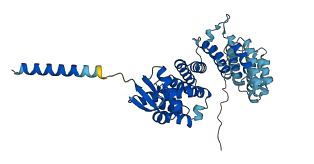
Descriptions
The autoinhibited protein was predicted that may have potential autoinhibitory elements via cis-regPred.
Autoinhibitory domains (AIDs)
Target domain |
|
Relief mechanism |
|
Assay |
cis-regPred |
Accessory elements
No accessory elements
Autoinhibited structure

Activated structure
1 structures for Q6IQT4
| Entry ID | Method | Resolution | Chain | Position | Source |
|---|---|---|---|---|---|
| AF-Q6IQT4-F1 | Predicted | AlphaFoldDB |
No variants for Q6IQT4
| Variant ID(s) | Position | Change | Description | Diseaes Association | Provenance |
|---|---|---|---|---|---|
| No variants for Q6IQT4 | |||||
No associated diseases with Q6IQT4
1 regional properties for Q6IQT4
| Type | Name | Position | InterPro Accession |
|---|---|---|---|
| domain | Polyribonucleotide 5'-hydroxyl-kinase Clp1, P-loop domain | 190 - 377 | IPR032319 |
3 GO annotations of cellular component
| Name | Definition |
|---|---|
| COP9 signalosome | A protein complex that catalyzes the deneddylation of proteins, including the cullin component of SCF ubiquitin E3 ligase; deneddylation increases the activity of cullin family ubiquitin ligases. The signalosome is involved in many regulatory process, including some which control development, in many species; also regulates photomorphogenesis in plants; in many species its subunits are highly similar to those of the proteasome. |
| cytoplasm | The contents of a cell excluding the plasma membrane and nucleus, but including other subcellular structures. |
| nucleus | A membrane-bounded organelle of eukaryotic cells in which chromosomes are housed and replicated. In most cells, the nucleus contains all of the cell's chromosomes except the organellar chromosomes, and is the site of RNA synthesis and processing. In some species, or in specialized cell types, RNA metabolism or DNA replication may be absent. |
No GO annotations of molecular function
| Name | Definition |
|---|---|
| No GO annotations for molecular function |
3 GO annotations of biological process
| Name | Definition |
|---|---|
| anatomical structure development | The biological process whose specific outcome is the progression of an anatomical structure from an initial condition to its mature state. This process begins with the formation of the structure and ends with the mature structure, whatever form that may be including its natural destruction. An anatomical structure is any biological entity that occupies space and is distinguished from its surroundings. Anatomical structures can be macroscopic such as a carpel, or microscopic such as an acrosome. |
| negative regulation of nucleic acid-templated transcription | Any process that stops, prevents or reduces the frequency, rate or extent of nucleic acid-templated transcription. |
| protein deneddylation | The removal of a ubiquitin-like protein of the NEDD8 type from a protein. |
4 homologous proteins in AiPD
| UniProt AC | Gene Name | Protein Name | Species | Evidence Code |
|---|---|---|---|---|
| P61201 | COPS2 | COP9 signalosome complex subunit 2 | Homo sapiens (Human) | PR |
| P61202 | Cops2 | COP9 signalosome complex subunit 2 | Mus musculus (Mouse) | PR |
| P61203 | Cops2 | COP9 signalosome complex subunit 2 | Rattus norvegicus (Rat) | PR |
| O01422 | csn-2 | COP9 signalosome complex subunit 2 | Caenorhabditis elegans | PR |
| 10 | 20 | 30 | 40 | 50 | 60 |
| MSDMEDDFMC | DDEEDYDLEY | SEDSNSEPNV | DLENQYYNSK | ALKEDDPKAA | LSSFQKVLEL |
| 70 | 80 | 90 | 100 | 110 | 120 |
| EGEKGEWGFK | ALKQMIKINF | KLTNFPEMMN | RYKQLLTYIR | SAVTRNYSEK | SINSILDYIS |
| 130 | 140 | 150 | 160 | 170 | 180 |
| TSKQMDLLQE | FYETTLEALK | DAKNDRLWFK | TNTKLGKLYL | EREEFGKLQK | ILRQLHQSCQ |
| 190 | 200 | 210 | 220 | 230 | 240 |
| TDDGEDDLKK | GTQLLEIYAL | EIQMYTAQKN | NKKLKALYEQ | SLHIKSAIPH | PLIMGVIREC |
| 250 | 260 | 270 | 280 | 290 | 300 |
| GGKMHLREGE | FEKAHTDFFE | AFKNYDESGS | PRRTTCLKYL | VLANMLMKSG | INPFDSQEAK |
| 310 | 320 | 330 | 340 | 350 | 360 |
| PYKNDPEILA | MTNLVSAYQN | NDITEFEKIL | KTNHSNIMDD | PFIREHIEEL | LRNIRTQVLI |
| 370 | 380 | 390 | 400 | 410 | 420 |
| KLIKPYTRIH | IPFISKELNI | DVADVESLLV | QCILDNTING | RIDQVNQLLE | LDHQKRGGAR |
| 430 | 440 | ||||
| YTALDKWTNQ | LNSLNQAIVS | KLA |