Q6IFT6
Gene name |
Ano7 (Ngep, Tmem16g) |
Protein name |
Anoctamin-7 |
Names |
New gene expressed in prostate homolog, Transmembrane protein 16G |
Species |
Rattus norvegicus (Rat) |
KEGG Pathway |
rno:367318 |
EC number |
|
Protein Class |
|
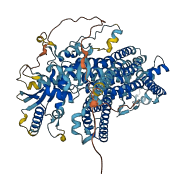
Descriptions
The autoinhibited protein was predicted that may have potential autoinhibitory elements via cis-regPred.
Autoinhibitory domains (AIDs)
Target domain |
|
Relief mechanism |
|
Assay |
cis-regPred |
Accessory elements
No accessory elements
Autoinhibited structure

Activated structure
1 structures for Q6IFT6
| Entry ID | Method | Resolution | Chain | Position | Source |
|---|---|---|---|---|---|
| AF-Q6IFT6-F1 | Predicted | AlphaFoldDB |
2 variants for Q6IFT6
| Variant ID(s) | Position | Change | Description | Diseaes Association | Provenance |
|---|---|---|---|---|---|
| rs197984476 | 834 | D>E | No | EVA | |
| rs199121640 | 846 | G>D | No | EVA |
No associated diseases with Q6IFT6
Functions
3 GO annotations of cellular component
| Name | Definition |
|---|---|
| endoplasmic reticulum | The irregular network of unit membranes, visible only by electron microscopy, that occurs in the cytoplasm of many eukaryotic cells. The membranes form a complex meshwork of tubular channels, which are often expanded into slitlike cavities called cisternae. The ER takes two forms, rough (or granular), with ribosomes adhering to the outer surface, and smooth (with no ribosomes attached). |
| integral component of membrane | The component of a membrane consisting of the gene products and protein complexes having at least some part of their peptide sequence embedded in the hydrophobic region of the membrane. |
| plasma membrane | The membrane surrounding a cell that separates the cell from its external environment. It consists of a phospholipid bilayer and associated proteins. |
4 GO annotations of molecular function
| Name | Definition |
|---|---|
| chloride channel activity | Enables the facilitated diffusion of a chloride (by an energy-independent process) involving passage through a transmembrane aqueous pore or channel without evidence for a carrier-mediated mechanism. |
| intracellular calcium activated chloride channel activity | Enables the transmembrane transfer of chloride by a channel that opens in response to stimulus by a calcium ion or ions. Transport by a channel involves catalysis of facilitated diffusion of a solute (by an energy-independent process) involving passage through a transmembrane aqueous pore or channel, without evidence for a carrier-mediated mechanism. |
| phospholipid scramblase activity | Catalysis of the movement of phospholipids from one membrane bilayer leaflet to the other, by an ATP-independent mechanism. |
| protein dimerization activity | The formation of a protein dimer, a macromolecular structure consists of two noncovalently associated identical or nonidentical subunits. |
9 GO annotations of biological process
| Name | Definition |
|---|---|
| calcium activated galactosylceramide scrambling | The movement of a population of galactosylceramide molecules from one leaflet of the plasma membrane bilayer to the opposite leaflet as a result of a calcium stimulus. |
| calcium activated phosphatidylcholine scrambling | The movement of a population of phosphatidylcholine molecules from one leaflet of the plasma membrane bilayer to the opposite leaflet as a result of a calcium stimulus. |
| calcium activated phosphatidylserine scrambling | The movement of a population of phosphatidylserine molecules from one leaflet of the plasma membrane bilayer to the opposite leaflet as a result of a calcium stimulus. |
| calcium activated phospholipid scrambling | The movement of a population of phospholipid molecules from one leaflet of the plasma membrane bilayer to the opposite leaflet as a result of a calcium stimulus. |
| chloride transmembrane transport | The process in which chloride is transported across a membrane. |
| chloride transport | The directed movement of chloride into, out of or within a cell, or between cells, by means of some agent such as a transporter or pore. |
| establishment of localization in cell | Any process, occuring in a cell, that localizes a substance or cellular component. This may occur via movement, tethering or selective degradation. |
| plasma membrane phospholipid scrambling | The movement of a population of phospholipid molecules from one leaflet of the plasma membrane bilayer to the opposite leaflet, resulting in loss of lipid asymmetry and surface exposure of phosphatidylserine (PS) and phosphatidylethanolamine (PE). |
| transmembrane transport | The process in which a solute is transported across a lipid bilayer, from one side of a membrane to the other. |
7 homologous proteins in AiPD
| UniProt AC | Gene Name | Protein Name | Species | Evidence Code |
|---|---|---|---|---|
| Q75V66 | ANO5 | Anoctamin-5 | Homo sapiens (Human) | PR |
| A1A5B4 | ANO9 | Anoctamin-9 | Homo sapiens (Human) | PR |
| Q9NQ90 | ANO2 | Anoctamin-2 | Homo sapiens (Human) | PR |
| Q6IWH7 | ANO7 | Anoctamin-7 | Homo sapiens (Human) | PR |
| A2AHL1 | Ano3 | Anoctamin-3 | Mus musculus (Mouse) | PR |
| Q8CFW1 | Ano2 | Anoctamin-2 | Mus musculus (Mouse) | PR |
| Q14AT5 | Ano7 | Anoctamin-7 | Mus musculus (Mouse) | PR |
| 10 | 20 | 30 | 40 | 50 | 60 |
| MLRKQAGEED | SVVLIDMTSP | EAGNGCSYGS | TAQASEAGKQ | QVAPSRVGSS | ANPPIDFVLV |
| 70 | 80 | 90 | 100 | 110 | 120 |
| WEEDLRSREN | PTQDKTDTHE | IWRETFLENL | RVAGLKIDQR | DVQDEAAAVH | YILLSAPWAV |
| 130 | 140 | 150 | 160 | 170 | 180 |
| LCYYAEDLRL | KLPLQELPNQ | ASNWSATLLE | WLGIPNILLE | NVPDTPPEYY | SCQFKASKLQ |
| 190 | 200 | 210 | 220 | 230 | 240 |
| WFLGSDNQDT | FFTSTKRHQI | LFEILAKTPY | GHQKKGLFGI | DQLLAEGVFS | AAFPLHDGPF |
| 250 | 260 | 270 | 280 | 290 | 300 |
| SVVPESSQVL | GLTQRQVLFK | HWARWGKWRK | YQPLDHVRRY | FGEKVALYFA | WLGFYTGWLL |
| 310 | 320 | 330 | 340 | 350 | 360 |
| PAAVVGTVVF | LAGCFLVFSD | VPTQELCHSS | DTFDMCPLCS | DCSFWLLSSA | CTLAQAGRLF |
| 370 | 380 | 390 | 400 | 410 | 420 |
| DHGGTVFFSL | FMALWAVLLL | EYWKRKNATL | AYRWDCSDYE | DIEERPRPQF | AATAPMTALN |
| 430 | 440 | 450 | 460 | 470 | 480 |
| PITGEDEPYF | PEKNRVRRML | AGSVVLLMMV | AVVIMCLVSI | ILYRAVMAII | VSKSNNAFLS |
| 490 | 500 | 510 | 520 | 530 | 540 |
| AWASRIASLT | GSVVNLVFIL | ILSKVYVILA | QVLTRWEMHR | TQTAFEDAFT | LKVFIFQFVN |
| 550 | 560 | 570 | 580 | 590 | 600 |
| FYASPVYIAF | FKGRFVGYPG | NYHTLFGVRN | EECPAGGCLS | ELAQELLVIM | VGKQIINNVQ |
| 610 | 620 | 630 | 640 | 650 | 660 |
| EVLVPKLKGC | WQKLCSRRKK | AGMGANPAPW | EADYELLPCE | GLFHEYLEMV | LQFGFVTIFV |
| 670 | 680 | 690 | 700 | 710 | 720 |
| AACPLAPLFA | LLNNWVEIRL | DARKFVCEYR | RPVAERAQDI | GIWFHILAGL | THLAVISNAF |
| 730 | 740 | 750 | 760 | 770 | 780 |
| LLAFSSDFLP | RVYYSWTRAP | DLRGFLNFTL | ARAPPTFTSA | HNRTCRYRAF | RDDDGHYSPT |
| 790 | 800 | 810 | 820 | 830 | 840 |
| YWTLLAIRLA | FVIVFEHVVF | STGRFLDLLV | PDIPESVEIK | VKREYYLAKQ | ALADNEALLG |
| 850 | |||||
| ATGVKGEQPP | SSEPSLGLPA |