Q6H1V1
Gene name |
Best3 (Vmd2l3) |
Protein name |
Bestrophin-3 |
Names |
Vitelliform macular dystrophy 2-like protein 3 |
Species |
Danio rerio (Zebrafish) (Brachydanio rerio) |
KEGG Pathway |
mmu:382427 |
EC number |
2.7.11.17: Protein-serine/threonine kinases |
Protein Class |
|
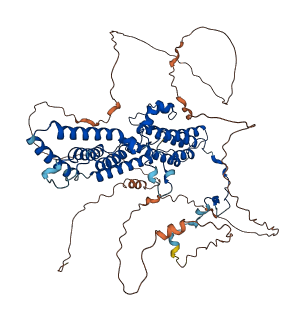
Descriptions
Autoinhibitory domains (AIDs)
Target domain |
1-486 (Bestrophin) |
Relief mechanism |
Ligand binding |
Assay |
Deletion assay, Mutagenesis experiment |
Accessory elements
No accessory elements
Autoinhibited structure

Activated structure
1 structures for Q6H1V1
| Entry ID | Method | Resolution | Chain | Position | Source |
|---|---|---|---|---|---|
| AF-Q6H1V1-F1 | Predicted | AlphaFoldDB |
37 variants for Q6H1V1
| Variant ID(s) | Position | Change | Description | Diseaes Association | Provenance |
|---|---|---|---|---|---|
| rs3389126167 | 10 | A>V | No | EVA | |
| rs3389104069 | 36 | F>C | No | EVA | |
| rs3389130663 | 37 | I>N | No | EVA | |
| rs3389126172 | 38 | V>G | No | EVA | |
| rs3389126203 | 98 | V>M | No | EVA | |
| rs3389124307 | 109 | L>F | No | EVA | |
| rs3401772199 | 116 | G>A | No | EVA | |
| rs3389129370 | 215 | N>K | No | EVA | |
| rs3389115685 | 217 | Y>N | No | EVA | |
| rs3389126182 | 234 | L>Q | No | EVA | |
| rs3389104045 | 301 | D>V | No | EVA | |
| rs3389129347 | 354 | Y>C | No | EVA | |
| rs3389130654 | 355 | C>S | No | EVA | |
| rs3389130692 | 370 | G>W | No | EVA | |
| rs244503351 | 372 | N>D | No | EVA | |
| rs3389101062 | 428 | S>C | No | EVA | |
| rs3389115752 | 430 | A>T | No | EVA | |
| rs3389137129 | 430 | A>V | No | EVA | |
| rs249610994 | 431 | R>Q | No | EVA | |
| rs3389129295 | 444 | G>D | No | EVA | |
| rs3401732630 | 464 | M>L | No | EVA | |
| rs3389120815 | 498 | V>I | No | EVA | |
| rs30914866 | 510 | A>V | No | EVA | |
| rs263317988 | 515 | S>N | No | EVA | |
| rs3389127440 | 517 | Q>H | No | EVA | |
| rs225459675 | 521 | T>A | No | EVA | |
| rs3389124317 | 562 | R>G | No | EVA | |
| rs3389137134 | 572 | E>G | No | EVA | |
| rs250715059 | 581 | S>N | No | EVA | |
| rs3389093500 | 589 | R>K | No | EVA | |
| rs249130176 | 615 | P>A | No | EVA | |
| rs249130176 | 615 | P>S | No | EVA | |
| rs257847231 | 627 | S>A | No | EVA | |
| rs226810481 | 630 | A>S | No | EVA | |
| rs3410930472 | 642 | K>M | No | EVA | |
| rs3389115738 | 652 | E>D | No | EVA | |
| rs3389127557 | 661 | T>A | No | EVA |
No associated diseases with Q6H1V1
9 regional properties for Q6H1V1
| Type | Name | Position | InterPro Accession |
|---|---|---|---|
| domain | Protein kinase domain | 645 - 900 | IPR000719 |
| domain | Ephrin receptor ligand binding domain | 35 - 216 | IPR001090 |
| domain | Serine-threonine/tyrosine-protein kinase, catalytic domain | 646 - 900 | IPR001245 |
| conserved_site | Tyrosine-protein kinase, receptor class V, conserved site | 192 - 212 | IPR001426-1 |
| conserved_site | Tyrosine-protein kinase, receptor class V, conserved site | 256 - 276 | IPR001426-2 |
| domain | Sterile alpha motif domain | 930 - 997 | IPR001660 |
| domain | Fibronectin type III | 338 - 452 | IPR003961-1 |
| domain | Fibronectin type III | 451 - 554 | IPR003961-2 |
| domain | Ephrin receptor, transmembrane domain | 570 - 642 | IPR027936 |
Functions
| Description | ||
|---|---|---|
| EC Number | 2.7.11.17 | Protein-serine/threonine kinases |
| Subcellular Localization |
|
|
| PANTHER Family | ||
| PANTHER Subfamily | ||
| PANTHER Protein Class | ||
| PANTHER Pathway Category | No pathway information available | |
2 GO annotations of cellular component
| Name | Definition |
|---|---|
| chloride channel complex | An ion channel complex through which chloride ions pass. |
| plasma membrane | The membrane surrounding a cell that separates the cell from its external environment. It consists of a phospholipid bilayer and associated proteins. |
1 GO annotations of molecular function
| Name | Definition |
|---|---|
| chloride channel activity | Enables the facilitated diffusion of a chloride (by an energy-independent process) involving passage through a transmembrane aqueous pore or channel without evidence for a carrier-mediated mechanism. |
2 GO annotations of biological process
| Name | Definition |
|---|---|
| inorganic anion transport | The directed movement of inorganic anions into, out of or within a cell, or between cells, by means of some agent such as a transporter or pore. Inorganic anions are atoms or small molecules with a negative charge which do not contain carbon in covalent linkage. |
| negative regulation of monoatomic ion transport | Any process that stops, prevents, or reduces the frequency, rate or extent of the directed movement of charged atoms or small charged molecules into, out of or within a cell, or between cells, by means of some agent such as a transporter or pore. |
12 homologous proteins in AiPD
| UniProt AC | Gene Name | Protein Name | Species | Evidence Code |
|---|---|---|---|---|
| Q8NFU0 | BEST4 | Bestrophin-4 | Homo sapiens (Human) | SS |
| O76090 | BEST1 | Bestrophin-1 | Homo sapiens (Human) | SS |
| Q8NFU1 | BEST2 | Bestrophin-2a | Homo sapiens (Human) | SS |
| Q8N1M1 | BEST3 | Bestrophin-3 | Homo sapiens (Human) | SS |
| O88870 | Best1 | Bestrophin-1 | Mus musculus (Mouse) | SS |
| Q8BGM5 | Best2 | Bestrophin-2 | Mus musculus (Mouse) | SS |
| O18303 | best-25 | Bestrophin homolog 25 | Caenorhabditis elegans | PR |
| O45435 | best-13 | Bestrophin homolog 13 | Caenorhabditis elegans | PR |
| P34319 | best-5 | Bestrophin homolog 5 | Caenorhabditis elegans | PR |
| P34672 | best-24 | Bestrophin homolog 24 | Caenorhabditis elegans | PR |
| Q19978 | best-14 | Bestrophin homolog 14 | Caenorhabditis elegans | PR |
| Q23369 | best-22 | Bestrophin homolog 22 | Caenorhabditis elegans | PR |
| 10 | 20 | 30 | 40 | 50 | 60 |
| MASTTCTRFT | DEYQLYEELG | KGAFSVVRRC | MKISTGQEYA | AKIINTKKLS | ARDHQKLERE |
| 70 | 80 | 90 | 100 | 110 | 120 |
| ARICRLLKHA | NIVRLHDSIS | EEGVHYLVFD | LVTGGELFED | IVAREYYSEA | DASHCIQQIL |
| 130 | 140 | 150 | 160 | 170 | 180 |
| EAVLHCHQMG | VVHRDLKPEN | LLLASKLKGA | AVKLADFGLA | IEVQGDQQAW | FGFAGTPGYL |
| 190 | 200 | 210 | 220 | 230 | 240 |
| SPEVLRKEPY | GKPVDMWACG | VILYILLVGY | PPFWDEDQHR | LYQQIKAGAY | DFPSPEWDTV |
| 250 | 260 | 270 | 280 | 290 | 300 |
| TPEAKDLINK | MLTINPAKRI | TAAEALKHPW | ICQRSTVASM | MHRQETVECL | KKFNARRKLK |
| 310 | 320 | 330 | 340 | 350 | 360 |
| GAILTTMLAT | RNFSSKNPYK | KPDGVKEPQT | TVIHNPTDGN | KESSESTNTT | IEDEDIKARK |
| 370 | 380 | 390 | 400 | 410 | 420 |
| QEIIKVTELL | IEAINNGEFE | AYTKICDPGL | TSFEPEALGN | LVEGTDFHRF | YFENSLSKGH |
| 430 | 440 | 450 | 460 | 470 | 480 |
| KPIHTILLNP | HVHLIGEDAA | CIAYIRLTQY | MDVNNMPRTM | QSEETRVWHR | RDGKWQNIHF |
| 490 | |||||
| HRSGSPTVPT | K |