Q60520
Gene name |
Sin3a (Kiaa4126) |
Protein name |
Paired amphipathic helix protein Sin3a |
Names |
Histone deacetylase complex subunit Sin3a, Transcriptional corepressor Sin3a |
Species |
Mus musculus (Mouse) |
KEGG Pathway |
mmu:20466 |
EC number |
|
Protein Class |
|
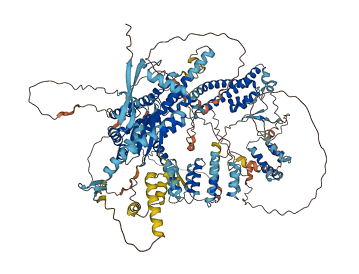
Descriptions
The autoinhibited protein was predicted that may have potential autoinhibitory elements via cis-regPred.
Autoinhibitory domains (AIDs)
Target domain |
|
Relief mechanism |
|
Assay |
cis-regPred |
Accessory elements
No accessory elements
Autoinhibited structure

Activated structure
9 structures for Q60520
55 variants for Q60520
| Variant ID(s) | Position | Change | Description | Diseaes Association | Provenance |
|---|---|---|---|---|---|
| rs3389048812 | 16 | Q>R | No | EVA | |
| rs3389048877 | 23 | S>G | No | EVA | |
| rs3389042550 | 38 | P>T | No | EVA | |
| rs3388994784 | 143 | V>I | No | EVA | |
| rs3389053098 | 158 | S>G | No | EVA | |
| rs3389042616 | 159 | I>T | No | EVA | |
| rs3389048299 | 166 | S>I | No | EVA | |
| rs3389015049 | 199 | M>I | No | EVA | |
| rs3389044511 | 213 | T>N | No | EVA | |
| rs3400109390 | 276 | R>C | No | EVA | |
| rs3389048291 | 284 | T>P | No | EVA | |
| rs3389053124 | 289 | S>P | No | EVA | |
| rs3400194603 | 349 | Y>* | No | EVA | |
| rs3389050648 | 483 | N>I | No | EVA | |
| rs3389056424 | 507 | P>S | No | EVA | |
| rs3413101720 | 511 | K>E | No | EVA | |
| rs3389044518 | 524 | G>A | No | EVA | |
| rs3389027357 | 549 | Y>D | No | EVA | |
| rs3389015015 | 593 | S>P | No | EVA | |
| rs3389048874 | 618 | F>L | No | EVA | |
| rs3389050664 | 643 | R>H | No | EVA | |
| rs3389023258 | 671 | Q>L | No | EVA | |
| rs3389023258 | 671 | Q>P | No | EVA | |
| rs3389048866 | 677 | K>T | No | EVA | |
| rs3389044723 | 709 | E>G | No | EVA | |
| rs3389036092 | 713 | G>S | No | EVA | |
| rs3389014968 | 714 | F>L | No | EVA | |
| rs3388994775 | 742 | T>I | No | EVA | |
| rs3389048311 | 768 | E>V | No | EVA | |
| rs3389015039 | 770 | A>T | No | EVA | |
| rs3389050638 | 773 | P>H | No | EVA | |
| rs3389014985 | 797 | H>N | No | EVA | |
| rs3389048252 | 829 | R>* | No | EVA | |
| rs3389044461 | 844 | D>G | No | EVA | |
| rs32801256 | 845 | V>M | No | EVA | |
| rs3389048872 | 858 | V>F | No | EVA | |
| rs3389023302 | 876 | K>T | No | EVA | |
| rs3388994791 | 935 | K>E | No | EVA | |
| rs3389056406 | 952 | M>K | No | EVA | |
| rs3389015050 | 954 | V>D | No | EVA | |
| rs3389048278 | 972 | D>Y | No | EVA | |
| rs3389040586 | 975 | I>K | No | EVA | |
| rs3389044737 | 1017 | V>F | No | EVA | |
| rs3389044696 | 1044 | R>M | No | EVA | |
| rs3389036098 | 1046 | L>H | No | EVA | |
| rs32797686 | 1061 | D>E | No | EVA | |
| rs3389053131 | 1084 | D>N | No | EVA | |
| rs3389048657 | 1175 | Y>* | No | EVA | |
| rs3389050730 | 1187 | M>L | No | EVA | |
| rs3388994795 | 1201 | E>V | No | EVA | |
| rs3400431600 | 1206 | R>H | No | EVA | |
| rs3389040632 | 1212 | Q>R | No | EVA | |
| rs3389027316 | 1248 | T>I | No | EVA | |
| rs3389041097 | 1258 | V>M | No | EVA | |
| rs3388994732 | 1259 | S>N | No | EVA |
No associated diseases with Q60520
5 regional properties for Q60520
| Type | Name | Position | InterPro Accession |
|---|---|---|---|
| repeat | Paired amphipathic helix | 119 - 189 | IPR003822-1 |
| repeat | Paired amphipathic helix | 300 - 383 | IPR003822-2 |
| repeat | Paired amphipathic helix | 457 - 526 | IPR003822-3 |
| domain | Histone deacetylase interacting domain | 551 - 651 | IPR013194 |
| domain | Sin3, C-terminal | 887 - 1187 | IPR031693 |
10 GO annotations of cellular component
| Name | Definition |
|---|---|
| chromatin | The ordered and organized complex of DNA, protein, and sometimes RNA, that forms the chromosome. |
| histone deacetylase complex | A protein complex that possesses histone deacetylase activity. |
| kinetochore | A multisubunit complex that is located at the centromeric region of DNA and provides an attachment point for the spindle microtubules. |
| nucleolus | A small, dense body one or more of which are present in the nucleus of eukaryotic cells. It is rich in RNA and protein, is not bounded by a limiting membrane, and is not seen during mitosis. Its prime function is the transcription of the nucleolar DNA into 45S ribosomal-precursor RNA, the processing of this RNA into 5.8S, 18S, and 28S components of ribosomal RNA, and the association of these components with 5S RNA and proteins synthesized outside the nucleolus. This association results in the formation of ribonucleoprotein precursors; these pass into the cytoplasm and mature into the 40S and 60S subunits of the ribosome. |
| nucleoplasm | That part of the nuclear content other than the chromosomes or the nucleolus. |
| nucleus | A membrane-bounded organelle of eukaryotic cells in which chromosomes are housed and replicated. In most cells, the nucleus contains all of the cell's chromosomes except the organellar chromosomes, and is the site of RNA synthesis and processing. In some species, or in specialized cell types, RNA metabolism or DNA replication may be absent. |
| protein-containing complex | A stable assembly of two or more macromolecules, i.e. proteins, nucleic acids, carbohydrates or lipids, in which at least one component is a protein and the constituent parts function together. |
| Sin3 complex | A multiprotein complex that functions broadly in eukaryotic organisms as a transcriptional repressor of protein-coding genes, through the gene-specific deacetylation of histones. Amongst its subunits, the Sin3 complex contains Sin3-like proteins, and a number of core proteins that are shared with the NuRD complex (including histone deacetylases and histone binding proteins). The Sin3 complex does not directly bind DNA itself, but is targeted to specific genes through protein-protein interactions with DNA-binding proteins. |
| transcription regulator complex | A protein complex that is capable of associating with DNA by direct binding, or via other DNA-binding proteins or complexes, and regulating transcription. |
| transcription repressor complex | A protein complex that possesses activity that prevents or downregulates transcription. |
8 GO annotations of molecular function
| Name | Definition |
|---|---|
| chromatin binding | Binding to chromatin, the network of fibers of DNA, protein, and sometimes RNA, that make up the chromosomes of the eukaryotic nucleus during interphase. |
| DNA binding | Any molecular function by which a gene product interacts selectively and non-covalently with DNA (deoxyribonucleic acid). |
| protein-containing complex binding | Binding to a macromolecular complex. |
| RNA binding | Binding to an RNA molecule or a portion thereof. |
| RNA polymerase II-specific DNA-binding transcription factor binding | Binding to a sequence-specific DNA binding RNA polymerase II transcription factor, any of the factors that interact selectively and non-covalently with a specific DNA sequence in order to modulate transcription. |
| transcription coactivator activity | A transcription coregulator activity that activates or increases the transcription of specific gene sets via binding to a DNA-bound DNA-binding transcription factor, either on its own or as part of a complex. Coactivators often act by altering chromatin structure and modifications. For example, one class of transcription coactivators modifies chromatin structure through covalent modification of histones. A second class remodels the conformation of chromatin in an ATP-dependent fashion. A third class modulates interactions of DNA-bound DNA-binding transcription factors with other transcription coregulators. A fourth class of coactivator activity is the bridging of a DNA-binding transcription factor to the general (basal) transcription machinery. The Mediator complex, which bridges sequence-specific DNA binding transcription factors and RNA polymerase, is also a transcription coactivator. |
| transcription corepressor activity | A transcription coregulator activity that represses or decreases the transcription of specific gene sets via binding to a DNA-bound DNA-binding transcription factor, either on its own or as part of a complex. Corepressors often act by altering chromatin structure and modifications. For example, one class of transcription corepressors modifies chromatin structure through covalent modification of histones. A second class remodels the conformation of chromatin in an ATP-dependent fashion. A third class modulates interactions of DNA-bound DNA-binding transcription factors with other transcription coregulators. |
| transcription regulator inhibitor activity | A molecular function regulator that inhibits the activity of a transcription regulator via direct binding and/or post-translational modification. |
34 GO annotations of biological process
| Name | Definition |
|---|---|
| activation of innate immune response | Any process that initiates an innate immune response. Innate immune responses are defense responses mediated by germline encoded components that directly recognize components of potential pathogens. Examples of this process include activation of the hypersensitive response of Arabidopsis thaliana and activation of any NOD or TLR signaling pathway in vertebrate species. |
| aging | A developmental process that is a deterioration and loss of function over time. Aging includes loss of functions such as resistance to disease, homeostasis, and fertility, as well as wear and tear. Aging includes cellular senescence, but is more inclusive. May precede death and may succeed developmental maturation (GO:0021700). |
| cellular response to dopamine | Any process that results in a change in state or activity of a cell (in terms of movement, secretion, enzyme production, gene expression, etc.) as a result of a dopamine stimulus. |
| cellular response to glucose stimulus | Any process that results in a change in state or activity of a cell (in terms of movement, secretion, enzyme production, gene expression, etc.) as a result of a glucose stimulus. |
| cerebral cortex neuron differentiation | The process in which a relatively unspecialized cell acquires specialized features of a neuron residing in the cerebral cortex. |
| DNA replication | The cellular metabolic process in which a cell duplicates one or more molecules of DNA. DNA replication begins when specific sequences, known as origins of replication, are recognized and bound by initiation proteins, and ends when the original DNA molecule has been completely duplicated and the copies topologically separated. The unit of replication usually corresponds to the genome of the cell, an organelle, or a virus. The template for replication can either be an existing DNA molecule or RNA. |
| hematopoietic progenitor cell differentiation | The process in which precursor cell type acquires the specialized features of a hematopoietic progenitor cell, a class of cell types including myeloid progenitor cells and lymphoid progenitor cells. |
| histone deacetylation | The modification of histones by removal of acetyl groups. |
| in utero embryonic development | The process whose specific outcome is the progression of the embryo in the uterus over time, from formation of the zygote in the oviduct, to birth. An example of this process is found in Mus musculus. |
| negative regulation of apoptotic process | Any process that stops, prevents, or reduces the frequency, rate or extent of cell death by apoptotic process. |
| negative regulation of cell migration | Any process that stops, prevents, or reduces the frequency, rate or extent of cell migration. |
| negative regulation of circadian rhythm | Any process that stops, prevents, or reduces the frequency, rate or extent of a circadian rhythm behavior. |
| negative regulation of DNA-templated transcription | Any process that stops, prevents, or reduces the frequency, rate or extent of cellular DNA-templated transcription. |
| negative regulation of histone H3-K27 acetylation | Any process that stops, prevents or reduces the frequency, rate or extent of histone H3-K27 acetylation. |
| negative regulation of protein localization to nucleus | Any process that stops, prevents or reduces the frequency, rate or extent of protein localization to nucleus. |
| negative regulation of stem cell population maintenance | Any process that stops, prevents or reduces the frequency, rate or extent of stem cell population maintenance. |
| negative regulation of transcription by RNA polymerase II | Any process that stops, prevents, or reduces the frequency, rate or extent of transcription mediated by RNA polymerase II. |
| negative regulation of transcription regulatory region DNA binding | Any process that stops, prevents or reduces the frequency, rate or extent of transcription regulatory region DNA binding. |
| negative regulation of transforming growth factor beta receptor signaling pathway | Any process that stops, prevents, or reduces the frequency, rate or extent of any TGF-beta receptor signaling pathway. |
| positive regulation of defense response to virus by host | Any host process that results in the promotion of antiviral immune response mechanisms, thereby limiting viral replication. |
| positive regulation of G2/M transition of mitotic cell cycle | Any signalling pathway that activates or increases the activity of a cell cycle cyclin-dependent protein kinase to modulate the switch from G2 phase to M phase of the mitotic cell cycle. |
| positive regulation of heterochromatin assembly | Any process that activates or increases the frequency, rate or extent of heterochromatin formation. |
| positive regulation of neuron differentiation | Any process that activates or increases the frequency, rate or extent of neuron differentiation. |
| positive regulation of stem cell population maintenance | Any process that activates or increases the frequency, rate or extent of stem cell population maintenance. |
| positive regulation of transcription by RNA polymerase II | Any process that activates or increases the frequency, rate or extent of transcription from an RNA polymerase II promoter. |
| protein deacetylation | The removal of an acetyl group from a protein amino acid. An acetyl group is CH3CO-, derived from acetic |
| protein localization | Any process in which a protein is transported to, or maintained in, a specific location. |
| regulation of axon extension | Any process that modulates the rate, direction or extent of axon extension. |
| regulation of DNA-templated transcription | Any process that modulates the frequency, rate or extent of cellular DNA-templated transcription. |
| regulation of hormone levels | Any process that modulates the levels of hormone within an organism or a tissue. A hormone is any substance formed in very small amounts in one specialized organ or group of cells and carried (sometimes in the bloodstream) to another organ or group of cells in the same organism, upon which it has a specific regulatory action. |
| regulation of transcription from RNA polymerase II promoter in response to oxidative stress | Modulation of the frequency, rate or extent of transcription from an RNA polymerase II promoter as a result of a stimulus indicating the organism is under oxidative stress, a state often resulting from exposure to high levels of reactive oxygen species, e.g. superoxide anions, hydrogen peroxide (H2O2), and hydroxyl radicals. |
| response to methylglyoxal | Any process that results in a change in state or activity of a cell or an organism (in terms of movement, secretion, enzyme production, gene expression, etc.) as a result of a methylglyoxal stimulus. Methylglyoxal is a 2-oxoaldehyde derived from propanal. |
| response to organonitrogen compound | Any process that results in a change in state or activity of a cell or an organism (in terms of movement, secretion, enzyme production, gene expression, etc.) as a result of an organonitrogen stimulus. An organonitrogen compound is formally a compound containing at least one carbon-nitrogen bond. |
| rhythmic process | Any process pertinent to the generation and maintenance of rhythms in the physiology of an organism. |
4 homologous proteins in AiPD
| UniProt AC | Gene Name | Protein Name | Species | Evidence Code |
|---|---|---|---|---|
| O75182 | SIN3B | Paired amphipathic helix protein Sin3b | Homo sapiens (Human) | PR |
| Q96ST3 | SIN3A | Paired amphipathic helix protein Sin3a | Homo sapiens (Human) | PR |
| Q62141 | Sin3b | Paired amphipathic helix protein Sin3b | Mus musculus (Mouse) | PR |
| Q9XIK6 | SNL6 | Paired amphipathic helix protein Sin3-like 6 | Arabidopsis thaliana (Mouse-ear cress) | PR |
| 10 | 20 | 30 | 40 | 50 | 60 |
| MKRRLDDQES | PVYAAQQRRI | PGSTEAFSHQ | HRVLAPAPPV | YEAVSETMQS | ATGIQYSVAP |
| 70 | 80 | 90 | 100 | 110 | 120 |
| NYQVSAVPQS | SGSHGPAIAA | VHSSHHHPTA | VQPHGGQVVQ | SHAHPAPPVA | PVQGQQQFQR |
| 130 | 140 | 150 | 160 | 170 | 180 |
| LKVEDALSYL | DQVKLQFGSQ | PQVYNDFLDI | MKEFKSQSID | TPGVISRVSQ | LFKGHPDLIM |
| 190 | 200 | 210 | 220 | 230 | 240 |
| GFNTFLPPGY | KIEVQTNDMV | NVTTPGQVHQ | IPTHGIQPQP | QPPPQHPSQP | SSQSAPTPAQ |
| 250 | 260 | 270 | 280 | 290 | 300 |
| PAPQPTAAKV | SKPSQLQAHT | PASQQTPPLP | PYASPRSPPV | QPHTPVTISL | GTAPSLQNNQ |
| 310 | 320 | 330 | 340 | 350 | 360 |
| PVEFNHAINY | VNKIKNRFQG | QPDIYKAFLE | ILHTYQKEQR | NAKEAGGNYT | PALTEQEVYA |
| 370 | 380 | 390 | 400 | 410 | 420 |
| QVARLFKNQE | DLLSEFGQFL | PDANSSVLLS | KTTAEKVDSV | RNDHGGTVKK | PQLNNKPQRP |
| 430 | 440 | 450 | 460 | 470 | 480 |
| SQNGCQIRRH | SGTGATPPVK | KKPKLMSLKE | SSMADASKHG | VGTESLFFDK | VRKALRSAEA |
| 490 | 500 | 510 | 520 | 530 | 540 |
| YENFLRCLVI | FNQEVISRAE | LVQLVSPFLG | KFPELFNWFK | NFLGYKESVH | LESFPKERAT |
| 550 | 560 | 570 | 580 | 590 | 600 |
| EGIAMEIDYA | SCKRLGSSYR | ALPKSYQQPK | CTGRTPLCKE | VLNDTWVSFP | SWSEDSTFVS |
| 610 | 620 | 630 | 640 | 650 | 660 |
| SKKTQYEEHI | YRCEDERFEL | DVVLETNLAT | IRVLEAIQKK | LSRLSAEEQA | KFRLDNTLGG |
| 670 | 680 | 690 | 700 | 710 | 720 |
| TSEVIHRKAL | QRIYADKAAD | IIDGLRKNPS | IAVPIVLKRL | KMKEEEWREA | QRGFNKVWRE |
| 730 | 740 | 750 | 760 | 770 | 780 |
| QNEKYYLKSL | DHQGINFKQN | DTKVLRSKSL | LNEIESIYDE | RQEQATEENA | GVPVGPHLSL |
| 790 | 800 | 810 | 820 | 830 | 840 |
| AYEDKQILED | AAALIIHHVK | RQTGIQKEDK | YKIKQIMHHF | IPDLLFAQRG | DLSDVEEEEE |
| 850 | 860 | 870 | 880 | 890 | 900 |
| EEMDVDEATG | APKKHNGVGG | SPPKSKLLFS | NTAAQKLRGM | DEVYNLFYVN | NNWYIFMRLH |
| 910 | 920 | 930 | 940 | 950 | 960 |
| QILCLRLLRI | CSQAERQIEE | ENREREWERE | VLGIKRDKSD | SPAIQLRLKE | PMDVDVEDYY |
| 970 | 980 | 990 | 1000 | 1010 | 1020 |
| PAFLDMVRSL | LDGNIDSSQY | EDSLREMFTI | HAYIAFTMDK | LIQSIVRQLQ | HIVSDEVCVQ |
| 1030 | 1040 | 1050 | 1060 | 1070 | 1080 |
| VTDLYLAENN | NGATGGQLNS | QTSRSLLESA | YQRKAEQLMS | DENCFKLMFI | QSQGQVQLTV |
| 1090 | 1100 | 1110 | 1120 | 1130 | 1140 |
| ELLDTEEENS | DDPVEAERWS | DYVERYMSSD | TTSPELREHL | AQKPVFLPRN | LRRIRKCQRG |
| 1150 | 1160 | 1170 | 1180 | 1190 | 1200 |
| REQQEKEGKE | GNSKKTMENV | ESLDKLECRF | KLNSYKMVYV | IKSEDYMYRR | TALLRAHQSH |
| 1210 | 1220 | 1230 | 1240 | 1250 | 1260 |
| ERVSKRLHQR | FQAWVDKWTK | EHVPREMAAE | TSKWLMGEGL | EGLVPCTTTC | DTETLHFVSI |
| 1270 | |||||
| NKYRVKYGTV | FKAP |