Q5ZLG8
Gene name |
TAPT1 (RCJMB04_6d24) |
Protein name |
Transmembrane anterior posterior transformation protein 1 homolog |
Names |
|
Species |
Gallus gallus (Chicken) |
KEGG Pathway |
gga:422824 |
EC number |
|
Protein Class |
|
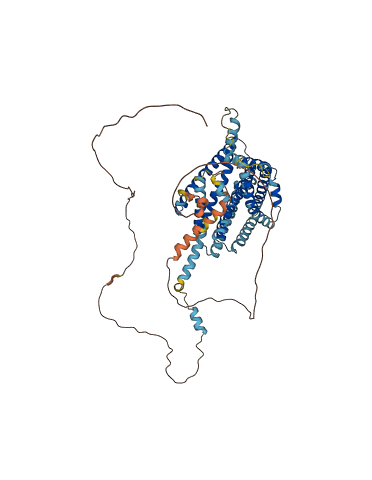
Descriptions
The autoinhibited protein was predicted that may have potential autoinhibitory elements via cis-regPred.
Autoinhibitory domains (AIDs)
Target domain |
|
Relief mechanism |
|
Assay |
cis-regPred |
Accessory elements
No accessory elements
Autoinhibited structure

Activated structure
1 structures for Q5ZLG8
| Entry ID | Method | Resolution | Chain | Position | Source |
|---|---|---|---|---|---|
| AF-Q5ZLG8-F1 | Predicted | AlphaFoldDB |
No variants for Q5ZLG8
| Variant ID(s) | Position | Change | Description | Diseaes Association | Provenance |
|---|---|---|---|---|---|
| No variants for Q5ZLG8 | |||||
1 associated diseases with Q5ZLG8
[MIM: 242840]: Vici syndrome (VICIS)
A rare congenital multisystem disorder characterized by agenesis of the corpus callosum, cataracts, pigmentary defects, progressive cardiomyopathy, and variable immunodeficiency. Affected individuals also have profound psychomotor retardation and hypotonia due to a myopathy. {ECO:0000269|PubMed:23222957, ECO:0000269|PubMed:25331754, ECO:0000269|PubMed:26917586, ECO:0000269|PubMed:27343256, ECO:0000269|PubMed:28168853, ECO:0000269|PubMed:29130391}. Note=The disease is caused by variants affecting the gene represented in this entry. Affected individuals show homozygosity or compound heterozygosity for truncating mutations, aberrant splicing and/or missense mutations. Parental studies suggest recessive inheritance with no carrier manifestation (PubMed:23222957). {ECO:0000269|PubMed:23222957}.
Without disease ID
- A rare congenital multisystem disorder characterized by agenesis of the corpus callosum, cataracts, pigmentary defects, progressive cardiomyopathy, and variable immunodeficiency. Affected individuals also have profound psychomotor retardation and hypotonia due to a myopathy. {ECO:0000269|PubMed:23222957, ECO:0000269|PubMed:25331754, ECO:0000269|PubMed:26917586, ECO:0000269|PubMed:27343256, ECO:0000269|PubMed:28168853, ECO:0000269|PubMed:29130391}. Note=The disease is caused by variants affecting the gene represented in this entry. Affected individuals show homozygosity or compound heterozygosity for truncating mutations, aberrant splicing and/or missense mutations. Parental studies suggest recessive inheritance with no carrier manifestation (PubMed:23222957). {ECO:0000269|PubMed:23222957}.
No regional properties for Q5ZLG8
| Type | Name | Position | InterPro Accession |
|---|---|---|---|
| No domain, repeats, and functional sites for Q5ZLG8 | |||
Functions
3 GO annotations of cellular component
| Name | Definition |
|---|---|
| centrosome | A structure comprised of a core structure (in most organisms, a pair of centrioles) and peripheral material from which a microtubule-based structure, such as a spindle apparatus, is organized. Centrosomes occur close to the nucleus during interphase in many eukaryotic cells, though in animal cells it changes continually during the cell-division cycle. |
| ciliary basal body | A membrane-tethered, short cylindrical array of microtubules and associated proteins found at the base of a eukaryotic cilium (also called flagellum) that is similar in structure to a centriole and derives from it. The cilium basal body is the site of assembly and remodelling of the cilium and serves as a nucleation site for axoneme growth. As well as anchoring the cilium, it is thought to provide a selective gateway regulating the entry of ciliary proteins and vesicles by intraflagellar transport. |
| integral component of endoplasmic reticulum membrane | The component of the endoplasmic reticulum membrane consisting of the gene products and protein complexes having at least some part of their peptide sequence embedded in the hydrophobic region of the membrane. |
No GO annotations of molecular function
| Name | Definition |
|---|---|
| No GO annotations for molecular function |
8 GO annotations of biological process
| Name | Definition |
|---|---|
| cartilage development | The process whose specific outcome is the progression of a cartilage element over time, from its formation to the mature structure. Cartilage elements are skeletal elements that consist of connective tissue dominated by extracellular matrix containing collagen type II and large amounts of proteoglycan, particularly chondroitin sulfate. |
| cell projection organization | A process that is carried out at the cellular level which results in the assembly, arrangement of constituent parts, or disassembly of a prolongation or process extending from a cell, e.g. a flagellum or axon. |
| maintenance of protein localization in endoplasmic reticulum | Any process in which a protein is maintained in the endoplasmic reticulum and prevented from moving elsewhere. These include sequestration within the endoplasmic reticulum, protein stabilization to prevent transport elsewhere and the active retrieval of proteins that escape the endoplasmic reticulum. |
| neural crest cell development | The process aimed at the progression of a neural crest cell over time, from initial commitment of the cell to its specific fate, to the fully functional differentiated cell. |
| ossification | The formation of bone or of a bony substance, or the conversion of fibrous tissue or of cartilage into bone or a bony substance. |
| positive regulation of bone development | Any process that activates or increases the frequency, rate or extent of bone development. |
| positive regulation of cartilage development | Any process that increases the rate, frequency, or extent of cartilage development, the process whose specific outcome is the progression of the cartilage over time, from its formation to the mature structure. Cartilage is a connective tissue dominated by extracellular matrix containing collagen type II and large amounts of proteoglycan, particularly chondroitin sulfate. |
| positive regulation of cilium assembly | Any process that activates or increases the frequency, rate or extent of the formation of a cilium. |
3 homologous proteins in AiPD
| UniProt AC | Gene Name | Protein Name | Species | Evidence Code |
|---|---|---|---|---|
| P40085 | EMP65 | Endoplasmic reticulum membrane protein 65 | Saccharomyces cerevisiae (strain ATCC 204508 / S288c) (Baker's yeast) | PR |
| Q4VBD2 | Tapt1 | Transmembrane anterior posterior transformation protein 1 | Mus musculus (Mouse) | PR |
| Q9U3H8 | F26F2.7 | Protein TAPT1 homolog | Caenorhabditis elegans | PR |
| 10 | 20 | 30 | 40 | 50 | 60 |
| MAGVSDAAAP | GSGGEGRRGG | GGSPEQLQQD | GCRGEPKTLW | GSSELRPPPA | GPGQPSPHQR |
| 70 | 80 | 90 | 100 | 110 | 120 |
| TETLGFYESD | RGRKKKRGLS | DLSLLRFISA | ELTRGYFLEH | NEAKYTERRE | RVYTCMRIPK |
| 130 | 140 | 150 | 160 | 170 | 180 |
| ELEKLMFFGI | FLCLDAFLYI | FTLLPLRVFL | AMFRFITLPC | YGLRDRRLLQ | PAQVCDILKG |
| 190 | 200 | 210 | 220 | 230 | 240 |
| VILVICYFMM | HYVDYSMMYH | LIRGQSVIKL | YIIYNMLEVA | DRLFSSFGQD | ILDALYWTAT |
| 250 | 260 | 270 | 280 | 290 | 300 |
| EPKERKRAHI | GVIPHFFMAV | LYVFLHAILI | MVQATTLNVA | FNSHNKSLLT | IMMSNNFVEI |
| 310 | 320 | 330 | 340 | 350 | 360 |
| KGSVFKKFEK | NNLFQMSNSD | IKERFTNYVL | LLIVCLRNME | QFSWNPDHLW | VLFPDVCMVV |
| 370 | 380 | 390 | 400 | 410 | 420 |
| ASEIAVDIVK | HAFITKFNDI | TADVYSEYRA | SLAFDLVSSR | QKNAYTDYSD | SVSRRMGFIP |
| 430 | 440 | 450 | 460 | 470 | 480 |
| LPLAVLLMRV | VTSSIKVQGV | LAYVCVVLFY | CGLISLKVLN | SIVLLGKSCQ | YVKEAKMEEK |
| 490 | 500 | 510 | 520 | 530 | 540 |
| LFNPVPSASA | GKPAGKPQSM | FKSTHGFSTD | ENGSTSVTNQ | PVHQKDSPPS | LLVTSNSDQF |
| 550 | 560 | 570 | 580 | ||
| LTTPDGEEKD | ISQDSSELKH | RSSKKDLLEI | DRFTICGNRI | D |