Q5ZKS6
Gene name |
BECN1 (RCJMB04_9f22) |
Protein name |
Beclin-1 |
Names |
|
Species |
Gallus gallus (Chicken) |
KEGG Pathway |
gga:420018 |
EC number |
|
Protein Class |
|
Descriptions
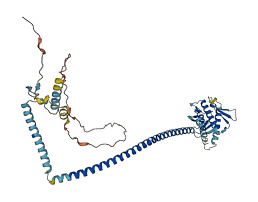
The autoinhibited protein was predicted that may have potential autoinhibitory elements via cis-regPred.
Autoinhibitory domains (AIDs)
Target domain |
|
Relief mechanism |
|
Assay |
cis-regPred |
Accessory elements
No accessory elements
Autoinhibited structure

Activated structure
1 structures for Q5ZKS6
| Entry ID | Method | Resolution | Chain | Position | Source |
|---|---|---|---|---|---|
| AF-Q5ZKS6-F1 | Predicted | AlphaFoldDB |
No variants for Q5ZKS6
| Variant ID(s) | Position | Change | Description | Diseaes Association | Provenance |
|---|---|---|---|---|---|
| No variants for Q5ZKS6 | |||||
No associated diseases with Q5ZKS6
Functions
9 GO annotations of cellular component
| Name | Definition |
|---|---|
| autophagosome | A double-membrane-bounded compartment that engulfs endogenous cellular material as well as invading microorganisms to target them to the lytic vacuole/lysosome for degradation as part of macroautophagy. |
| cytosol | The part of the cytoplasm that does not contain organelles but which does contain other particulate matter, such as protein complexes. |
| endoplasmic reticulum membrane | The lipid bilayer surrounding the endoplasmic reticulum. |
| endosome membrane | The lipid bilayer surrounding an endosome. |
| Golgi apparatus | A membrane-bound cytoplasmic organelle of the endomembrane system that further processes the core oligosaccharides (e.g. N-glycans) added to proteins in the endoplasmic reticulum and packages them into membrane-bound vesicles. The Golgi apparatus operates at the intersection of the secretory, lysosomal, and endocytic pathways. |
| mitochondrial membrane | Either of the lipid bilayers that surround the mitochondrion and form the mitochondrial envelope. |
| phagophore assembly site | Punctate structures proximal to the endoplasmic reticulum which are the sites where the Atg machinery assembles upon autophagy induction. |
| phosphatidylinositol 3-kinase complex, class III, type I | A class III phosphatidylinositol 3-kinase complex that is involved in autophagy. In budding yeast, this complex consists of Vps30p, Vps34p, Apg14p and Vps15p. |
| phosphatidylinositol 3-kinase complex, class III, type II | A class III phosphatidylinositol 3-kinase complex that is involved in vacuolar protein sorting (VPS) via endosomes. In budding yeast, this complex consists of Vps30p, Vps34p, Vps38 and Vps15p. |
No GO annotations of molecular function
| Name | Definition |
|---|---|
| No GO annotations for molecular function |
11 GO annotations of biological process
| Name | Definition |
|---|---|
| autophagosome assembly | The formation of a double membrane-bounded structure, the autophagosome, that occurs when a specialized membrane sac, called the isolation membrane, starts to enclose a portion of the cytoplasm. |
| cell cycle | The progression of biochemical and morphological phases and events that occur in a cell during successive cell replication or nuclear replication events. Canonically, the cell cycle comprises the replication and segregation of genetic material followed by the division of the cell, but in endocycles or syncytial cells nuclear replication or nuclear division may not be followed by cell division. |
| cell division | The process resulting in division and partitioning of components of a cell to form more cells; may or may not be accompanied by the physical separation of a cell into distinct, individually membrane-bounded daughter cells. |
| cellular response to nitrogen starvation | Any process that results in a change in state or activity of a cell (in terms of movement, secretion, enzyme production, gene expression, etc.) as a result of deprivation of nitrogen. |
| defense response to virus | Reactions triggered in response to the presence of a virus that act to protect the cell or organism. |
| early endosome to late endosome transport | The directed movement of substances, in membrane-bounded vesicles, from the early sorting endosomes to the late sorting endosomes; transport occurs along microtubules and can be experimentally blocked with microtubule-depolymerizing drugs. |
| endocytosis | A vesicle-mediated transport process in which cells take up external materials or membrane constituents by the invagination of a small region of the plasma membrane to form a new membrane-bounded vesicle. |
| late endosome to vacuole transport | The directed movement of substances from late endosomes to the vacuole. In yeast, after transport to the prevacuolar compartment, endocytic content is delivered to the late endosome and on to the vacuole. This pathway is analogous to endosome to lysosome transport. |
| positive regulation of autophagy | Any process that activates, maintains or increases the rate of autophagy. Autophagy is the process in which cells digest parts of their own cytoplasm. |
| regulation of cytokinesis | Any process that modulates the frequency, rate or extent of the division of the cytoplasm of a cell and its separation into two daughter cells. |
| regulation of response to stimulus | Any process that modulates the frequency, rate or extent of a response to a stimulus. Response to stimulus is a change in state or activity of a cell or an organism (in terms of movement, secretion, enzyme production, gene expression, etc.) as a result of a stimulus. |
7 homologous proteins in AiPD
| UniProt AC | Gene Name | Protein Name | Species | Evidence Code |
|---|---|---|---|---|
| Q4A1L4 | BECN1 | Beclin-1 | Bos taurus (Bovine) | PR |
| A8MW95 | BECN2 | Beclin-2 | Homo sapiens (Human) | PR |
| Q14457 | BECN1 | Beclin-1 | Homo sapiens (Human) | PR |
| O88597 | Becn1 | Beclin-1 | Mus musculus (Mouse) | PR |
| Q4A1L5 | BECN1 | Beclin-1 | Sus scrofa (Pig) | PR |
| Q91XJ1 | Becn1 | Beclin-1 | Rattus norvegicus (Rat) | PR |
| Q4A1L3 | becn1 | Beclin-1 | Xenopus tropicalis (Western clawed frog) (Silurana tropicalis) | PR |
| 10 | 20 | 30 | 40 | 50 | 60 |
| MEGGRAPACT | TQVSFVCQRC | SQPLKLDTSF | KILDRLTIQE | LTAPPLTAAP | ARPGDAQEES |
| 70 | 80 | 90 | 100 | 110 | 120 |
| ALSEEAFTEG | RQDGVSRRFI | PPARMMSTES | ANSFTLIGEA | SDGGTMENLS | RRLKVTGDLF |
| 130 | 140 | 150 | 160 | 170 | 180 |
| DIMSGQTDVD | HPLCEECTDT | LLDQLDTQLN | ITENECQNYK | RCLEILEKMN | EDDKEKLQTE |
| 190 | 200 | 210 | 220 | 230 | 240 |
| LKELALEEEQ | LIQELEDVEK | NRKIVAEDFE | RVRAEAERLE | QEEAQYQKEY | CEFKRQQLEL |
| 250 | 260 | 270 | 280 | 290 | 300 |
| DDELKSVENQ | MRYAQMQLDK | LKKTNVFNAT | FHIWHSGQFG | TINNFRLGRL | PSVPVEWNEI |
| 310 | 320 | 330 | 340 | 350 | 360 |
| NAAWGQTVLL | LHALANKMGL | KFQRYRLVPY | GNHSYLESLT | DKSKELPLYC | SGGLRFFWDN |
| 370 | 380 | 390 | 400 | 410 | 420 |
| KFDHAMVAFL | DCVQQFKEEV | EKGETRFCLP | YRMDVEKGKI | EDTGGSGGSY | SIKTQFNSEE |
| 430 | 440 | ||||
| QWTKALKFML | TNLKWGLAWV | SSQFYNK |