Q5XI65
Gene name |
Drc1 (Ccdc164) |
Protein name |
Dynein regulatory complex protein 1 |
Names |
Coiled-coil domain-containing protein 164 |
Species |
Rattus norvegicus (Rat) |
KEGG Pathway |
rno:362712 |
EC number |
|
Protein Class |
|
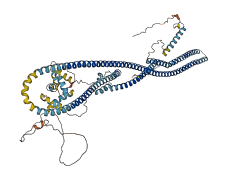
Descriptions
The autoinhibited protein was predicted that may have potential autoinhibitory elements via cis-regPred.
Autoinhibitory domains (AIDs)
Target domain |
|
Relief mechanism |
|
Assay |
cis-regPred |
Accessory elements
No accessory elements
Autoinhibited structure

Activated structure
1 structures for Q5XI65
| Entry ID | Method | Resolution | Chain | Position | Source |
|---|---|---|---|---|---|
| AF-Q5XI65-F1 | Predicted | AlphaFoldDB |
1 variants for Q5XI65
| Variant ID(s) | Position | Change | Description | Diseaes Association | Provenance |
|---|---|---|---|---|---|
| rs3320604656 | 604 | T>I | No | EVA |
No associated diseases with Q5XI65
4 GO annotations of cellular component
| Name | Definition |
|---|---|
| axonemal dynein complex | A dynein complex found in eukaryotic cilia and flagella; the motor domain heads interact with adjacent microtubules to generate a sliding force which is converted to a bending motion. |
| axoneme | The bundle of microtubules and associated proteins that forms the core of cilia (also called flagella) in eukaryotic cells and is responsible for their movements. |
| cytosol | The part of the cytoplasm that does not contain organelles but which does contain other particulate matter, such as protein complexes. |
| motile cilium | A cilium which may have a variable arrangement of axonemal microtubules and also contains molecular motors. It may beat with a whip-like pattern that promotes cell motility or transport of fluids and other cells across a cell surface, such as on epithelial cells that line the lumenal ducts of various tissues; or they may display a distinct twirling motion that directs fluid flow asymmetrically across the cellular surface to affect asymmetric body plan organization. Motile cilia can be found in single as well as multiple copies per cell. |
No GO annotations of molecular function
| Name | Definition |
|---|---|
| No GO annotations for molecular function |
5 GO annotations of biological process
| Name | Definition |
|---|---|
| axonemal dynein complex assembly | The aggregation, arrangement and bonding together of a set of components to form an axonemal dynein complex, a dynein complex found in eukaryotic cilia and flagella, in which the motor domain heads interact with adjacent microtubules to generate a sliding force which is converted to a bending motion. |
| cilium-dependent cell motility | Cell motility due to the motion of one or more eukaryotic cilia. A eukaryotic cilium is a specialized organelle that consists of a filiform extrusion of the cell surface. Each cilium is bounded by an extrusion of the cytoplasmic (plasma) membrane, and contains a regular longitudinal array of microtubules, anchored basally in a centriole. |
| determination of left/right symmetry | The establishment of an organism's body plan or part of an organism with respect to the left and right halves. The pattern can either be symmetric, such that the halves are mirror images, or asymmetric where the pattern deviates from this symmetry. |
| heart development | The process whose specific outcome is the progression of the heart over time, from its formation to the mature structure. The heart is a hollow, muscular organ, which, by contracting rhythmically, keeps up the circulation of the blood. |
| regulation of cilium movement | Any process that modulates the rate, frequency, or extent of cilium movement, the directed, self-propelled movement of a cilium. |
4 homologous proteins in AiPD
| UniProt AC | Gene Name | Protein Name | Species | Evidence Code |
|---|---|---|---|---|
| Q32KY1 | DRC1 | Dynein regulatory complex protein 1 | Bos taurus (Bovine) | PR |
| Q9W3J8 | CG10958 | Dynein regulatory complex protein 1 homolog | Drosophila melanogaster (Fruit fly) | PR |
| Q96MC2 | DRC1 | Dynein regulatory complex protein 1 | Homo sapiens (Human) | PR |
| Q3USS3 | Drc1 | Dynein regulatory complex protein 1 | Mus musculus (Mouse) | PR |
| 10 | 20 | 30 | 40 | 50 | 60 |
| MNPSGSIGVL | EQNGEEHLAA | PILGPSVNSD | NPQERIQARR | LRIAARQEAR | RREALGEYLD |
| 70 | 80 | 90 | 100 | 110 | 120 |
| GKKESEEEQS | KSYKQKEESR | LKLTKLLLCG | TELVTNIQVA | ADIREIHRRV | EEEETKRQRL |
| 130 | 140 | 150 | 160 | 170 | 180 |
| EKLENEVKTS | QDKFDEITSK | WEEGRQKRIP | QELWEMLNNQ | QVHCAGLVED | KNKLISELQQ |
| 190 | 200 | 210 | 220 | 230 | 240 |
| ELKIKDDQYV | KDLKKQSEDI | TVLLERMEEQ | VKSVMKNFRQ | ELNYIEKAFE | SERQELLTTN |
| 250 | 260 | 270 | 280 | 290 | 300 |
| KKKWERALQA | HNAKELEYLI | NRMKRVEDYE | KQLNRQRVWD | CEEYNSIKIK | LEQDVQILEQ |
| 310 | 320 | 330 | 340 | 350 | 360 |
| QLQQMKATYQ | LNQEKLEYNF | QVLKKRDEES | TVIKSQQKRK | LNRLHDILNN | LRTKYSKQIK |
| 370 | 380 | 390 | 400 | 410 | 420 |
| QFQEDNQSLT | SDYKRLVTQF | KDLQKAIRHF | IIIDQDKFRE | IWLMNEAEAK | ELAQRAFDVD |
| 430 | 440 | 450 | 460 | 470 | 480 |
| KIIHSQHLGL | PWKIPNFWFL | NNVGPISLQQ | QQKSVTQILE | ELLLQSEDEG | TETAMSEDES |
| 490 | 500 | 510 | 520 | 530 | 540 |
| YMDLPNQVSA | KTTKKILVLL | CDESGFLIES | KLLSLLLPLE | KSECYLLRLD | AIFSALGIES |
| 550 | 560 | 570 | 580 | 590 | 600 |
| EDDLYKMVNF | FLRFKAHHLS | SAQVSISTHS | NAERTSLVSA | LQHMSLMSQT | DRRSSASKSD |
| 610 | 620 | 630 | 640 | 650 | 660 |
| GDPTELEDQQ | GSDNGSLMGR | ELVEQEDLSS | PMFIHPNDVL | KILDAFVTGL | KKPKDARPVQ |
| 670 | 680 | 690 | 700 | 710 | 720 |
| RLKKDTRNNL | KDTEYWESLA | MVIPFSKQNL | WDALFKALEK | YYLVLTQRAK | LLMENDSLEQ |
| 730 | 740 | 750 | |||
| QNAEMQSLLQ | QYLQAKVNLE | LQVPPTQGFR | MPSK |