Q5M7N9
Gene name |
esyt3 (fam62c) |
Protein name |
Extended synaptotagmin-3 |
Names |
E-Syt3 |
Species |
Xenopus tropicalis (Western clawed frog) (Silurana tropicalis) |
KEGG Pathway |
xtr:496831 |
EC number |
|
Protein Class |
|
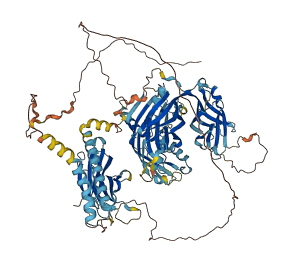
Descriptions
The autoinhibited protein was predicted that may have potential autoinhibitory elements via cis-regPred.
Autoinhibitory domains (AIDs)
Target domain |
|
Relief mechanism |
|
Assay |
cis-regPred |
Accessory elements
No accessory elements
Autoinhibited structure

Activated structure
1 structures for Q5M7N9
| Entry ID | Method | Resolution | Chain | Position | Source |
|---|---|---|---|---|---|
| AF-Q5M7N9-F1 | Predicted | AlphaFoldDB |
No variants for Q5M7N9
| Variant ID(s) | Position | Change | Description | Diseaes Association | Provenance |
|---|---|---|---|---|---|
| No variants for Q5M7N9 | |||||
2 associated diseases with Q5M7N9
[MIM: 609033]: Posterior column ataxia with retinitis pigmentosa (PCARP)
A neurodegenerative syndrome beginning in infancy with areflexia and retinitis pigmentosa. Nyctalopia (night blindness) and peripheral visual field loss are usually evident during late childhood or teenage years, with subsequent progressive constriction of the visual fields and loss of central retinal function over time. A sensory ataxia caused by degeneration of the posterior columns of the spinal cord results in a loss of proprioceptive sensation that is clinically evident in the second decade of life and gradually progresses. Scoliosis, camptodactyly, achalasia, gastrointestinal dysmotility, and a sensory peripheral neuropathy are variable features of the disease. Affected individuals have no clinical or radiological evidence of cerebral or cerebellar involvement. {ECO:0000269|PubMed:21070897, ECO:0000269|PubMed:21267618}. Note=The disease is caused by variants affecting the gene represented in this entry. Defective neuronal heme transmembrane export due to FLVCR1 mutations may abrogate the neuroprotective effects of neuroglobin and initiate an apoptotic cascade that results in the selective degeneration of photoreceptors in the neurosensory retina and sensory neurons in the posterior spinal cord.
Without disease ID
- A neurodegenerative syndrome beginning in infancy with areflexia and retinitis pigmentosa. Nyctalopia (night blindness) and peripheral visual field loss are usually evident during late childhood or teenage years, with subsequent progressive constriction of the visual fields and loss of central retinal function over time. A sensory ataxia caused by degeneration of the posterior columns of the spinal cord results in a loss of proprioceptive sensation that is clinically evident in the second decade of life and gradually progresses. Scoliosis, camptodactyly, achalasia, gastrointestinal dysmotility, and a sensory peripheral neuropathy are variable features of the disease. Affected individuals have no clinical or radiological evidence of cerebral or cerebellar involvement. {ECO:0000269|PubMed:21070897, ECO:0000269|PubMed:21267618}. Note=The disease is caused by variants affecting the gene represented in this entry. Defective neuronal heme transmembrane export due to FLVCR1 mutations may abrogate the neuroprotective effects of neuroglobin and initiate an apoptotic cascade that results in the selective degeneration of photoreceptors in the neurosensory retina and sensory neurons in the posterior spinal cord.
1 regional properties for Q5M7N9
| Type | Name | Position | InterPro Accession |
|---|---|---|---|
| domain | F-box domain | 555 - 592 | IPR001810 |
Functions
4 GO annotations of cellular component
| Name | Definition |
|---|---|
| endoplasmic reticulum-plasma membrane contact site | A contact site between the endoplasmic reticulum membrane and the plasma membrane, structured by bridging complexes. |
| extrinsic component of cytoplasmic side of plasma membrane | The component of a plasma membrane consisting of gene products and protein complexes that are loosely bound to its cytoplasmic surface, but not integrated into the hydrophobic region. |
| integral component of membrane | The component of a membrane consisting of the gene products and protein complexes having at least some part of their peptide sequence embedded in the hydrophobic region of the membrane. |
| intrinsic component of endoplasmic reticulum membrane | The component of the endoplasmic reticulum membrane consisting of the gene products and protein complexes having either part of their peptide sequence embedded in the hydrophobic region of the membrane or some other covalently attached group such as a GPI anchor that is similarly embedded in the membrane. |
5 GO annotations of molecular function
| Name | Definition |
|---|---|
| calcium ion binding | Binding to a calcium ion (Ca2+). |
| calcium-dependent phospholipid binding | Binding to a phospholipid, a class of lipids containing phosphoric acid as a mono- or diester, in the presence of calcium. |
| phosphatidylcholine binding | Binding to a phosphatidylcholine, a glycophospholipid in which a phosphatidyl group is esterified to the hydroxyl group of choline. |
| phosphatidylethanolamine binding | Binding to a phosphatidylethanolamine, a class of glycerophospholipids in which a phosphatidyl group is esterified to the hydroxyl group of ethanolamine. |
| phosphatidylinositol binding | Binding to an inositol-containing glycerophospholipid, i.e. phosphatidylinositol (PtdIns) and its phosphorylated derivatives. |
2 GO annotations of biological process
| Name | Definition |
|---|---|
| endoplasmic reticulum-plasma membrane tethering | The attachment of an endoplasmic reticulum membrane to the plasma membrane via molecular tethers. |
| lipid transport | The directed movement of lipids into, out of or within a cell, or between cells, by means of some agent such as a transporter or pore. Lipids are compounds soluble in an organic solvent but not, or sparingly, in an aqueous solvent. |
4 homologous proteins in AiPD
| UniProt AC | Gene Name | Protein Name | Species | Evidence Code |
|---|---|---|---|---|
| Q9SKR2 | SYT1 | Synaptotagmin-1 | Arabidopsis thaliana (Mouse-ear cress) | PR |
| Q7XA06 | SYT3 | Synaptotagmin-3 | Arabidopsis thaliana (Mouse-ear cress) | PR |
| B6ETT4 | SYT2 | Synaptotagmin-2 | Arabidopsis thaliana (Mouse-ear cress) | PR |
| A0JJX5 | SYT4 | Synaptotagmin-4 | Arabidopsis thaliana (Mouse-ear cress) | PR |
| 10 | 20 | 30 | 40 | 50 | 60 |
| MAQGDPGGQT | PQAPQGTDKK | PDEPKATEKP | QGAGPQPRDP | PGGEKGLRDP | PGGEKGPRDP |
| 70 | 80 | 90 | 100 | 110 | 120 |
| GQGGAGEALA | EALYGLGRPV | LRAVLYLFPV | YLCGRFGLSP | TWLLFGLFLW | MFWTRNKKFK |
| 130 | 140 | 150 | 160 | 170 | 180 |
| LARIQAAWDL | HENEKLGVTR | GLYLQQLPAW | VNFPDVERVE | WLNKVVGQMW | PYIGMYVEKM |
| 190 | 200 | 210 | 220 | 230 | 240 |
| FQDKVEPLVR | SSSAHLKAFT | FTKVHLGEKF | PRINGVKSYT | KNVDKREVIL | DLQLSYNGDV |
| 250 | 260 | 270 | 280 | 290 | 300 |
| EINVEVKKMC | KAGVKGVQLH | GTLRVILAPL | LPDLPFVGAV | TMFFIQRPHL | DINWTGLTNV |
| 310 | 320 | 330 | 340 | 350 | 360 |
| LEIPGVSDFS | DSMIVDMIAS | HLVLPNRFTV | PLSSQVQAAQ | LRFPLPHGVL | RLHLIEAEDL |
| 370 | 380 | 390 | 400 | 410 | 420 |
| IPKDNYLKGI | IRGKSDPYAV | LRIGNQNFKS | RTIKENLNPK | WGEMYEFVVH | EVPGQDLEVD |
| 430 | 440 | 450 | 460 | 470 | 480 |
| LYDEDPDKDD | FLGSLVIGLE | GVMQDRVVDE | WFPLSDVPSG | SVHLRLEWLS | LLPKSEKLSE |
| 490 | 500 | 510 | 520 | 530 | 540 |
| AKGGISTAML | IVYLDSASAL | PRNHFEYSSS | EYTTRKQRHM | TYTKTDKDPN | SYVLMSVGKK |
| 550 | 560 | 570 | 580 | 590 | 600 |
| SVKSKTCTGS | TEPVWGQAFA | FFIQDVHMQH | LHLEVKDSER | QCALGMLDLP | LHRLLGNEEL |
| 610 | 620 | 630 | 640 | 650 | 660 |
| TADQRFPLAN | SGPNSTIKMK | IVLRVLHVEA | PEPESIYTGI | NSLKQGPVSI | KRAQSQQHKS |
| 670 | 680 | 690 | 700 | 710 | 720 |
| HGKSHQAHHQ | AHQTQQNHTV | QQPKAERKES | ISTTSQQANT | SSSNPAPNQN | PNSTGAVPES |
| 730 | 740 | 750 | 760 | 770 | 780 |
| HTPSLKPLER | IAPSLLSLNS | IGSSVFDPND | KRWPSEMTGE | VEVSVRYASL | RRCLVVLINS |
| 790 | 800 | 810 | 820 | 830 | 840 |
| CRNLIQCSSN | GADPYVRIYL | LPDRKWSGRK | KTSVKRKTLN | PQYNERFEFL | VSQEEAKKRM |
| 850 | 860 | 870 | 880 | ||
| LDVAVKNNRG | FGSHERKELG | KVLVDLSCDD | LVKGFTKWFE | LTPTGLPTS |