Q3UVL4
Gene name |
Vps51 (Ffr) |
Protein name |
Vacuolar protein sorting-associated protein 51 homolog |
Names |
Protein fat-free homolog |
Species |
Mus musculus (Mouse) |
KEGG Pathway |
mmu:68505 |
EC number |
|
Protein Class |
|
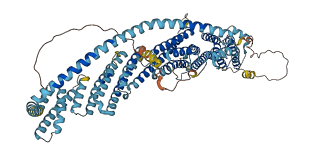
Descriptions
The autoinhibited protein was predicted that may have potential autoinhibitory elements via cis-regPred.
Autoinhibitory domains (AIDs)
Target domain |
|
Relief mechanism |
|
Assay |
cis-regPred |
Accessory elements
No accessory elements
Autoinhibited structure

Activated structure
1 structures for Q3UVL4
| Entry ID | Method | Resolution | Chain | Position | Source |
|---|---|---|---|---|---|
| AF-Q3UVL4-F1 | Predicted | AlphaFoldDB |
38 variants for Q3UVL4
| Variant ID(s) | Position | Change | Description | Diseaes Association | Provenance |
|---|---|---|---|---|---|
| rs3389532693 | 71 | E>K | No | EVA | |
| rs3389468344 | 97 | I>F | No | EVA | |
| rs3389525337 | 172 | A>P | No | EVA | |
| rs3389532706 | 222 | I>V | No | EVA | |
| rs3389468355 | 223 | Q>* | No | EVA | |
| rs3389478126 | 240 | R>C | No | EVA | |
| rs46084358 | 265 | A>P | No | EVA | |
| rs223551972 | 269 | C>F | No | EVA | |
| rs256558969 | 269 | C>W | No | EVA | |
| rs3389525354 | 297 | A>S | No | EVA | |
| rs3389429075 | 298 | P>L | No | EVA | |
| rs3389429075 | 298 | P>R | No | EVA | |
| rs3389521568 | 299 | D>Y | No | EVA | |
| rs3389520986 | 301 | L>S | No | EVA | |
| rs3389525372 | 302 | E>D | No | EVA | |
| rs3389529073 | 306 | R>C | No | EVA | |
| rs3389478130 | 306 | R>H | No | EVA | |
| rs3389468279 | 313 | G>S | No | EVA | |
| rs237654877 | 316 | C>Y | No | EVA | |
| rs3389478163 | 391 | L>F | No | EVA | |
| rs3389468294 | 405 | E>V | No | EVA | |
| rs3389525306 | 437 | K>E | No | EVA | |
| rs3389486666 | 444 | E>G | No | EVA | |
| rs251279178 | 459 | T>A | No | EVA | |
| rs3389499868 | 476 | N>D | No | EVA | |
| rs3408530558 | 495 | V>A | No | EVA | |
| rs3389429099 | 517 | G>D | No | EVA | |
| rs3389535360 | 536 | T>R | No | EVA | |
| rs3389513441 | 570 | E>V | No | EVA | |
| rs3389486631 | 593 | K>E | No | EVA | |
| rs3389468352 | 594 | S>* | No | EVA | |
| rs3389520959 | 604 | L>M | No | EVA | |
| rs3389535409 | 624 | D>G | No | EVA | |
| rs3389513380 | 628 | G>R | No | EVA | |
| rs3389525290 | 637 | K>N | No | EVA | |
| rs3389478123 | 665 | T>S | No | EVA | |
| rs3389525340 | 672 | T>I | No | EVA | |
| rs3389520987 | 723 | F>Y | No | EVA |
No associated diseases with Q3UVL4
1 regional properties for Q3UVL4
| Type | Name | Position | InterPro Accession |
|---|---|---|---|
| domain | Exocyst complex component EXOC2/Sec5, N-terminal domain | 64 - 287 | IPR039481 |
Functions
9 GO annotations of cellular component
| Name | Definition |
|---|---|
| cytosol | The part of the cytoplasm that does not contain organelles but which does contain other particulate matter, such as protein complexes. |
| EARP complex | A quatrefoil tethering complex required for endocytic recycling. |
| GARP complex | A quatrefoil tethering complex required for retrograde traffic from the early endosome back to the late Golgi and biogenesis of cytoplasmic vesicles. |
| Golgi apparatus | A membrane-bound cytoplasmic organelle of the endomembrane system that further processes the core oligosaccharides (e.g. N-glycans) added to proteins in the endoplasmic reticulum and packages them into membrane-bound vesicles. The Golgi apparatus operates at the intersection of the secretory, lysosomal, and endocytic pathways. |
| intracellular membrane-bounded organelle | Organized structure of distinctive morphology and function, bounded by a single or double lipid bilayer membrane and occurring within the cell. Includes the nucleus, mitochondria, plastids, vacuoles, and vesicles. Excludes the plasma membrane. |
| membrane | A lipid bilayer along with all the proteins and protein complexes embedded in it an attached to it. |
| nucleolus | A small, dense body one or more of which are present in the nucleus of eukaryotic cells. It is rich in RNA and protein, is not bounded by a limiting membrane, and is not seen during mitosis. Its prime function is the transcription of the nucleolar DNA into 45S ribosomal-precursor RNA, the processing of this RNA into 5.8S, 18S, and 28S components of ribosomal RNA, and the association of these components with 5S RNA and proteins synthesized outside the nucleolus. This association results in the formation of ribonucleoprotein precursors; these pass into the cytoplasm and mature into the 40S and 60S subunits of the ribosome. |
| recycling endosome | An organelle consisting of a network of tubules that functions in targeting molecules, such as receptors transporters and lipids, to the plasma membrane. |
| trans-Golgi network | The network of interconnected tubular and cisternal structures located within the Golgi apparatus on the side distal to the endoplasmic reticulum, from which secretory vesicles emerge. The trans-Golgi network is important in the later stages of protein secretion where it is thought to play a key role in the sorting and targeting of secreted proteins to the correct destination. |
No GO annotations of molecular function
| Name | Definition |
|---|---|
| No GO annotations for molecular function |
9 GO annotations of biological process
| Name | Definition |
|---|---|
| autophagy | The cellular catabolic process in which cells digest parts of their own cytoplasm; allows for both recycling of macromolecular constituents under conditions of cellular stress and remodeling the intracellular structure for cell differentiation. |
| brain morphogenesis | The process in which the anatomical structures of the brain are generated and organized. The brain is one of the two components of the central nervous system and is the center of thought and emotion. It is responsible for the coordination and control of bodily activities and the interpretation of information from the senses (sight, hearing, smell, etc.). |
| endocytic recycling | The directed movement of membrane-bounded vesicles from endosomes back to the plasma membrane, a trafficking pathway that promotes the recycling of internalized transmembrane proteins. |
| Golgi organization | A process that is carried out at the cellular level which results in the assembly, arrangement of constituent parts, or disassembly of the Golgi apparatus. |
| Golgi vesicle transport | The directed movement of substances into, out of or within the Golgi apparatus, mediated by vesicles. |
| lipid transport | The directed movement of lipids into, out of or within a cell, or between cells, by means of some agent such as a transporter or pore. Lipids are compounds soluble in an organic solvent but not, or sparingly, in an aqueous solvent. |
| lysosomal transport | The directed movement of substances into, out of or within a lysosome. |
| protein transport | The directed movement of proteins into, out of or within a cell, or between cells, by means of some agent such as a transporter or pore. |
| retrograde transport, endosome to Golgi | The directed movement of membrane-bounded vesicles from endosomes back to the trans-Golgi network where they are recycled for further rounds of transport. |
4 homologous proteins in AiPD
| UniProt AC | Gene Name | Protein Name | Species | Evidence Code |
|---|---|---|---|---|
| A6QQ47 | VPS51 | Vacuolar protein sorting-associated protein 51 homolog | Bos taurus (Bovine) | PR |
| Q9UID3 | VPS51 | Vacuolar protein sorting-associated protein 51 homolog | Homo sapiens (Human) | PR |
| Q4V9Y0 | vps51 | Vacuolar protein sorting-associated protein 51 homolog | Xenopus tropicalis (Western clawed frog) (Silurana tropicalis) | PR |
| Q155U0 | vps51 | Vacuolar protein sorting-associated protein 51 homolog | Danio rerio (Zebrafish) (Brachydanio rerio) | PR |
| 10 | 20 | 30 | 40 | 50 | 60 |
| MAAAAAVGPG | LGSGPGDSPE | GPEADAPERR | RKAHGMLKLY | YGLSEGEVAG | HPAGPDPLDP |
| 70 | 80 | 90 | 100 | 110 | 120 |
| TDLNGAHFDP | EVYLDKLRRE | CPLAQLMDSE | TDMVRQIRAL | DSDMQTLVYE | NYNKFISATD |
| 130 | 140 | 150 | 160 | 170 | 180 |
| TIRKMKNDFR | KMEDEMDRLA | TNMAVITNFS | ARISATLQDR | HERITKLAGV | HALLRKLQFL |
| 190 | 200 | 210 | 220 | 230 | 240 |
| FELPSRLTKC | VELGAYGQAV | RYQGRARAVL | QQYQHLPSFR | AIQDDCQVIT | ARLAQQLRQR |
| 250 | 260 | 270 | 280 | 290 | 300 |
| FREGCSGAPE | QAECVELLLA | LGEPAEELCE | EFLAHARGRL | EEELSSLEAE | LGPSPPAPDV |
| 310 | 320 | 330 | 340 | 350 | 360 |
| LEFTDRGGNG | FVGGLCQVAA | AYQELFAAQG | PAGAEKLAAF | AQELGGRYFA | LVERRLAQEQ |
| 370 | 380 | 390 | 400 | 410 | 420 |
| GGSDNSLLVR | ALDRFHRRLR | APGALLAAAG | LSESATEIVE | RVARERLSHH | LQGLKAAFLS |
| 430 | 440 | 450 | 460 | 470 | 480 |
| SLTDVRQALA | APRLAGKEGP | SLAELLANVA | SSILSHIKTS | LASVHLFTAK | EVSFSNKPYF |
| 490 | 500 | 510 | 520 | 530 | 540 |
| RGEFCSQGVR | EGLIVGFIRS | MCQTAQSFCD | SPGEKGGATP | PALLLLLSRL | CLDYETATIS |
| 550 | 560 | 570 | 580 | 590 | 600 |
| YILTLTDEQF | LVQDQSPVTP | VSTLCAEARE | TARRLLTHYV | KVQGLVISQM | LRKSVETRDW |
| 610 | 620 | 630 | 640 | 650 | 660 |
| LSTLEPRNVR | AVMKRVVEDT | TAIDVQVGLL | YEEGVRKAQS | SDSSKRTFSV | YSSSRQQGRY |
| 670 | 680 | 690 | 700 | 710 | 720 |
| APSYTPSAPM | DTNLLSNIQK | LFSERIDVFS | PVEFNKVSVL | TGIIKISLKT | LLECVRLRTF |
| 730 | 740 | 750 | 760 | 770 | 780 |
| GRFGLQQVQV | DCHFLQLYLW | RFVADEELVH | LLLDEVVASA | ALRCPDPVPM | EPSVVEVICE |
| RG |