Q3T165
Gene name |
PHB1 (PHB) |
Protein name |
Prohibitin 1 |
Names |
|
Species |
Bos taurus (Bovine) |
KEGG Pathway |
bta:530409 |
EC number |
|
Protein Class |
|
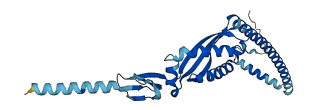
Descriptions
The autoinhibited protein was predicted that may have potential autoinhibitory elements via cis-regPred.
Autoinhibitory domains (AIDs)
Target domain |
|
Relief mechanism |
|
Assay |
cis-regPred |
Accessory elements
No accessory elements
Autoinhibited structure

Activated structure
1 structures for Q3T165
| Entry ID | Method | Resolution | Chain | Position | Source |
|---|---|---|---|---|---|
| AF-Q3T165-F1 | Predicted | AlphaFoldDB |
46 variants for Q3T165
| Variant ID(s) | Position | Change | Description | Diseaes Association | Provenance |
|---|---|---|---|---|---|
| rs476775124 | 8 | S>C | No | EVA | |
| rs443800072 | 11 | K>R | No | EVA | |
| rs452715099 | 23 | V>G | No | EVA | |
| rs435302030 | 34 | H>Q | No | EVA | |
| rs475478963 | 37 | V>G | No | EVA | |
| rs439455061 | 38 | I>L | No | EVA | |
| rs458066545 | 38 | I>N | No | EVA | |
| rs440245061 | 42 | F>L | No | EVA | |
| rs461983699 | 42 | F>Y | No | EVA | |
| rs481489993 | 43 | R>Q | No | EVA | |
| rs448630745 | 44 | G>A | No | EVA | |
| rs463683707 | 45 | V>A | No | EVA | |
| rs463683707 | 45 | V>G | No | EVA | |
| rs446256723 | 50 | V>G | No | EVA | |
| rs479960255 | 52 | E>D | No | EVA | |
| rs468634843 | 60 | W>L | No | EVA | |
| rs435240651 | 67 | F>L | No | EVA | |
| rs480308303 | 68 | D>A | No | EVA | |
| rs468925626 | 75 | N>H | No | EVA | |
| rs432773862 | 75 | N>I | No | EVA | |
| rs473287262 | 80 | T>P | No | EVA | |
| rs436714973 | 94 | I>N | No | EVA | |
| rs455039019 | 107 | F>V | No | EVA | |
| rs476876466 | 110 | I>L | No | EVA | |
| rs436835002 | 126 | I>M | No | EVA | |
| rs452203426 | 129 | S>Y | No | EVA | |
| rs482072529 | 139 | L>M | No | EVA | |
| rs450075189 | 143 | R>G | No | EVA | |
| rs385078998 | 159 | A>V | No | EVA | |
| rs441847853 | 192 | E>* | No | EVA | |
| rs457254916 | 192 | E>D | No | EVA | |
| rs433749859 | 207 | K>E | No | EVA | |
| rs475131475 | 222 | E>G | No | EVA | |
| rs442133679 | 226 | N>K | No | EVA | |
| rs463727472 | 239 | R>G | No | EVA | |
| rs475811645 | 243 | A>G | No | EVA | |
| rs458292271 | 247 | I>M | No | EVA | |
| rs479954019 | 248 | A>P | No | EVA | |
| rs446978448 | 249 | Y>D | No | EVA | |
| rs446978448 | 249 | Y>N | No | EVA | |
| rs462370377 | 251 | L>V | No | EVA | |
| rs480337524 | 252 | S>W | No | EVA | |
| rs450507469 | 253 | R>G | No | EVA | |
| rs432764177 | 264 | Q>P | No | EVA | |
| rs466849773 | 273 | Q>L | No | EVA | |
| rs445117730 | 273 | Q>R | No | EVA |
No associated diseases with Q3T165
10 GO annotations of cellular component
| Name | Definition |
|---|---|
| cell surface | The external part of the cell wall and/or plasma membrane. |
| cytoplasm | The contents of a cell excluding the plasma membrane and nucleus, but including other subcellular structures. |
| early endosome | A membrane-bounded organelle that receives incoming material from primary endocytic vesicles that have been generated by clathrin-dependent and clathrin-independent endocytosis; vesicles fuse with the early endosome to deliver cargo for sorting into recycling or degradation pathways. |
| integral component of plasma membrane | The component of the plasma membrane consisting of the gene products and protein complexes having at least some part of their peptide sequence embedded in the hydrophobic region of the membrane. |
| mitochondrial inner membrane | The inner, i.e. lumen-facing, lipid bilayer of the mitochondrial envelope. It is highly folded to form cristae. |
| mitochondrial prohibitin complex | A complex composed of two proteins, prohibitin 1 and prohibitin 2 (PHB1/PHB-1 and PHB2/PHB-2) that is highly conserved amongst eukaryotes and associated with the inner mitochondrial membrane. The mitochondrial prohibitin complex is a macromolecular supercomplex composed of repeating heterodimeric subunits of PHB1 and PHB2. The mitochondrial prohibitin complex plays a role in a number of biological processes, including mitochondrial biogenesis and function, development, replicative senescence, and cell death. |
| mitochondrion | A semiautonomous, self replicating organelle that occurs in varying numbers, shapes, and sizes in the cytoplasm of virtually all eukaryotic cells. It is notably the site of tissue respiration. |
| nucleoplasm | That part of the nuclear content other than the chromosomes or the nucleolus. |
| nucleus | A membrane-bounded organelle of eukaryotic cells in which chromosomes are housed and replicated. In most cells, the nucleus contains all of the cell's chromosomes except the organellar chromosomes, and is the site of RNA synthesis and processing. In some species, or in specialized cell types, RNA metabolism or DNA replication may be absent. |
| plasma membrane | The membrane surrounding a cell that separates the cell from its external environment. It consists of a phospholipid bilayer and associated proteins. |
7 GO annotations of molecular function
| Name | Definition |
|---|---|
| complement component C3a binding | Binding to a C3a product of the complement cascade. |
| complement component C3b binding | Binding to a C3b product of the complement cascade. |
| histone deacetylase binding | Binding to histone deacetylase. |
| protein C-terminus binding | Binding to a protein C-terminus, the end of a peptide chain at which the 1-carboxyl function of a constituent amino acid is not attached in peptide linkage to another amino-acid residue. |
| protein heterodimerization activity | Binding to a nonidentical protein to form a heterodimer. |
| proteinase activated receptor binding | Binding to a proteinase activated receptor. |
| transcription corepressor activity | A transcription coregulator activity that represses or decreases the transcription of specific gene sets via binding to a DNA-bound DNA-binding transcription factor, either on its own or as part of a complex. Corepressors often act by altering chromatin structure and modifications. For example, one class of transcription corepressors modifies chromatin structure through covalent modification of histones. A second class remodels the conformation of chromatin in an ATP-dependent fashion. A third class modulates interactions of DNA-bound DNA-binding transcription factors with other transcription coregulators. |
33 GO annotations of biological process
| Name | Definition |
|---|---|
| activation of phospholipase C activity | The initiation of the activity of the inactive enzyme phospolipase C as the result of The series of molecular signals generated as a consequence of a G protein-coupled receptor binding to its physiological ligand. |
| activation of protein kinase C activity | Any process that initiates the activity of the inactive enzyme protein kinase C. |
| antiviral innate immune response | A defense response against viruses mediated through an innate immune response. An innate immune response is mediated by germline encoded components that directly recognize components of potential pathogens. |
| B cell activation | The change in morphology and behavior of a mature or immature B cell resulting from exposure to a mitogen, cytokine, chemokine, cellular ligand, or an antigen for which it is specific. |
| CD40 signaling pathway | The series of molecular signals initiated by the binding of the cell surface receptor CD40 to one of its physiological ligands, and ending with the regulation of a downstream cellular process, e.g. transcription. |
| cellular response to interleukin-6 | Any process that results in a change in state or activity of a cell (in terms of movement, secretion, enzyme production, gene expression, etc.) as a result of an interleukin-6 stimulus. |
| DNA biosynthetic process | The biosynthetic process resulting in the formation of DNA. |
| histone deacetylation | The modification of histones by removal of acetyl groups. |
| mitochondrion organization | A process that is carried out at the cellular level which results in the assembly, arrangement of constituent parts, or disassembly of a mitochondrion; includes mitochondrial morphogenesis and distribution, and replication of the mitochondrial genome as well as synthesis of new mitochondrial components. |
| modulation by host of viral RNA genome replication | A process in which a host organism modulates the frequency, rate or extent of viral RNA genome replication. |
| negative regulation of androgen receptor signaling pathway | Any process that decreases the rate, frequency, or extent of the androgen receptor signaling pathway. |
| negative regulation of cell growth | Any process that stops, prevents, or reduces the frequency, rate, extent or direction of cell growth. |
| negative regulation of cell population proliferation | Any process that stops, prevents or reduces the rate or extent of cell proliferation. |
| negative regulation of ERK1 and ERK2 cascade | Any process that stops, prevents, or reduces the frequency, rate or extent of signal transduction mediated by the ERK1 and ERK2 cascade. |
| negative regulation of glucocorticoid receptor signaling pathway | Any process that stops, prevents or reduces the frequency, rate or extent of glucocorticoid receptor signaling pathway. |
| negative regulation of protein catabolic process | Any process that stops, prevents or reduces the frequency, rate or extent of protein catabolic process. |
| negative regulation of transcription by competitive promoter binding | Any process that stops, prevents, or reduces the frequency, rate or extent of DNA-dependent transcription using a mechanism that involves direct competition for interaction with a promoter binding site. |
| negative regulation of transcription by RNA polymerase II | Any process that stops, prevents, or reduces the frequency, rate or extent of transcription mediated by RNA polymerase II. |
| positive regulation of cell death | Any process that increases the rate or frequency of cell death. Cell death is the specific activation or halting of processes within a cell so that its vital functions markedly cease, rather than simply deteriorating gradually over time, which culminates in cell death. |
| positive regulation of complement activation | Any process that activates or increases the frequency, rate or extent of complement activation. |
| positive regulation of DNA-templated transcription | Any process that activates or increases the frequency, rate or extent of cellular DNA-templated transcription. |
| positive regulation of ERK1 and ERK2 cascade | Any process that activates or increases the frequency, rate or extent of signal transduction mediated by the ERK1 and ERK2 cascade. |
| positive regulation of G protein-coupled receptor signaling pathway | Any process that activates or increases the frequency, rate or extent of G protein-coupled receptor signaling pathway activity. |
| positive regulation of immunoglobulin production | Any process that activates or increases the frequency, rate, or extent of immunoglobulin production. |
| positive regulation of interleukin-17 production | Any process that activates or increases the frequency, rate, or extent of production of any member of the interleukin-17 family of cytokines. |
| positive regulation of NIK/NF-kappaB signaling | Any process that activates or increases the frequency, rate or extent of NIK/NF-kappaB signaling. |
| positive regulation of protein kinase B signaling | Any process that activates or increases the frequency, rate or extent of protein kinase B signaling, a series of reactions mediated by the intracellular serine/threonine kinase protein kinase B. |
| positive regulation of smooth muscle cell proliferation | Any process that activates or increases the rate or extent of smooth muscle cell proliferation. |
| progesterone receptor signaling pathway | The series of molecular signals initiated by progesterone binding to its receptor in the cytoplasm. |
| protein stabilization | Any process involved in maintaining the structure and integrity of a protein and preventing it from degradation or aggregation. |
| RIG-I signaling pathway | The series of molecular signals initiated by the binding of viral RNA to a pattern recognition receptor (PRR) RIG-1 (also known as DDX58). RIG-I is a cytoplasmic receptor that detects RNA synthesized during viral replication and triggers a signaling pathway to protect the host against viral infection, for example by inducing the expression of antiviral cytokines. |
| T-helper 17 type immune response | An immune response which is associated with resistance to intracellular bacteria with a key role in inflammation and tissue injury. This immune response is associated with pathological autoimmune conditions such as multiple sclerosis, arthritis and psoriasis which is typically orchestrated by the production of particular cytokines by T-helper 17 cells, most notably interleukin-17, IL-21 and IL-22. |
| viral entry into host cell | The process that occurs after viral attachment by which a virus, or viral nucleic acid, breaches the plasma membrane or cell envelope and enters the host cell. The process ends when the viral nucleic acid is released into the host cell cytoplasm. |
4 homologous proteins in AiPD
| UniProt AC | Gene Name | Protein Name | Species | Evidence Code |
|---|---|---|---|---|
| P84173 | PHB1 | Prohibitin 1 | Gallus gallus (Chicken) | PR |
| P35232 | PHB1 | Prohibitin 1 | Homo sapiens (Human) | PR |
| Q9LK25 | PHB4 | Prohibitin-4, mitochondrial | Arabidopsis thaliana (Mouse-ear cress) | PR |
| Q9LY99 | PHB5 | Prohibitin-5, mitochondrial | Arabidopsis thaliana (Mouse-ear cress) | PR |
| 10 | 20 | 30 | 40 | 50 | 60 |
| MAAKVFESIG | KFGLALAVAG | GVVNSALYNV | DAGHRAVIFD | RFRGVQDIVV | GEGTHFLIPW |
| 70 | 80 | 90 | 100 | 110 | 120 |
| VQKPIIFDCR | SRPRNVPVIT | GSKDLQNVNI | TLRILFRPVA | SQLPRIFTSI | GEDYDERVLP |
| 130 | 140 | 150 | 160 | 170 | 180 |
| SITTEILKSV | VARFDAGELI | TQRELVSRQV | SDDLTERAAT | FGLILDDVSL | THLTFGKEFT |
| 190 | 200 | 210 | 220 | 230 | 240 |
| EAVEAKQVAQ | QEAERARFVV | EKAEQQKKAA | IISAEGDSKA | AELIANSLAT | AGDGLIELRK |
| 250 | 260 | 270 | |||
| LEAAEDIAYQ | LSRSRNITYL | PAGQSVLLQL | PQ |