Descriptions
The autoinhibited protein was predicted that may have potential autoinhibitory elements via cis-regPred.
Autoinhibitory domains (AIDs)
Target domain |
|
Relief mechanism |
|
Assay |
cis-regPred |
Accessory elements
No accessory elements
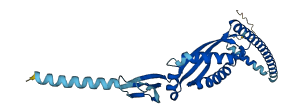
Autoinhibited structure

Activated structure
1 structures for P84173
| Entry ID | Method | Resolution | Chain | Position | Source |
|---|---|---|---|---|---|
| AF-P84173-F1 | Predicted | AlphaFoldDB |
2 variants for P84173
| Variant ID(s) | Position | Change | Description | Diseaes Association | Provenance |
|---|---|---|---|---|---|
| rs3137810 | 106 | I>T | No | Ensembl | |
| rs735668239 | 268 | L>P | No | Ensembl |
No associated diseases with P84173
1 regional properties for P84173
| Type | Name | Position | InterPro Accession |
|---|---|---|---|
| domain | Band 7 domain | 26 - 204 | IPR001107 |
7 GO annotations of cellular component
| Name | Definition |
|---|---|
| cell surface | The external part of the cell wall and/or plasma membrane. |
| cytoplasm | The contents of a cell excluding the plasma membrane and nucleus, but including other subcellular structures. |
| mitochondrial inner membrane | The inner, i.e. lumen-facing, lipid bilayer of the mitochondrial envelope. It is highly folded to form cristae. |
| mitochondrial prohibitin complex | A complex composed of two proteins, prohibitin 1 and prohibitin 2 (PHB1/PHB-1 and PHB2/PHB-2) that is highly conserved amongst eukaryotes and associated with the inner mitochondrial membrane. The mitochondrial prohibitin complex is a macromolecular supercomplex composed of repeating heterodimeric subunits of PHB1 and PHB2. The mitochondrial prohibitin complex plays a role in a number of biological processes, including mitochondrial biogenesis and function, development, replicative senescence, and cell death. |
| mitochondrion | A semiautonomous, self replicating organelle that occurs in varying numbers, shapes, and sizes in the cytoplasm of virtually all eukaryotic cells. It is notably the site of tissue respiration. |
| nucleus | A membrane-bounded organelle of eukaryotic cells in which chromosomes are housed and replicated. In most cells, the nucleus contains all of the cell's chromosomes except the organellar chromosomes, and is the site of RNA synthesis and processing. In some species, or in specialized cell types, RNA metabolism or DNA replication may be absent. |
| plasma membrane | The membrane surrounding a cell that separates the cell from its external environment. It consists of a phospholipid bilayer and associated proteins. |
No GO annotations of molecular function
| Name | Definition |
|---|---|
| No GO annotations for molecular function |
2 GO annotations of biological process
| Name | Definition |
|---|---|
| DNA biosynthetic process | The biosynthetic process resulting in the formation of DNA. |
| mitochondrion organization | A process that is carried out at the cellular level which results in the assembly, arrangement of constituent parts, or disassembly of a mitochondrion; includes mitochondrial morphogenesis and distribution, and replication of the mitochondrial genome as well as synthesis of new mitochondrial components. |
4 homologous proteins in AiPD
| UniProt AC | Gene Name | Protein Name | Species | Evidence Code |
|---|---|---|---|---|
| Q3T165 | PHB1 | Prohibitin 1 | Bos taurus (Bovine) | PR |
| P35232 | PHB1 | Prohibitin 1 | Homo sapiens (Human) | PR |
| Q9LK25 | PHB4 | Prohibitin-4, mitochondrial | Arabidopsis thaliana (Mouse-ear cress) | PR |
| Q9LY99 | PHB5 | Prohibitin-5, mitochondrial | Arabidopsis thaliana (Mouse-ear cress) | PR |
| 10 | 20 | 30 | 40 | 50 | 60 |
| MAAKVFESIG | KFGLGLAVAG | GVVNSALYNV | DAGHRAVIFD | RFRGVQDTVV | GEGTHFLIPW |
| 70 | 80 | 90 | 100 | 110 | 120 |
| VQKPIIFDCR | SRPRNIPVIT | GSKDLQNVNI | TLRILFRPVT | AQLPRIFTSI | GEDYDERVLP |
| 130 | 140 | 150 | 160 | 170 | 180 |
| SITTEILKSV | VARFDAGELI | TQRELVSRQV | SEDLTERAAT | FGLILDDVSL | THLTFGKEFT |
| 190 | 200 | 210 | 220 | 230 | 240 |
| EAVEMKQVAQ | QEAERARFIV | EKAEQQKKAA | VISAEGDSKA | AELIANSLAT | AGDGLIELRK |
| 250 | 260 | 270 | |||
| LEAAEDIAYQ | LSRSRNITYL | PSGQSVLLQL | PQ |