Q2TBE6
Gene name |
Pi4k2a |
Protein name |
Phosphatidylinositol 4-kinase type 2-alpha |
Names |
Phosphatidylinositol 4-kinase type II-alpha |
Species |
Mus musculus (Mouse) |
KEGG Pathway |
mmu:84095 |
EC number |
2.7.1.67: Phosphotransferases with an alcohol group as acceptor |
Protein Class |
|
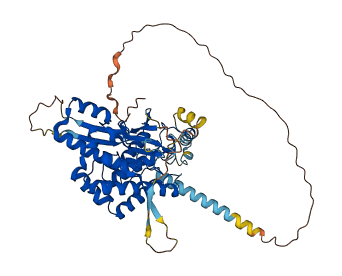
Descriptions
The autoinhibited protein was predicted that may have potential autoinhibitory elements via cis-regPred.
Autoinhibitory domains (AIDs)
Target domain |
|
Relief mechanism |
|
Assay |
cis-regPred |
Accessory elements
No accessory elements
Autoinhibited structure

Activated structure
1 structures for Q2TBE6
| Entry ID | Method | Resolution | Chain | Position | Source |
|---|---|---|---|---|---|
| AF-Q2TBE6-F1 | Predicted | AlphaFoldDB |
8 variants for Q2TBE6
| Variant ID(s) | Position | Change | Description | Diseaes Association | Provenance |
|---|---|---|---|---|---|
| rs3408550229 | 179 | F>S | No | EVA | |
| rs3389542186 | 287 | N>S | No | EVA | |
| rs3389533310 | 357 | D>H | No | EVA | |
| rs3389507404 | 442 | H>L | No | EVA | |
| rs3389533292 | 448 | P>S | No | EVA | |
| rs3389544475 | 453 | T>K | No | EVA | |
| rs217323870 | 461 | A>T | No | EVA | |
| rs3389497319 | 462 | S>R | No | EVA |
No associated diseases with Q2TBE6
1 regional properties for Q2TBE6
| Type | Name | Position | InterPro Accession |
|---|---|---|---|
| domain | Phosphatidylinositol 3-/4-kinase, catalytic domain | 124 - 453 | IPR000403 |
Functions
| Description | ||
|---|---|---|
| EC Number | 2.7.1.67 | Phosphotransferases with an alcohol group as acceptor |
| Subcellular Localization |
|
|
| PANTHER Family | ||
| PANTHER Subfamily | ||
| PANTHER Protein Class | ||
| PANTHER Pathway Category | No pathway information available | |
22 GO annotations of cellular component
| Name | Definition |
|---|---|
| anchoring junction | A cell junction that mechanically attaches a cell (and its cytoskeleton) to neighboring cells or to the extracellular matrix. |
| BLOC-1 complex | A protein complex required for the biogenesis of specialized organelles of the endosomal-lysosomal system, such as melanosomes and platelet dense granules. Many of the protein subunits are conserved between mouse and human; the mouse complex contains the Pallidin, Muted, Cappuccino, Dysbindin, Snapin, BLOS1, BLOS2, AND BLOS3 proteins. |
| cytoplasmic vesicle | A vesicle found in the cytoplasm of a cell. |
| dendrite | A neuron projection that has a short, tapering, morphology. Dendrites receive and integrate signals from other neurons or from sensory stimuli, and conduct nerve impulses towards the axon or the cell body. In most neurons, the impulse is conveyed from dendrites to axon via the cell body, but in some types of unipolar neuron, the impulse does not travel via the cell body. |
| early endosome membrane | The lipid bilayer surrounding an early endosome. |
| endosome | A vacuole to which materials ingested by endocytosis are delivered. |
| exocytic vesicle | A transport vesicle that mediates transport from an intracellular compartment to the plasma membrane, and fuses with the plasma membrane to release various cargo molecules, such as proteins or hormones, by exocytosis. |
| Golgi membrane | The lipid bilayer surrounding any of the compartments of the Golgi apparatus. |
| growing cell tip | The region at either end of the longest axis of a cylindrical or elongated cell, where polarized growth occurs. |
| integral component of plasma membrane | The component of the plasma membrane consisting of the gene products and protein complexes having at least some part of their peptide sequence embedded in the hydrophobic region of the membrane. |
| intracellular membrane-bounded organelle | Organized structure of distinctive morphology and function, bounded by a single or double lipid bilayer membrane and occurring within the cell. Includes the nucleus, mitochondria, plastids, vacuoles, and vesicles. Excludes the plasma membrane. |
| intrinsic component of membrane | The component of a membrane consisting of the gene products having some covalently attached portion, for example part of a peptide sequence or some other covalently attached group such as a GPI anchor, which spans or is embedded in one or both leaflets of the membrane. |
| membrane raft | Any of the small (10-200 nm), heterogeneous, highly dynamic, sterol- and sphingolipid-enriched membrane domains that compartmentalize cellular processes. Small rafts can sometimes be stabilized to form larger platforms through protein-protein and protein-lipid interactions. |
| mitochondrion | A semiautonomous, self replicating organelle that occurs in varying numbers, shapes, and sizes in the cytoplasm of virtually all eukaryotic cells. It is notably the site of tissue respiration. |
| neuron projection | A prolongation or process extending from a nerve cell, e.g. an axon or dendrite. |
| neuronal cell body | The portion of a neuron that includes the nucleus, but excludes cell projections such as axons and dendrites. |
| perikaryon | The portion of the cell soma (neuronal cell body) that excludes the nucleus. |
| plasma membrane | The membrane surrounding a cell that separates the cell from its external environment. It consists of a phospholipid bilayer and associated proteins. |
| presynaptic membrane | A specialized area of membrane of the axon terminal that faces the plasma membrane of the neuron or muscle fiber with which the axon terminal establishes a synaptic junction; many synaptic junctions exhibit structural presynaptic characteristics, such as conical, electron-dense internal protrusions, that distinguish it from the remainder of the axon plasma membrane. |
| protein-containing complex | A stable assembly of two or more macromolecules, i.e. proteins, nucleic acids, carbohydrates or lipids, in which at least one component is a protein and the constituent parts function together. |
| synaptic vesicle membrane | The lipid bilayer surrounding a synaptic vesicle. |
| trans-Golgi network | The network of interconnected tubular and cisternal structures located within the Golgi apparatus on the side distal to the endoplasmic reticulum, from which secretory vesicles emerge. The trans-Golgi network is important in the later stages of protein secretion where it is thought to play a key role in the sorting and targeting of secreted proteins to the correct destination. |
4 GO annotations of molecular function
| Name | Definition |
|---|---|
| 1-phosphatidylinositol 4-kinase activity | Catalysis of the reaction: 1-phosphatidyl-1D-myo-inositol + ATP = 1-phosphatidyl-1D-myo-inositol 4-phosphate + ADP + 2 H(+). |
| AP-3 adaptor complex binding | Binding to an AP-3 adaptor complex. The AP-3 adaptor complex is a heterotetrameric AP-type membrane coat adaptor complex that consists of beta3, delta, mu3 and sigma3 subunits and is found associated with endosomal membranes. In at least humans, the AP-3 complex can be heterogeneric due to the existence of multiple subunit isoforms encoded by different genes (beta3A and beta3B, mu3A and mu3B, and sigma3A and sigma3B). |
| ATP binding | Binding to ATP, adenosine 5'-triphosphate, a universally important coenzyme and enzyme regulator. |
| protein-containing complex binding | Binding to a macromolecular complex. |
6 GO annotations of biological process
| Name | Definition |
|---|---|
| basophil degranulation | The regulated exocytosis of secretory granules containing preformed mediators such as histamine, serotonin, and neutral proteases by a basophil. |
| endosome organization | A process that is carried out at the cellular level which results in the assembly, arrangement of constituent parts, or disassembly of endosomes. |
| Golgi organization | A process that is carried out at the cellular level which results in the assembly, arrangement of constituent parts, or disassembly of the Golgi apparatus. |
| phosphatidylinositol biosynthetic process | The chemical reactions and pathways resulting in the formation of phosphatidylinositol, any glycophospholipid in which the sn-glycerol 3-phosphate residue is esterified to the 1-hydroxyl group of 1D-myo-inositol. |
| phosphatidylinositol phosphate biosynthetic process | The chemical reactions and pathways resulting in the formation of phosphatidylinositol phosphate. |
| phosphorylation | The process of introducing a phosphate group into a molecule, usually with the formation of a phosphoric ester, a phosphoric anhydride or a phosphoric amide. |
9 homologous proteins in AiPD
| UniProt AC | Gene Name | Protein Name | Species | Evidence Code |
|---|---|---|---|---|
| Q5ZIK0 | PI4K2B | Phosphatidylinositol 4-kinase type 2-beta | Gallus gallus (Chicken) | PR |
| Q8TCG2 | PI4K2B | Phosphatidylinositol 4-kinase type 2-beta | Homo sapiens (Human) | PR |
| Q9BTU6 | PI4K2A | Phosphatidylinositol 4-kinase type 2-alpha | Homo sapiens (Human) | PR |
| Q8CBQ5 | Pi4k2b | Phosphatidylinositol 4-kinase type 2-beta | Mus musculus (Mouse) | PR |
| Q5XIL2 | Pi4k2b | Phosphatidylinositol 4-kinase type 2-beta | Rattus norvegicus (Rat) | PR |
| Q99M64 | Pi4k2a | Phosphatidylinositol 4-kinase type 2-alpha | Rattus norvegicus (Rat) | PR |
| Q28G26 | pi4k2b | Phosphatidylinositol 4-kinase type 2-beta | Xenopus tropicalis (Western clawed frog) (Silurana tropicalis) | PR |
| Q505I0 | pi4k2a | Phosphatidylinositol 4-kinase type 2-alpha | Xenopus tropicalis (Western clawed frog) (Silurana tropicalis) | PR |
| Q6PE18 | pi4k2a | Phosphatidylinositol 4-kinase type 2-alpha | Danio rerio (Zebrafish) (Brachydanio rerio) | PR |
| 10 | 20 | 30 | 40 | 50 | 60 |
| MDETSPLVSP | ERAQPPEYTF | PSGSGAHFPQ | VPGGAVRVAA | AAGSGPSPPC | SPGHDRERQP |
| 70 | 80 | 90 | 100 | 110 | 120 |
| LLDRARGAAA | QGQTHTVAVQ | AQALAAQAAV | AAHAVQTHRE | RNDFPEDPEF | EVVVRQAEVA |
| 130 | 140 | 150 | 160 | 170 | 180 |
| IECSIYPERI | YQGSSGSYFV | KDSQGRIVAV | FKPKNEEPYG | HLNPKWTKWL | QKLCCPCCFG |
| 190 | 200 | 210 | 220 | 230 | 240 |
| RDCLVLNQGY | LSEAGASLVD | QKLELNIVPR | TKVVYLASET | FNYSAIDRVK | SRGKRLALEK |
| 250 | 260 | 270 | 280 | 290 | 300 |
| VPKVGQRFNR | IGLPPKVGSF | QLFVEGYKDA | DYWLRRFEAE | PLPENTNRQL | LLQFERLVVL |
| 310 | 320 | 330 | 340 | 350 | 360 |
| DYIIRNTDRG | NDNWLIKYDC | PMDNSSCRDT | DWVMVREPVI | KVAAIDNGLA | FPLKHPDSWR |
| 370 | 380 | 390 | 400 | 410 | 420 |
| AYPFYWAWLP | QAKVPFSQEI | KDLILPKISD | PNFIKDLEED | LYELFKRDPG | FDRGQFHKQI |
| 430 | 440 | 450 | 460 | 470 | |
| AVMRGQILNL | TQALKDNKSP | LHLVQMPPVI | VETARSHQRS | ASESYTQSFQ | SRKPFFSWW |