Q28G26
Gene name |
pi4k2b (TGas067g11.1) |
Protein name |
Phosphatidylinositol 4-kinase type 2-beta |
Names |
Phosphatidylinositol 4-kinase type II-beta |
Species |
Xenopus tropicalis (Western clawed frog) (Silurana tropicalis) |
KEGG Pathway |
xtr:549707 |
EC number |
2.7.1.67: Phosphotransferases with an alcohol group as acceptor |
Protein Class |
|
Descriptions
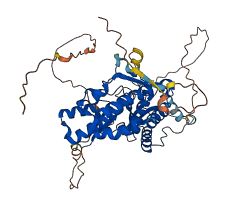
The autoinhibited protein was predicted that may have potential autoinhibitory elements via cis-regPred.
Autoinhibitory domains (AIDs)
Target domain |
|
Relief mechanism |
|
Assay |
cis-regPred |
Accessory elements
No accessory elements
Autoinhibited structure

Activated structure
1 structures for Q28G26
| Entry ID | Method | Resolution | Chain | Position | Source |
|---|---|---|---|---|---|
| AF-Q28G26-F1 | Predicted | AlphaFoldDB |
No variants for Q28G26
| Variant ID(s) | Position | Change | Description | Diseaes Association | Provenance |
|---|---|---|---|---|---|
| No variants for Q28G26 | |||||
No associated diseases with Q28G26
1 regional properties for Q28G26
| Type | Name | Position | InterPro Accession |
|---|---|---|---|
| domain | Phosphatidylinositol 3-/4-kinase, catalytic domain | 127 - 462 | IPR000403 |
Functions
| Description | ||
|---|---|---|
| EC Number | 2.7.1.67 | Phosphotransferases with an alcohol group as acceptor |
| Subcellular Localization |
|
|
| PANTHER Family | ||
| PANTHER Subfamily | ||
| PANTHER Protein Class | ||
| PANTHER Pathway Category | No pathway information available | |
7 GO annotations of cellular component
| Name | Definition |
|---|---|
| cytosol | The part of the cytoplasm that does not contain organelles but which does contain other particulate matter, such as protein complexes. |
| early endosome membrane | The lipid bilayer surrounding an early endosome. |
| endoplasmic reticulum membrane | The lipid bilayer surrounding the endoplasmic reticulum. |
| endosome | A vacuole to which materials ingested by endocytosis are delivered. |
| Golgi membrane | The lipid bilayer surrounding any of the compartments of the Golgi apparatus. |
| plasma membrane | The membrane surrounding a cell that separates the cell from its external environment. It consists of a phospholipid bilayer and associated proteins. |
| trans-Golgi network | The network of interconnected tubular and cisternal structures located within the Golgi apparatus on the side distal to the endoplasmic reticulum, from which secretory vesicles emerge. The trans-Golgi network is important in the later stages of protein secretion where it is thought to play a key role in the sorting and targeting of secreted proteins to the correct destination. |
2 GO annotations of molecular function
| Name | Definition |
|---|---|
| 1-phosphatidylinositol 4-kinase activity | Catalysis of the reaction: 1-phosphatidyl-1D-myo-inositol + ATP = 1-phosphatidyl-1D-myo-inositol 4-phosphate + ADP + 2 H(+). |
| ATP binding | Binding to ATP, adenosine 5'-triphosphate, a universally important coenzyme and enzyme regulator. |
4 GO annotations of biological process
| Name | Definition |
|---|---|
| endosome organization | A process that is carried out at the cellular level which results in the assembly, arrangement of constituent parts, or disassembly of endosomes. |
| Golgi organization | A process that is carried out at the cellular level which results in the assembly, arrangement of constituent parts, or disassembly of the Golgi apparatus. |
| phosphatidylinositol phosphate biosynthetic process | The chemical reactions and pathways resulting in the formation of phosphatidylinositol phosphate. |
| phosphorylation | The process of introducing a phosphate group into a molecule, usually with the formation of a phosphoric ester, a phosphoric anhydride or a phosphoric amide. |
9 homologous proteins in AiPD
| UniProt AC | Gene Name | Protein Name | Species | Evidence Code |
|---|---|---|---|---|
| Q5ZIK0 | PI4K2B | Phosphatidylinositol 4-kinase type 2-beta | Gallus gallus (Chicken) | PR |
| Q9BTU6 | PI4K2A | Phosphatidylinositol 4-kinase type 2-alpha | Homo sapiens (Human) | PR |
| Q8TCG2 | PI4K2B | Phosphatidylinositol 4-kinase type 2-beta | Homo sapiens (Human) | PR |
| Q2TBE6 | Pi4k2a | Phosphatidylinositol 4-kinase type 2-alpha | Mus musculus (Mouse) | PR |
| Q8CBQ5 | Pi4k2b | Phosphatidylinositol 4-kinase type 2-beta | Mus musculus (Mouse) | PR |
| Q99M64 | Pi4k2a | Phosphatidylinositol 4-kinase type 2-alpha | Rattus norvegicus (Rat) | PR |
| Q5XIL2 | Pi4k2b | Phosphatidylinositol 4-kinase type 2-beta | Rattus norvegicus (Rat) | PR |
| Q505I0 | pi4k2a | Phosphatidylinositol 4-kinase type 2-alpha | Xenopus tropicalis (Western clawed frog) (Silurana tropicalis) | PR |
| Q6PE18 | pi4k2a | Phosphatidylinositol 4-kinase type 2-alpha | Danio rerio (Zebrafish) (Brachydanio rerio) | PR |
| 10 | 20 | 30 | 40 | 50 | 60 |
| MEPKQTADAR | DSPPLLVFLE | PAAEEVTAHT | APLSPNPQSA | RAAPGSAVRF | FSDSAREEEA |
| 70 | 80 | 90 | 100 | 110 | 120 |
| GEDEPLLKKS | GPVSPRAARK | GRTRLSSSSD | RENMSGGHVG | NGEFNVILDD | LEFADIIHRA |
| 130 | 140 | 150 | 160 | 170 | 180 |
| EQAIESGVFP | ERISQGSSGS | YFVKDPKGKI | IGVFKPKSEE | PYGHLNPKWT | KYFHKICCPC |
| 190 | 200 | 210 | 220 | 230 | 240 |
| CFGRGCLVPN | QGYLSEAGAY | LVDEKLGLGV | VPKTKVVWLV | SETFNYSAID | RAKSRGKKYA |
| 250 | 260 | 270 | 280 | 290 | 300 |
| LEKVPKVGRK | FHRIGLPPKV | GSFQLFVDGY | KEADYWLRKF | ETDPLPENTR | KQLQCQFEKL |
| 310 | 320 | 330 | 340 | 350 | 360 |
| VILDYVIRNT | DRGNDNWLIR | YDSQDDDELM | EKGDDFPLKD | WKEIKEPVIK | IAAIDNGLAF |
| 370 | 380 | 390 | 400 | 410 | 420 |
| PFKHPDEWRA | YPFHWAWLPQ | AKVPFSQETR | DLILPRISDM | NFVQDLCEDL | YELFKTDKGF |
| 430 | 440 | 450 | 460 | 470 | 480 |
| DKATFEKQMS | VMRGQILNLT | QALKDGKTPI | QLVQMPRVVV | ERSCSGSQGR | IVQMSNAFTQ |
| 490 | |||||
| TFHCRKPFFS | SW |