Q29441
Gene name |
CNGA3 (CNCG3) |
Protein name |
Cyclic nucleotide-gated cation channel alpha-3 |
Names |
Cone photoreceptor cGMP-gated channel subunit alpha, Cyclic nucleotide-gated channel alpha-3, CNG channel alpha-3, CNG-3, CNG3 |
Species |
Bos taurus (Bovine) |
KEGG Pathway |
bta:281701 |
EC number |
|
Protein Class |
|
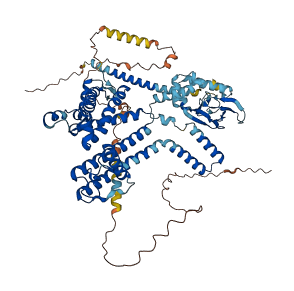
Descriptions
The autoinhibited protein was predicted that may have potential autoinhibitory elements via cis-regPred.
Autoinhibitory domains (AIDs)
Target domain |
|
Relief mechanism |
|
Assay |
cis-regPred |
Accessory elements
No accessory elements
Autoinhibited structure

Activated structure
1 structures for Q29441
| Entry ID | Method | Resolution | Chain | Position | Source |
|---|---|---|---|---|---|
| AF-Q29441-F1 | Predicted | AlphaFoldDB |
No variants for Q29441
| Variant ID(s) | Position | Change | Description | Diseaes Association | Provenance |
|---|---|---|---|---|---|
| No variants for Q29441 | |||||
1 associated diseases with Q29441
[MIM: 602483]: Auriculocondylar syndrome 1 (ARCND1)
An autosomal dominant form of auriculocondylar syndrome, a craniofacial malformation syndrome characterized by variable mandibular anomalies, including mild to severe micrognathia, temporomandibular joint ankylosis, cleft palate, and a characteristic ear malformation that consists of separation of the lobule from the external ear, giving the appearance of a question mark (question-mark ear). Other frequently described features include prominent cheeks, cupped and posteriorly rotated ears, preauricular tags, and microstomia. Glossoptosis, masticatory abnormalities, orthodontic problems, and malocclusion occur in a majority of affected subjects. . Note=The disease is caused by variants affecting the gene represented in this entry.
Without disease ID
- An autosomal dominant form of auriculocondylar syndrome, a craniofacial malformation syndrome characterized by variable mandibular anomalies, including mild to severe micrognathia, temporomandibular joint ankylosis, cleft palate, and a characteristic ear malformation that consists of separation of the lobule from the external ear, giving the appearance of a question mark (question-mark ear). Other frequently described features include prominent cheeks, cupped and posteriorly rotated ears, preauricular tags, and microstomia. Glossoptosis, masticatory abnormalities, orthodontic problems, and malocclusion occur in a majority of affected subjects. . Note=The disease is caused by variants affecting the gene represented in this entry.
No regional properties for Q29441
| Type | Name | Position | InterPro Accession |
|---|---|---|---|
| No domain, repeats, and functional sites for Q29441 | |||
1 GO annotations of cellular component
| Name | Definition |
|---|---|
| integral component of membrane | The component of a membrane consisting of the gene products and protein complexes having at least some part of their peptide sequence embedded in the hydrophobic region of the membrane. |
2 GO annotations of molecular function
| Name | Definition |
|---|---|
| cGMP binding | Binding to cGMP, the nucleotide cyclic GMP (guanosine 3',5'-cyclophosphate). |
| ion channel activity | Enables the facilitated diffusion of an ion (by an energy-independent process) by passage through a transmembrane aqueous pore or channel without evidence for a carrier-mediated mechanism. May be either selective (it enables passage of a specific ion only) or non-selective (it enables passage of two or more ions of same charge but different size). |
2 GO annotations of biological process
| Name | Definition |
|---|---|
| response to stimulus | Any process that results in a change in state or activity of a cell or an organism (in terms of movement, secretion, enzyme production, gene expression, etc.) as a result of a stimulus. The process begins with detection of the stimulus and ends with a change in state or activity or the cell or organism. |
| visual perception | The series of events required for an organism to receive a visual stimulus, convert it to a molecular signal, and recognize and characterize the signal. Visual stimuli are detected in the form of photons and are processed to form an image. |
15 homologous proteins in AiPD
| UniProt AC | Gene Name | Protein Name | Species | Evidence Code |
|---|---|---|---|---|
| Q00194 | CNGA1 | cGMP-gated cation channel alpha-1 | Bos taurus (Bovine) | PR |
| Q03041 | CNGA2 | Cyclic nucleotide-gated olfactory channel | Bos taurus (Bovine) | PR |
| Q90980 | Cyclic nucleotide-gated channel rod photoreceptor subunit alpha | Gallus gallus (Chicken) | PR | |
| Q90805 | Cyclic nucleotide-gated channel cone photoreceptor subunit alpha | Gallus gallus (Chicken) | PR | |
| P29973 | CNGA1 | cGMP-gated cation channel alpha-1 | Homo sapiens (Human) | PR |
| Q16280 | CNGA2 | Cyclic nucleotide-gated olfactory channel | Homo sapiens (Human) | PR |
| Q16281 | CNGA3 | Cyclic nucleotide-gated cation channel alpha-3 | Homo sapiens (Human) | PR |
| P29974 | Cnga1 | cGMP-gated cation channel alpha-1 | Mus musculus (Mouse) | PR |
| Q62398 | Cnga2 | Cyclic nucleotide-gated olfactory channel | Mus musculus (Mouse) | PR |
| Q9JJZ8 | Cnga3 | Cyclic nucleotide-gated cation channel alpha-3 | Mus musculus (Mouse) | PR |
| Q62927 | Cnga1 | cGMP-gated cation channel alpha-1 | Rattus norvegicus (Rat) | PR |
| Q00195 | Cnga2 | Cyclic nucleotide-gated olfactory channel | Rattus norvegicus (Rat) | PR |
| Q9SKD7 | CNGC3 | Probable cyclic nucleotide-gated ion channel 3 | Arabidopsis thaliana (Mouse-ear cress) | PR |
| Q9SU64 | CNGC16 | Probable cyclic nucleotide-gated ion channel 16 | Arabidopsis thaliana (Mouse-ear cress) | PR |
| Q9LDR2 | CNGC19 | Putative cyclic nucleotide-gated ion channel 19 | Arabidopsis thaliana (Mouse-ear cress) | PR |
| 10 | 20 | 30 | 40 | 50 | 60 |
| MAKISTQYSH | PTRTHPSVRT | MDRDLDCIEN | GLSRTHLPCE | ETSSELQEGI | AMETRGLAES |
| 70 | 80 | 90 | 100 | 110 | 120 |
| RQSSFTSQGP | TRLSRLIISL | RAWSARHLHQ | EDQRPDSFLE | RFRGAELQEV | SSRESHVQFN |
| 130 | 140 | 150 | 160 | 170 | 180 |
| VGSQEPPDRG | RSAWPLARNN | TNTCNNSEKD | DKAKKEEKEK | KEEKKENPKK | EEKKKDSVVM |
| 190 | 200 | 210 | 220 | 230 | 240 |
| DPSSNMYYHW | LTVIAVPVFY | NWCLLVCRAC | FDELQSEHLM | LWLVLDYSAD | ILYGMDMLVR |
| 250 | 260 | 270 | 280 | 290 | 300 |
| ARTGFLEQGL | MVMDASRLWK | HYTQTLHFKL | DVLSLVPTDL | AYFKLGMNYP | ELRFNRLLKL |
| 310 | 320 | 330 | 340 | 350 | 360 |
| ARLFEFFDRT | ETRTNYPNMF | RIGNLVLYIL | IIIHWNACIY | FAISKFIGFG | TDSWVYPNVS |
| 370 | 380 | 390 | 400 | 410 | 420 |
| NPEYGRLSRK | YIYSLYWSTL | TLTTIGETPP | PVKDEEYLFV | VIDFLVGVLI | FATIVGNVGS |
| 430 | 440 | 450 | 460 | 470 | 480 |
| MISNMNASRA | EFQAKIDSIK | QYMQFRKVTK | DLETRVIRWF | DYLWANKKTV | DEKEVLKSLP |
| 490 | 500 | 510 | 520 | 530 | 540 |
| DKLKAEIAIN | VHLDTLRKVR | IFQDCEAGLL | VELVLKLRPA | VFSPGDYICK | KGDIGREMYI |
| 550 | 560 | 570 | 580 | 590 | 600 |
| IKEGKLAVVA | EDGITQFVVL | GDGSYFGEIS | ILNIKGSKSG | NRRTANIRSI | GYSDLFCLSK |
| 610 | 620 | 630 | 640 | 650 | 660 |
| DDLMEALTEY | PEAKKALEEK | GRQILMKDNL | IDEELAKAGA | DPKDIEEKVE | HLETSLDSLQ |
| 670 | 680 | 690 | 700 | ||
| TRFARLLAEY | NATQMKVKQR | LSQLESQVKM | GLPPDGDAPQ | TEASQP |