Q23571
Gene name |
dbt-1 |
Protein name |
Lipoamide acyltransferase component of branched-chain alpha-keto acid dehydrogenase complex, mitochondrial |
Names |
Branched-chain alpha-keto acid dehydrogenase complex component E2, Dihydrolipoamide branched-chain transacylase E2 |
Species |
Caenorhabditis elegans |
KEGG Pathway |
cel:CELE_ZK669.4 |
EC number |
2.3.1.168: Transferring groups other than amino-acyl groups |
Protein Class |
|
Descriptions
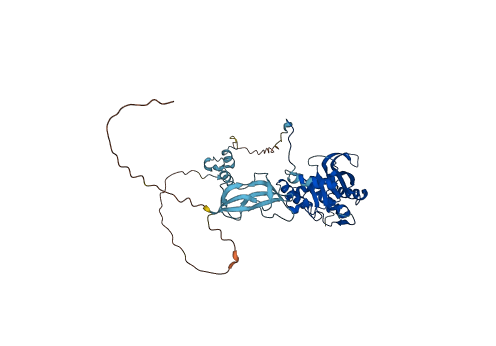
The autoinhibited protein was predicted that may have potential autoinhibitory elements via cis-regPred.
Autoinhibitory domains (AIDs)
Target domain |
|
Relief mechanism |
|
Assay |
cis-regPred |
Accessory elements
No accessory elements
Autoinhibited structure

Activated structure
1 structures for Q23571
| Entry ID | Method | Resolution | Chain | Position | Source |
|---|---|---|---|---|---|
| AF-Q23571-F1 | Predicted | AlphaFoldDB |
No variants for Q23571
| Variant ID(s) | Position | Change | Description | Diseaes Association | Provenance |
|---|---|---|---|---|---|
| No variants for Q23571 | |||||
No associated diseases with Q23571
4 regional properties for Q23571
| Type | Name | Position | InterPro Accession |
|---|---|---|---|
| domain | Biotin/lipoyl attachment | 30 - 105 | IPR000089 |
| domain | 2-oxoacid dehydrogenase acyltransferase, catalytic domain | 216 - 444 | IPR001078 |
| binding_site | 2-oxo acid dehydrogenase, lipoyl-binding site | 55 - 84 | IPR003016 |
| domain | Peripheral subunit-binding domain | 145 - 183 | IPR004167 |
Functions
| Description | ||
|---|---|---|
| EC Number | 2.3.1.168 | Transferring groups other than amino-acyl groups |
| Subcellular Localization |
|
|
| PANTHER Family | ||
| PANTHER Subfamily | ||
| PANTHER Protein Class | ||
| PANTHER Pathway Category | No pathway information available | |
7 GO annotations of cellular component
| Name | Definition |
|---|---|
| cilium | A specialized eukaryotic organelle that consists of a filiform extrusion of the cell surface and of some cytoplasmic parts. Each cilium is largely bounded by an extrusion of the cytoplasmic (plasma) membrane, and contains a regular longitudinal array of microtubules, anchored to a basal body. |
| cytoplasm | The contents of a cell excluding the plasma membrane and nucleus, but including other subcellular structures. |
| cytosol | The part of the cytoplasm that does not contain organelles but which does contain other particulate matter, such as protein complexes. |
| dendrite | A neuron projection that has a short, tapering, morphology. Dendrites receive and integrate signals from other neurons or from sensory stimuli, and conduct nerve impulses towards the axon or the cell body. In most neurons, the impulse is conveyed from dendrites to axon via the cell body, but in some types of unipolar neuron, the impulse does not travel via the cell body. |
| mitochondrial matrix | The gel-like material, with considerable fine structure, that lies in the matrix space, or lumen, of a mitochondrion. It contains the enzymes of the tricarboxylic acid cycle and, in some organisms, the enzymes concerned with fatty acid oxidation. |
| mitochondrion | A semiautonomous, self replicating organelle that occurs in varying numbers, shapes, and sizes in the cytoplasm of virtually all eukaryotic cells. It is notably the site of tissue respiration. |
| neuron projection | A prolongation or process extending from a nerve cell, e.g. an axon or dendrite. |
3 GO annotations of molecular function
| Name | Definition |
|---|---|
| acetyltransferase activity | Catalysis of the transfer of an acetyl group to an acceptor molecule. |
| dihydrolipoyllysine-residue (2-methylpropanoyl)transferase activity | Catalysis of the reaction: 2-methylpropanoyl-CoA + enzyme N6-(dihydrolipoyl)lysine = CoA + enzyme N6-(S-dihydrolipoyl)lysine. |
| lipoic acid binding | Binding to lipoic acid, 1,2-dithiolane-3-pentanoic acid. |
5 GO annotations of biological process
| Name | Definition |
|---|---|
| fatty acid biosynthetic process | The chemical reactions and pathways resulting in the formation of a fatty acid, any of the aliphatic monocarboxylic acids that can be liberated by hydrolysis from naturally occurring fats and oils. Fatty acids are predominantly straight-chain acids of 4 to 24 carbon atoms, which may be saturated or unsaturated; branched fatty acids and hydroxy fatty acids also occur, and very long chain acids of over 30 carbons are found in waxes. |
| positive regulation of embryonic development | Any process that activates or increases the frequency, rate or extent of embryonic development. |
| positive regulation of fatty acid biosynthetic process | Any process that activates or increases the frequency, rate or extent of the chemical reactions and pathways resulting in the formation of fatty acids. |
| positive regulation of nematode larval development | Any process that increases the rate, frequency, or extent of nematode larval development, the process whose specific outcome is the progression of the nematode larva over time, from its formation to the mature structure. Nematode larval development begins with the newly hatched first-stage larva (L1) and ends with the end of the last larval stage (for example the fourth larval stage (L4) in C. elegans). Each stage of nematode larval development is characterized by proliferation of specific cell lineages and an increase in body size without alteration of the basic body plan. Nematode larval stages are separated by molts in which each stage-specific exoskeleton, or cuticle, is shed and replaced anew. |
| positive regulation of oviposition | Any process that activates or increases the frequency, rate or extent of oviposition. |
6 homologous proteins in AiPD
| UniProt AC | Gene Name | Protein Name | Species | Evidence Code |
|---|---|---|---|---|
| P11181 | DBT | Lipoamide acyltransferase component of branched-chain alpha-keto acid dehydrogenase complex, mitochondrial | Bos taurus (Bovine) | PR |
| P11182 | DBT | Lipoamide acyltransferase component of branched-chain alpha-keto acid dehydrogenase complex, mitochondrial | Homo sapiens (Human) | PR |
| P53395 | Dbt | Lipoamide acyltransferase component of branched-chain alpha-keto acid dehydrogenase complex, mitochondrial | Mus musculus (Mouse) | PR |
| Q9M7Z1 | BCE2 | Lipoamide acyltransferase component of branched-chain alpha-keto acid dehydrogenase complex, mitochondrial | Arabidopsis thaliana (Mouse-ear cress) | PR |
| Q5M729 | At1g54220 | Dihydrolipoyllysine-residue acetyltransferase component 3 of pyruvate dehydrogenase complex, mitochondrial | Arabidopsis thaliana (Mouse-ear cress) | PR |
| Q8RWN9 | At3g13930 | Dihydrolipoyllysine-residue acetyltransferase component 2 of pyruvate dehydrogenase complex, mitochondrial | Arabidopsis thaliana (Mouse-ear cress) | PR |
| 10 | 20 | 30 | 40 | 50 | 60 |
| MMAARLLGTS | SRIFKLNKHL | HTSKVAFMPV | VQFKLSDIGE | GIAEVQVKEW | YVKEGDTISQ |
| 70 | 80 | 90 | 100 | 110 | 120 |
| FDKVCEVQSD | KAAVTISCRY | DGIVKKLYHE | VDGMARVGQA | LIDVEIEGNV | EEPEQPKKEA |
| 130 | 140 | 150 | 160 | 170 | 180 |
| ASSSPEAPKS | SAPKAPESAH | SEGKVLATPA | VRRIAIENKI | KLAEVRGTGK | DGRVLKEDVL |
| 190 | 200 | 210 | 220 | 230 | 240 |
| KFLGQVPADH | TSGSTNIRTT | HQAPQPSSKS | YEPLKEDVAV | PIRGYTRAMV | KTMTEALKIP |
| 250 | 260 | 270 | 280 | 290 | 300 |
| HFGYNDEINV | DSLVKYRAEL | KEFAKERHIK | LSYMPFFIKA | ASLALLEYPS | LNSTTDEKME |
| 310 | 320 | 330 | 340 | 350 | 360 |
| NVIHKASHNI | CLAMDTPGGL | VVPNIKNCEQ | RSIFEIAQEL | NRLLEAGKKQ | QIKREDLIDG |
| 370 | 380 | 390 | 400 | 410 | 420 |
| TFSLSNIGNI | GGTYASPVVF | PPQVAIGAIG | KIEKLPRFDK | HDNVIPVNIM | KVSWCADHRV |
| 430 | 440 | ||||
| VDGATMARFS | NRWKFYLEHP | SAMLAQLK |