P11182
Gene name |
DBT (BCATE2) |
Protein name |
Lipoamide acyltransferase component of branched-chain alpha-keto acid dehydrogenase complex, mitochondrial |
Names |
52 kDa mitochondrial autoantigen of primary biliary cirrhosis, Branched chain 2-oxo-acid dehydrogenase complex component E2, BCOADC-E2, Branched-chain alpha-keto acid dehydrogenase complex component E2, BCKAD-E2, BCKADE2, Dihydrolipoamide acetyltransferase component of branched-chain alpha-keto acid dehydrogenase complex, Dihydrolipoamide branched chain transacylase, Dihydrolipoyllysine-residue (2-methylpropanoyl)transferase |
Species |
Homo sapiens (Human) |
KEGG Pathway |
hsa:1629 |
EC number |
2.3.1.168: Transferring groups other than amino-acyl groups |
Protein Class |
|
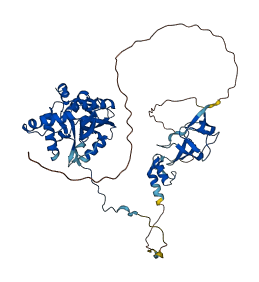
Descriptions
The autoinhibited protein was predicted that may have potential autoinhibitory elements via cis-regPred.
Autoinhibitory domains (AIDs)
Target domain |
|
Relief mechanism |
|
Assay |
cis-regPred |
Accessory elements
No accessory elements

3 variants for P11182
| Variant ID(s) | Position | Change | Description | Diseaes Association | Provenance |
|---|---|---|---|---|---|
|
VAR_015099 rs121965001 RCV000012726 CA121802 |
98 | I>M | Intermediate maple syrup urine disease type 2 MSUD2 [ClinVar, UniProt] | Yes |
ClinGen ClinVar UniProt Ensembl dbSNP |
|
rs121964999 RCV002251898 CA121797 RCV000012721 VAR_004978 RCV000179835 RCV000079957 |
276 | F>C | Maple syrup urine disease, thiamine-responsive, type II Maple syrup urine disease (msud) Maple syrup urine disease MSUD2 [ClinVar, Ensembl, UniProt] | Yes |
ClinGen ClinVar UniProt ESP ExAC TOPMed dbSNP gnomAD |
|
rs12021720 RCV000012727 VAR_015100 RCV000532824 |
384 | G>S | Intermediate maple syrup urine disease type 2 Maple syrup urine disease MSUD2 [ClinVar, UniProt] | Yes |
ClinVar UniProt dbSNP |
2 associated diseases with P11182
[MIM: 248600]: Maple syrup urine disease 2 (MSUD2)
A metabolic disorder due to an enzyme defect in the catabolic pathway of the branched-chain amino acids leucine, isoleucine, and valine. Accumulation of these 3 amino acids and their corresponding keto acids leads to encephalopathy and progressive neurodegeneration. Clinical features include mental and physical retardation, feeding problems, and a maple syrup odor to the urine. The keto acids of the branched-chain amino acids are present in the urine. If untreated, maple syrup urine disease can lead to seizures, coma, and death. The disease is often classified by its pattern of signs and symptoms. The most common and severe form of the disease is the classic type, which becomes apparent soon after birth. Variant forms of the disorder become apparent later in infancy or childhood and are typically milder, but they still involve developmental delay and other medical problems if not treated. {ECO:0000269|PubMed:1847055, ECO:0000269|PubMed:9621512}. Note=The disease is caused by variants affecting the gene represented in this entry.
Without disease ID
- A metabolic disorder due to an enzyme defect in the catabolic pathway of the branched-chain amino acids leucine, isoleucine, and valine. Accumulation of these 3 amino acids and their corresponding keto acids leads to encephalopathy and progressive neurodegeneration. Clinical features include mental and physical retardation, feeding problems, and a maple syrup odor to the urine. The keto acids of the branched-chain amino acids are present in the urine. If untreated, maple syrup urine disease can lead to seizures, coma, and death. The disease is often classified by its pattern of signs and symptoms. The most common and severe form of the disease is the classic type, which becomes apparent soon after birth. Variant forms of the disorder become apparent later in infancy or childhood and are typically milder, but they still involve developmental delay and other medical problems if not treated. {ECO:0000269|PubMed:1847055, ECO:0000269|PubMed:9621512}. Note=The disease is caused by variants affecting the gene represented in this entry.
4 regional properties for P11182
| Type | Name | Position | InterPro Accession |
|---|---|---|---|
| domain | Biotin/lipoyl attachment | 64 - 139 | IPR000089 |
| domain | 2-oxoacid dehydrogenase acyltransferase, catalytic domain | 250 - 479 | IPR001078 |
| binding_site | 2-oxo acid dehydrogenase, lipoyl-binding site | 89 - 118 | IPR003016 |
| domain | Peripheral subunit-binding domain | 172 - 209 | IPR004167 |
Functions
| Description | ||
|---|---|---|
| EC Number | 2.3.1.168 | Transferring groups other than amino-acyl groups |
| Subcellular Localization |
|
|
| PANTHER Family | ||
| PANTHER Subfamily | ||
| PANTHER Protein Class | ||
| PANTHER Pathway Category | No pathway information available | |
7 GO annotations of cellular component
| Name | Definition |
|---|---|
| cytoplasm | The contents of a cell excluding the plasma membrane and nucleus, but including other subcellular structures. |
| cytosol | The part of the cytoplasm that does not contain organelles but which does contain other particulate matter, such as protein complexes. |
| microtubule cytoskeleton | The part of the cytoskeleton (the internal framework of a cell) composed of microtubules and associated proteins. |
| mitochondrial alpha-ketoglutarate dehydrogenase complex | Mitochondrial complex that possesses alpha-ketoglutarate dehydrogenase activity. |
| mitochondrial matrix | The gel-like material, with considerable fine structure, that lies in the matrix space, or lumen, of a mitochondrion. It contains the enzymes of the tricarboxylic acid cycle and, in some organisms, the enzymes concerned with fatty acid oxidation. |
| mitochondrial nucleoid | The region of a mitochondrion to which the DNA is confined. |
| mitochondrion | A semiautonomous, self replicating organelle that occurs in varying numbers, shapes, and sizes in the cytoplasm of virtually all eukaryotic cells. It is notably the site of tissue respiration. |
4 GO annotations of molecular function
| Name | Definition |
|---|---|
| acetyltransferase activity | Catalysis of the transfer of an acetyl group to an acceptor molecule. |
| dihydrolipoyllysine-residue (2-methylpropanoyl)transferase activity | Catalysis of the reaction: 2-methylpropanoyl-CoA + enzyme N6-(dihydrolipoyl)lysine = CoA + enzyme N6-(S-dihydrolipoyl)lysine. |
| lipoic acid binding | Binding to lipoic acid, 1,2-dithiolane-3-pentanoic acid. |
| ubiquitin protein ligase binding | Binding to a ubiquitin protein ligase enzyme, any of the E3 proteins. |
1 GO annotations of biological process
| Name | Definition |
|---|---|
| branched-chain amino acid catabolic process | The chemical reactions and pathways resulting in the breakdown of amino acids containing a branched carbon skeleton, comprising isoleucine, leucine and valine. |
6 homologous proteins in AiPD
| UniProt AC | Gene Name | Protein Name | Species | Evidence Code |
|---|---|---|---|---|
| P11181 | DBT | Lipoamide acyltransferase component of branched-chain alpha-keto acid dehydrogenase complex, mitochondrial | Bos taurus (Bovine) | PR |
| P53395 | Dbt | Lipoamide acyltransferase component of branched-chain alpha-keto acid dehydrogenase complex, mitochondrial | Mus musculus (Mouse) | PR |
| Q23571 | dbt-1 | Lipoamide acyltransferase component of branched-chain alpha-keto acid dehydrogenase complex, mitochondrial | Caenorhabditis elegans | PR |
| Q9M7Z1 | BCE2 | Lipoamide acyltransferase component of branched-chain alpha-keto acid dehydrogenase complex, mitochondrial | Arabidopsis thaliana (Mouse-ear cress) | PR |
| Q5M729 | At1g54220 | Dihydrolipoyllysine-residue acetyltransferase component 3 of pyruvate dehydrogenase complex, mitochondrial | Arabidopsis thaliana (Mouse-ear cress) | PR |
| Q8RWN9 | At3g13930 | Dihydrolipoyllysine-residue acetyltransferase component 2 of pyruvate dehydrogenase complex, mitochondrial | Arabidopsis thaliana (Mouse-ear cress) | PR |
| 10 | 20 | 30 | 40 | 50 | 60 |
| MAAVRMLRTW | SRNAGKLICV | RYFQTCGNVH | VLKPNYVCFF | GYPSFKYSHP | HHFLKTTAAL |
| 70 | 80 | 90 | 100 | 110 | 120 |
| RGQVVQFKLS | DIGEGIREVT | VKEWYVKEGD | TVSQFDSICE | VQSDKASVTI | TSRYDGVIKK |
| 130 | 140 | 150 | 160 | 170 | 180 |
| LYYNLDDIAY | VGKPLVDIET | EALKDSEEDV | VETPAVSHDE | HTHQEIKGRK | TLATPAVRRL |
| 190 | 200 | 210 | 220 | 230 | 240 |
| AMENNIKLSE | VVGSGKDGRI | LKEDILNYLE | KQTGAILPPS | PKVEIMPPPP | KPKDMTVPIL |
| 250 | 260 | 270 | 280 | 290 | 300 |
| VSKPPVFTGK | DKTEPIKGFQ | KAMVKTMSAA | LKIPHFGYCD | EIDLTELVKL | REELKPIAFA |
| 310 | 320 | 330 | 340 | 350 | 360 |
| RGIKLSFMPF | FLKAASLGLL | QFPILNASVD | ENCQNITYKA | SHNIGIAMDT | EQGLIVPNVK |
| 370 | 380 | 390 | 400 | 410 | 420 |
| NVQICSIFDI | ATELNRLQKL | GSVGQLSTTD | LTGGTFTLSN | IGSIGGTFAK | PVIMPPEVAI |
| 430 | 440 | 450 | 460 | 470 | 480 |
| GALGSIKAIP | RFNQKGEVYK | AQIMNVSWSA | DHRVIDGATM | SRFSNLWKSY | LENPAFMLLD |
| LK |