Q12018
Gene name |
CDC53 (YDL132W, D2190) |
Protein name |
Cell division control protein 53 |
Names |
Cullin-A, E3 ubiquitin ligase complex SCF subunit CDC53 |
Species |
Saccharomyces cerevisiae (strain ATCC 204508 / S288c) (Baker's yeast) |
KEGG Pathway |
sce:YDL132W |
EC number |
|
Protein Class |
|
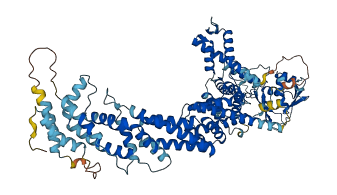
Descriptions
The autoinhibited protein was predicted that may have potential autoinhibitory elements via cis-regPred.
Autoinhibitory domains (AIDs)
Target domain |
|
Relief mechanism |
|
Assay |
cis-regPred |
Accessory elements
No accessory elements
Autoinhibited structure

Activated structure
3 structures for Q12018
| Entry ID | Method | Resolution | Chain | Position | Source |
|---|---|---|---|---|---|
| 3O2P | X-ray | 223 A | E | 730-815 | PDB |
| 3O6B | X-ray | 310 A | B/D/F/H/J | 742-815 | PDB |
| AF-Q12018-F1 | Predicted | AlphaFoldDB |
8 variants for Q12018
| Variant ID(s) | Position | Change | Description | Diseaes Association | Provenance |
|---|---|---|---|---|---|
| s04-224325 | 8 | S>A | No | SGRP | |
| s04-224809 | 169 | S>N | No | SGRP | |
| s04-224854 | 184 | G>E | No | SGRP | |
| s04-224966 | 221 | I>M | No | SGRP | |
| s04-225018 | 239 | Y>H | No | SGRP | |
| s04-225328 | 342 | N>S | No | SGRP | |
| s04-225445 | 381 | K>R | No | SGRP | |
| s04-225510 | 403 | P>T | No | SGRP |
No associated diseases with Q12018
4 GO annotations of cellular component
| Name | Definition |
|---|---|
| cullin-RING ubiquitin ligase complex | Any ubiquitin ligase complex in which the catalytic core consists of a member of the cullin family and a RING domain protein; the core is associated with one or more additional proteins that confer substrate specificity. |
| cytoplasm | The contents of a cell excluding the plasma membrane and nucleus, but including other subcellular structures. |
| nucleus | A membrane-bounded organelle of eukaryotic cells in which chromosomes are housed and replicated. In most cells, the nucleus contains all of the cell's chromosomes except the organellar chromosomes, and is the site of RNA synthesis and processing. In some species, or in specialized cell types, RNA metabolism or DNA replication may be absent. |
| SCF ubiquitin ligase complex | A ubiquitin ligase complex in which a cullin from the Cul1 subfamily and a RING domain protein form the catalytic core; substrate specificity is conferred by a Skp1 adaptor and an F-box protein. SCF complexes are involved in targeting proteins for degradation by the proteasome. The best characterized complexes are those from yeast and mammals (with core subunits named Cdc53/Cul1, Rbx1/Hrt1/Roc1). |
3 GO annotations of molecular function
| Name | Definition |
|---|---|
| DNA replication origin binding | Binding to a DNA replication origin, a unique DNA sequence of a replicon at which DNA replication is initiated and proceeds bidirectionally or unidirectionally. |
| protein-macromolecule adaptor activity | The binding activity of a protein that brings together two or more macromolecules in contact, permitting those molecules to function in a coordinated way. The adaptor can bring together two proteins, or a protein and another macromolecule such as a lipid or a nucleic acid. |
| ubiquitin protein ligase binding | Binding to a ubiquitin protein ligase enzyme, any of the E3 proteins. |
15 GO annotations of biological process
| Name | Definition |
|---|---|
| cell division | The process resulting in division and partitioning of components of a cell to form more cells; may or may not be accompanied by the physical separation of a cell into distinct, individually membrane-bounded daughter cells. |
| cellular response to methylmercury | Any process that results in a change in state or activity of a cell (in terms of movement, secretion, enzyme production, gene expression, etc.) as a result of a methylmercury stimulus. |
| G1/S transition of mitotic cell cycle | The mitotic cell cycle transition by which a cell in G1 commits to S phase. The process begins with the build up of G1 cyclin-dependent kinase (G1 CDK), resulting in the activation of transcription of G1 cyclins. The process ends with the positive feedback of the G1 cyclins on the G1 CDK which commits the cell to S phase, in which DNA replication is initiated. |
| G2/M transition of mitotic cell cycle | The mitotic cell cycle transition by which a cell in G2 commits to M phase. The process begins when the kinase activity of M cyclin/CDK complex reaches a threshold high enough for the cell cycle to proceed. This is accomplished by activating a positive feedback loop that results in the accumulation of unphosphorylated and active M cyclin/CDK complex. |
| mitochondrial fusion | Merging of two or more mitochondria within a cell to form a single compartment. |
| mitotic intra-S DNA damage checkpoint signaling | A mitotic cell cycle checkpoint that slows DNA synthesis in response to DNA damage by the prevention of new origin firing and the stabilization of slow replication fork progression. |
| positive regulation of glucose transmembrane transport | Any process that increases the frequency, rate or extent of glucose transport across a membrane. Glucose transport is the directed movement of the hexose monosaccharide glucose into, out of or within a cell, or between cells, by means of some agent such as a transporter or pore. |
| protein ubiquitination | The process in which one or more ubiquitin groups are added to a protein. |
| regulation of metabolic process | Any process that modulates the frequency, rate or extent of the chemical reactions and pathways within a cell or an organism. |
| regulation of mitotic cell cycle | Any process that modulates the rate or extent of progress through the mitotic cell cycle. |
| regulation of sulfur amino acid metabolic process | Any process that modulates the frequency, rate or extent of the chemical reactions and pathways involving sulfur amino acids. |
| regulation of transcription by galactose | Any process involving galactose that modulates the frequency, rate or extent or transcription. |
| SCF-dependent proteasomal ubiquitin-dependent protein catabolic process | The chemical reactions and pathways resulting in the breakdown of a protein or peptide by hydrolysis of its peptide bonds, initiated by the covalent attachment of ubiquitin, with ubiquitin-protein ligation catalyzed by an SCF (Skp1/Cul1/F-box protein) complex, and mediated by the proteasome. |
| silent mating-type cassette heterochromatin assembly | Repression of transcription at silent mating-type loci by alteration of the structure of chromatin. |
| ubiquitin-dependent protein catabolic process | The chemical reactions and pathways resulting in the breakdown of a protein or peptide by hydrolysis of its peptide bonds, initiated by the covalent attachment of a ubiquitin group, or multiple ubiquitin groups, to the protein. |
| 10 | 20 | 30 | 40 | 50 | 60 |
| MSETLPRSDD | LEATWNFIEP | GINQILGNEK | NQASTSKRVY | KILSPTMYME | VYTAIYNYCV |
| 70 | 80 | 90 | 100 | 110 | 120 |
| NKSRSSGHFS | TDSRTGQSTI | LVGSEIYEKL | KNYLKNYILN | FKQSNSETFL | QFYVKRWKRF |
| 130 | 140 | 150 | 160 | 170 | 180 |
| TIGAIFLNHA | FDYMNRYWVQ | KERSDGKRHI | FDVNTLCLMT | WKEVMFDPSK | DVLINELLDQ |
| 190 | 200 | 210 | 220 | 230 | 240 |
| VTLGREGQII | QRSNISTAIK | SLVALGIDPQ | DLKKLNLNVY | IQVFEKPFLK | KTQEYYTQYT |
| 250 | 260 | 270 | 280 | 290 | 300 |
| NDYLEKHSVT | EYIFEAHEII | KREEKAMTIY | WDDHTKKPLS | MALNKVLITD | HIEKLENEFV |
| 310 | 320 | 330 | 340 | 350 | 360 |
| VLLDARDIEK | ITSLYALIRR | DFTLIPRMAS | VFENYVKKTG | ENEISSLLAM | HKHNIMKNEN |
| 370 | 380 | 390 | 400 | 410 | 420 |
| ANPKKLALMT | AHSLSPKDYI | KKLLEVHDIF | SKIFNESFPD | DIPLAKALDN | ACGAFININE |
| 430 | 440 | 450 | 460 | 470 | 480 |
| FALPAGSPKS | ATSKTSEMLA | KYSDILLKKA | TKPEVASDMS | DEDIITIFKY | LTDKDAFETH |
| 490 | 500 | 510 | 520 | 530 | 540 |
| YRRLFAKRLI | HGTSTSAEDE | ENIIQRLQAA | NSMEYTGKIT | KMFQDIRLSK | ILEDDFAVAL |
| 550 | 560 | 570 | 580 | 590 | 600 |
| KNEPDYSKAK | YPDLQPFVLA | ENMWPFSYQE | VEFKLPKELV | PSHEKLKESY | SQKHNGRILK |
| 610 | 620 | 630 | 640 | 650 | 660 |
| WLWPLCRGEL | KADIGKPGRM | PFNFTVTLFQ | MAILLLYNDA | DVLTLENIQE | GTSLTIQHIA |
| 670 | 680 | 690 | 700 | 710 | 720 |
| AAMVPFIKFK | LIQQVPPGLD | ALVKPETQFK | LSRPYKALKT | NINFASGVKN | DILQSLSGGG |
| 730 | 740 | 750 | 760 | 770 | 780 |
| HDNHGNKLGN | KRLTEDERIE | KELNTERQIF | LEACIVRIMK | AKRNLPHTTL | VNECIAQSHQ |
| 790 | 800 | 810 | |||
| RFNAKVSMVK | RAIDSLIQKG | YLQRGDDGES | YAYLA |