Q08509
Gene name |
Eps8 |
Protein name |
Epidermal growth factor receptor kinase substrate 8 |
Names |
|
Species |
Mus musculus (Mouse) |
KEGG Pathway |
mmu:13860 |
EC number |
|
Protein Class |
|
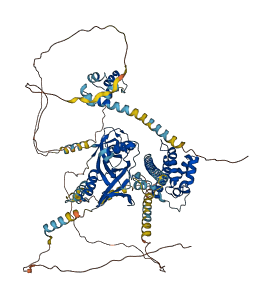
Descriptions
The autoinhibited protein was predicted that may have potential autoinhibitory elements via cis-regPred.
Autoinhibitory domains (AIDs)
Target domain |
|
Relief mechanism |
|
Assay |
cis-regPred |
Accessory elements
No accessory elements
Autoinhibited structure

Activated structure
4 structures for Q08509
| Entry ID | Method | Resolution | Chain | Position | Source |
|---|---|---|---|---|---|
| 1AOJ | X-ray | 250 A | A/B | 532-591 | PDB |
| 1I07 | X-ray | 180 A | A/B | 532-591 | PDB |
| 1I0C | X-ray | 200 A | A/B | 532-591 | PDB |
| AF-Q08509-F1 | Predicted | AlphaFoldDB |
39 variants for Q08509
| Variant ID(s) | Position | Change | Description | Diseaes Association | Provenance |
|---|---|---|---|---|---|
| rs3388844484 | 30 | Q>K | No | EVA | |
| rs3388874212 | 42 | K>R | No | EVA | |
| rs222543897 | 111 | D>E | No | EVA | |
| rs3388865398 | 182 | S>N | No | EVA | |
| rs3388864373 | 197 | E>G | No | EVA | |
| rs3388860962 | 219 | V>M | No | EVA | |
| rs3388866928 | 231 | S>T | No | EVA | |
| rs3397624668 | 240 | A>S | No | EVA | |
| rs3397471289 | 242 | D>A | No | EVA | |
| rs241189691 | 253 | H>Y | No | EVA | |
| rs3388874232 | 366 | N>S | No | EVA | |
| rs3388869829 | 371 | A>G | No | EVA | |
| rs232320910 | 387 | T>I | No | EVA | |
| rs3388870363 | 407 | M>L | No | EVA | |
| rs3388867620 | 419 | E>D | No | EVA | |
| rs31956055 | 447 | A>V | No | EVA | |
| rs218888298 | 457 | A>S | No | EVA | |
| rs3388865471 | 458 | E>K | No | EVA | |
| rs31951379 | 479 | S>F | No | EVA | |
| rs3388867634 | 484 | Y>F | No | EVA | |
| rs3412804431 | 484 | Y>H | No | EVA | |
| rs6159862 | 521 | D>E | No | EVA | |
| rs3388865448 | 539 | Y>H | No | EVA | |
| rs3388861021 | 560 | L>F | No | EVA | |
| rs3388869852 | 566 | W>* | No | EVA | |
| rs3388861665 | 574 | G>D | No | EVA | |
| rs3388861665 | 574 | G>E | No | EVA | |
| rs3388866879 | 575 | D>E | No | EVA | |
| rs3388865421 | 577 | G>E | No | EVA | |
| rs3388864361 | 577 | G>E* | No | EVA | |
| rs3388861016 | 587 | M>V | No | EVA | |
| rs250853381 | 628 | T>A | No | EVA | |
| rs16811271 | 652 | N>D | No | EVA | |
| rs241113183 | 655 | R>C | No | EVA | |
| rs215881186 | 711 | P>L | No | EVA | |
| rs3388867664 | 753 | Q>H | No | EVA | |
| rs3388857844 | 788 | G>E | No | EVA | |
| rs3388870342 | 798 | R>* | No | EVA | |
| rs3388861708 | 809 | D>N | No | EVA |
No associated diseases with Q08509
6 regional properties for Q08509
| Type | Name | Position | InterPro Accession |
|---|---|---|---|
| domain | SH3 domain | 530 - 589 | IPR001452 |
| domain | PTB/PI domain | 60 - 197 | IPR006020 |
| domain | Tensin/EPS8 phosphotyrosine-binding domain | 64 - 194 | IPR013625 |
| domain | Epidermal growth factor receptor kinase substrate, phosphotyrosine-binding domain | 64 - 191 | IPR033928 |
| domain | Eps8, SH3 domain | 534 - 587 | IPR035462 |
| domain | SAM domain | 718 - 777 | IPR041418 |
Functions
14 GO annotations of cellular component
| Name | Definition |
|---|---|
| anchoring junction | A cell junction that mechanically attaches a cell (and its cytoskeleton) to neighboring cells or to the extracellular matrix. |
| brush border | The dense covering of microvilli on the apical surface of an epithelial cell in tissues such as the intestine, kidney, and choroid plexus; the microvilli aid absorption by increasing the surface area of the cell. |
| cell cortex | The region of a cell that lies just beneath the plasma membrane and often, but not always, contains a network of actin filaments and associated proteins. |
| cytosol | The part of the cytoplasm that does not contain organelles but which does contain other particulate matter, such as protein complexes. |
| glutamatergic synapse | A synapse that uses glutamate as a neurotransmitter. |
| growth cone | The migrating motile tip of a growing neuron projection, where actin accumulates, and the actin cytoskeleton is the most dynamic. |
| NMDA selective glutamate receptor complex | An assembly of four or five subunits which form a structure with an extracellular N-terminus and a large loop that together form the ligand binding domain. The C-terminus is intracellular. The ionotropic glutamate receptor complex itself acts as a ligand gated ion channel; on binding glutamate, charged ions pass through a channel in the center of the receptor complex. NMDA receptors are composed of assemblies of NR1 subunits (Figure 3) and NR2 subunits, which can be one of four separate gene products (NR2A-D). Expression of both subunits are required to form functional channels. The glutamate binding domain is formed at the junction of NR1 and NR2 subunits. NMDA receptors are permeable to calcium ions as well as being permeable to other ions. Thus NMDA receptor activation leads to a calcium influx into the post-synaptic cells, a signal thought to be crucial for the induction of NMDA-receptor dependent LTP and LTD. |
| plasma membrane | The membrane surrounding a cell that separates the cell from its external environment. It consists of a phospholipid bilayer and associated proteins. |
| postsynaptic density | An electron dense network of proteins within and adjacent to the postsynaptic membrane of an asymmetric, neuron-neuron synapse. Its major components include neurotransmitter receptors and the proteins that spatially and functionally organize them such as anchoring and scaffolding molecules, signaling enzymes and cytoskeletal components. |
| ruffle membrane | The portion of the plasma membrane surrounding a ruffle. |
| stereocilium | An actin-based protrusion from the apical surface of auditory and vestibular hair cells and of neuromast cells. These protrusions are supported by a bundle of cross-linked actin filaments (an actin cable), oriented such that the plus (barbed) ends are at the tip of the protrusion, capped by a tip complex which bridges to the plasma. Bundles of stereocilia act as mechanosensory organelles. |
| stereocilium bundle | A bundle of cross-linked stereocilia, arranged around a kinocilium on the apical surface of a sensory hair cell (e.g. a neuromast, auditory or vestibular hair cell). Stereocilium bundles act as mechanosensory organelles by responding to fluid motion or fluid pressure changes. |
| stereocilium tip | A distinct compartment at the tip of a stereocilium, distal to the site of attachment to the apical cell surface. It consists of a dense matrix bridging the barbed ends of the stereocilium actin filaments with the overlying plasma membrane, is dynamic compared to the shaft, and is required for stereocilium elongation. |
| synapse | The junction between an axon of one neuron and a dendrite of another neuron, a muscle fiber or a glial cell. As the axon approaches the synapse it enlarges into a specialized structure, the presynaptic terminal bouton, which contains mitochondria and synaptic vesicles. At the tip of the terminal bouton is the presynaptic membrane; facing it, and separated from it by a minute cleft (the synaptic cleft) is a specialized area of membrane on the receiving cell, known as the postsynaptic membrane. In response to the arrival of nerve impulses, the presynaptic terminal bouton secretes molecules of neurotransmitters into the synaptic cleft. These diffuse across the cleft and transmit the signal to the postsynaptic membrane. |
3 GO annotations of molecular function
| Name | Definition |
|---|---|
| actin binding | Binding to monomeric or multimeric forms of actin, including actin filaments. |
| signaling adaptor activity | The binding activity of a molecule that brings together two or more molecules in a signaling pathway, permitting those molecules to function in a coordinated way. Adaptor molecules themselves do not have catalytic activity. |
| small GTPase binding | Binding to a small monomeric GTPase. |
17 GO annotations of biological process
| Name | Definition |
|---|---|
| actin crosslink formation | The process in which two or more actin filaments are connected together by proteins that act as crosslinks between the filaments. The crosslinked filaments may be on the same or differing axes. |
| actin cytoskeleton reorganization | A process that is carried out at the cellular level which results in dynamic structural changes to the arrangement of constituent parts of cytoskeletal structures comprising actin filaments and their associated proteins. |
| actin filament bundle assembly | The assembly of actin filament bundles; actin filaments are on the same axis but may be oriented with the same or opposite polarities and may be packed with different levels of tightness. |
| actin polymerization-dependent cell motility | A process involved in the controlled movement of a bacterial cell powered by the continuous polymerization of actin at one pole of the cell. |
| adult locomotory behavior | Locomotory behavior in a fully developed and mature organism. |
| barbed-end actin filament capping | The binding of a protein or protein complex to the barbed (or plus) end of an actin filament, thus preventing the addition, exchange or removal of further actin subunits. |
| behavioral response to ethanol | Any process that results in a change in the behavior of an organism as a result of an ethanol stimulus. |
| cellular response to leukemia inhibitory factor | Any process that results in a change in state or activity of a cell (in terms of movement, secretion, enzyme production, gene expression, etc.) as a result of a leukemia inhibitory factor stimulus. |
| dendritic cell migration | The movement of a dendritic cell within or between different tissues and organs of the body. |
| exit from mitosis | The cell cycle transition where a cell leaves M phase and enters a new G1 phase. M phase is the part of the mitotic cell cycle during which mitosis and cytokinesis take place. |
| positive regulation of ruffle assembly | Any process that activates or increases the frequency, rate or extent of ruffle assembly. |
| Rac protein signal transduction | The series of molecular signals within the cell that are mediated by a member of the Rac family of proteins switching to a GTP-bound active state. |
| regulation of actin filament length | Any process that controls the length of actin filaments in a cell. |
| regulation of cell shape | Any process that modulates the surface configuration of a cell. |
| regulation of postsynaptic membrane neurotransmitter receptor levels | Any process that regulates the the local concentration of neurotransmitter receptor at the postsynaptic membrane. |
| regulation of Rho protein signal transduction | Any process that modulates the frequency, rate or extent of Rho protein signal transduction. |
| Rho protein signal transduction | The series of molecular signals within the cell that are mediated by a member of the Rho family of proteins switching to a GTP-bound active state. |
6 homologous proteins in AiPD
| UniProt AC | Gene Name | Protein Name | Species | Evidence Code |
|---|---|---|---|---|
| Q8TE67 | EPS8L3 | Epidermal growth factor receptor kinase substrate 8-like protein 3 | Homo sapiens (Human) | PR |
| Q8TE68 | EPS8L1 | Epidermal growth factor receptor kinase substrate 8-like protein 1 | Homo sapiens (Human) | PR |
| Q9H6S3 | EPS8L2 | Epidermal growth factor receptor kinase substrate 8-like protein 2 | Homo sapiens (Human) | PR |
| Q8R5F8 | Eps8l1 | Epidermal growth factor receptor kinase substrate 8-like protein 1 | Mus musculus (Mouse) | PR |
| Q91WL0 | Eps8l3 | Epidermal growth factor receptor kinase substrate 8-like protein 3 | Mus musculus (Mouse) | PR |
| Q99K30 | Eps8l2 | Epidermal growth factor receptor kinase substrate 8-like protein 2 | Mus musculus (Mouse) | PR |
| 10 | 20 | 30 | 40 | 50 | 60 |
| MNGHMSNRSS | GYGVYPSQLN | GYGSSPPYSQ | MDREHSSRTS | AKALYEQRKN | YARDSVSSVS |
| 70 | 80 | 90 | 100 | 110 | 120 |
| DVSQYRVEHL | TTFVLDRKDA | MITVEDGIRK | LKLLDAKGKV | WTQDMILQVD | DRAVSLIDLE |
| 130 | 140 | 150 | 160 | 170 | 180 |
| SKNELENFPL | NTISHCQAVV | HACSYDSILA | LVCKEPTQSK | PDLHLFQCDE | VKANLISEDI |
| 190 | 200 | 210 | 220 | 230 | 240 |
| ESAISDSKGG | KQKRRPEALR | MIAKADPGIP | PPPRAPAPVP | PGTVTQVDVR | SRVAAWSAWA |
| 250 | 260 | 270 | 280 | 290 | 300 |
| ADQGDFEKPR | QYHEQEETPE | MMAARIDRDV | QILNHILDDI | EFFITKLQKA | AEAFSELSKR |
| 310 | 320 | 330 | 340 | 350 | 360 |
| KKSKKSKRKG | PGEGVLTLRA | KPPPPDEFVD | CFQKFKHGFN | LLAKLKSHIQ | NPSASDLVHF |
| 370 | 380 | 390 | 400 | 410 | 420 |
| LFTPLNMVVQ | ATGGPELASS | VLSPLLTKDT | VDFLNYTATA | EERKLWMSLG | DSWVKVRAEW |
| 430 | 440 | 450 | 460 | 470 | 480 |
| PKEQFIPPYV | PRFRNGWEPP | MLNFMGAPTE | QDMYQLAESV | ANAEHQRKQD | SKRLSTEHSN |
| 490 | 500 | 510 | 520 | 530 | 540 |
| VSDYPPADGY | AYSSSMYHRG | PHADHGEAAM | PFKSTPNHQV | DRNYDAVKTQ | PKKYAKSKYD |
| 550 | 560 | 570 | 580 | 590 | 600 |
| FVARNSSELS | VMKDDVLEIL | DDRRQWWKVR | NASGDSGFVP | NNILDIMRTP | ESGVGRADPP |
| 610 | 620 | 630 | 640 | 650 | 660 |
| YTHTIQKQRT | EYGLRSADTP | SAPSPPPTPA | PVPVPLPPSV | PAPVSVPKVP | ANVTRQNSSS |
| 670 | 680 | 690 | 700 | 710 | 720 |
| SDSGGSIVRD | SQRYKQLPVD | RRKSQMEEVQ | DELFQRLTIG | RSAAQRKFHV | PRQNVPVINI |
| 730 | 740 | 750 | 760 | 770 | 780 |
| TYDSSPEEVK | TWLQSKGFNP | VTVNSLGVLN | GAQLFSLNKD | ELRSVCPEGA | RVFNQITVQK |
| 790 | 800 | 810 | 820 | ||
| AALEDSNGSS | ELQEIMRRRQ | EKISAAASDS | GVESFDEGSS | H |