P70696
Gene name |
H2bc1 |
Protein name |
Histone H2B type 1-A |
Names |
Histone H2B, testis, Testis-specific histone H2B |
Species |
Mus musculus (Mouse) |
KEGG Pathway |
mmu:319177 |
EC number |
|
Protein Class |
|
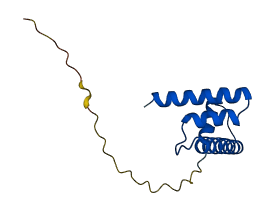
Descriptions
The autoinhibited protein was predicted that may have potential autoinhibitory elements via cis-regPred.
Autoinhibitory domains (AIDs)
Target domain |
|
Relief mechanism |
|
Assay |
cis-regPred |
Accessory elements
No accessory elements
Autoinhibited structure

Activated structure
3 structures for P70696
| Entry ID | Method | Resolution | Chain | Position | Source |
|---|---|---|---|---|---|
| 3X1T | X-ray | 281 A | D/H | 2-127 | PDB |
| 3X1V | X-ray | 292 A | D/H | 2-127 | PDB |
| AF-P70696-F1 | Predicted | AlphaFoldDB |
5 variants for P70696
| Variant ID(s) | Position | Change | Description | Diseaes Association | Provenance |
|---|---|---|---|---|---|
| rs3389273121 | 27 | E>D | No | EVA | |
| rs3389276984 | 29 | R>W | No | EVA | |
| rs3389282865 | 82 | L>P | No | EVA | |
| rs3389285019 | 88 | R>H | No | EVA | |
| rs3404087830 | 127 | K>M | No | EVA |
No associated diseases with P70696
1 regional properties for P70696
| Type | Name | Position | InterPro Accession |
|---|---|---|---|
| domain | Histone H2A/H2B/H3 | 17 - 102 | IPR007125 |
6 GO annotations of cellular component
| Name | Definition |
|---|---|
| DNA packaging complex | A protein complex that plays a role in the process of DNA packaging. |
| extrinsic component of plasma membrane | The component of a plasma membrane consisting of gene products and protein complexes that are loosely bound to one of its surfaces, but not integrated into the hydrophobic region. |
| female germ cell nucleus | The nucleus of the female germ cell, a reproductive cell in females. |
| nucleoplasm | That part of the nuclear content other than the chromosomes or the nucleolus. |
| nucleosome | A complex comprised of DNA wound around a multisubunit core and associated proteins, which forms the primary packing unit of DNA into higher order structures. |
| nucleus | A membrane-bounded organelle of eukaryotic cells in which chromosomes are housed and replicated. In most cells, the nucleus contains all of the cell's chromosomes except the organellar chromosomes, and is the site of RNA synthesis and processing. In some species, or in specialized cell types, RNA metabolism or DNA replication may be absent. |
4 GO annotations of molecular function
| Name | Definition |
|---|---|
| DNA binding | Any molecular function by which a gene product interacts selectively and non-covalently with DNA (deoxyribonucleic acid). |
| histone binding | Binding to a histone, any of a group of water-soluble proteins found in association with the DNA of eukaryotic or archaeal chromosomes. They are involved in the condensation and coiling of chromosomes during cell division and have also been implicated in gene regulation and DNA replication. They may be chemically modified (methylated, acetlyated and others) to regulate gene transcription. |
| protein heterodimerization activity | Binding to a nonidentical protein to form a heterodimer. |
| structural constituent of chromatin | The action of a molecule that contributes to the structural integrity of chromatin. |
8 GO annotations of biological process
| Name | Definition |
|---|---|
| chromatin organization | The assembly or remodeling of chromatin composed of DNA complexed with histones, other associated proteins, and sometimes RNA. |
| chromosome organization | A process that is carried out at the cellular level that results in the assembly, arrangement of constituent parts, or disassembly of chromosomes, structures composed of a very long molecule of DNA and associated proteins that carries hereditary information. This term covers covalent modifications at the molecular level as well as spatial relationships among the major components of a chromosome. |
| inflammatory response | The immediate defensive reaction (by vertebrate tissue) to infection or injury caused by chemical or physical agents. The process is characterized by local vasodilation, extravasation of plasma into intercellular spaces and accumulation of white blood cells and macrophages. |
| mononuclear cell migration | The movement of a mononuclear cell within or between different tissues and organs of the body. |
| nucleosome assembly | The aggregation, arrangement and bonding together of a nucleosome, the beadlike structural units of eukaryotic chromatin composed of histones and DNA. |
| nucleosome disassembly | The controlled breakdown of nucleosomes, the beadlike structural units of eukaryotic chromatin composed of histones and DNA. |
| plasminogen activation | The process in which inactive plasminogen is processed to active plasmin. This process includes cleavage at an internal Arg-Val site to form an N-terminal A-chain and C-terminal B-chain held together by a disulfide bond, and can include further proteolytic cleavage events to remove the preactivation peptide. |
| positive regulation of binding | Any process that activates or increases the rate or extent of binding, the selective interaction of a molecule with one or more specific sites on another molecule. |
5 homologous proteins in AiPD
| UniProt AC | Gene Name | Protein Name | Species | Evidence Code |
|---|---|---|---|---|
| Q96A08 | H2BC1 | Histone H2B type 1-A | Homo sapiens (Human) | PR |
| Q9LZ45 | At5g02570 | Histone H2B.9 | Arabidopsis thaliana (Mouse-ear cress) | PR |
| Q9SF55 | At3g09480 | Histone H2B.5 | Arabidopsis thaliana (Mouse-ear cress) | PR |
| O65818 | H2B-2 | Histone H2B.2 | Solanum lycopersicum (Tomato) (Lycopersicon esculentum) | PR |
| O65821 | H2B-1 | Histone H2B.1 | Solanum lycopersicum (Tomato) (Lycopersicon esculentum) | PR |
| 10 | 20 | 30 | 40 | 50 | 60 |
| MPEVAVKGAT | ISKKGFKKAV | TKTQKKEGRK | RKRCRKESYS | IYIYKVLKQV | HPDTGISSKA |
| 70 | 80 | 90 | 100 | 110 | 120 |
| MSIMNSFVTD | IFERIASEAS | RLAHYNKRST | ITSREIQTAV | RLLLPGELAK | HAVSEGTKAV |
| TKYTSSK |